Table of Contents
In recent years, AI has moved far beyond the role of a simple chatbot that merely provides quick, somewhat robotic answers. Next-generation models not only answer, but can also reason and process information with a depth nearly identical to human thinking. In a context where data is increasingly central to many industries, the challenge is no longer finding a single correct answer, but rather working with complex data, detecting subtle errors, and building robust systems for long-term operation. This is where Gemini 3 Deep Think clearly demonstrates its strengths.
This article focuses on clarifying what makes this inference mode different, how to access it, and more importantly, how to leverage it to improve work efficiency, especially in workflows involving Python, SQL, and R.
What is Gemini 3 Deep Think?
Gemini 3 Deep Think is a specialized reasoning mode built to expand the capabilities of the Gemini ecosystem. While traditional chat models excel at quickly retrieving information or summarizing content, Deep Think focuses on problems that don't have clear-cut solutions.
Instead of simply selecting the most likely answer, this model is designed to think in a way that is closer to human thinking, considering multiple options and conducting in-depth analysis before reaching a conclusion. Building on the foundation of previous versions such as Gemini 3 and update 3.1, Deep Think places particular emphasis on algorithmic rigor and mathematical accuracy.
This makes it function more like a problem solver than an autocomplete tool. The model not only provides answers but also identifies potential errors, evaluates multiple approaches, and selects the most reasonable solution.
How to access Gemini 3 Deep Think
Google has integrated this mode primarily into Gemini's web application, while also opening selective access via API to serve developers and businesses.
Users who subscribe to the premium plan can access Deep Think directly within the Gemini interface. Meanwhile, developers and research teams can integrate it via API in the early access program, enabling the construction of custom data applications.
How does Deep Think work?
Unlike conventional models that generate token-by-token responses based on immediate probability, Gemini 3 Deep Think uses a 'test-time compute' mechanism—meaning it takes extra time to think before responding.
When faced with a complex question, the model will 'pause' to analyze it. It doesn't respond immediately like a typical chatbot, but considers multiple approaches. Therefore, Deep Think is sometimes called 'Slow AI' — slower, but more thorough.
Behind the scenes, the system generates multiple independent hypotheses, tests them based on context, and self-evaluates the options. For example, when asked to build a data simulation, it not only provides a solution but also analyzes potential risks in the execution process.
This approach is particularly effective when combined with advanced environmental frameworks like Google ADK, which helps AI handle multi-step tasks with high accuracy and minimizes hallucination errors.
Practical application: Smarter Python debugging
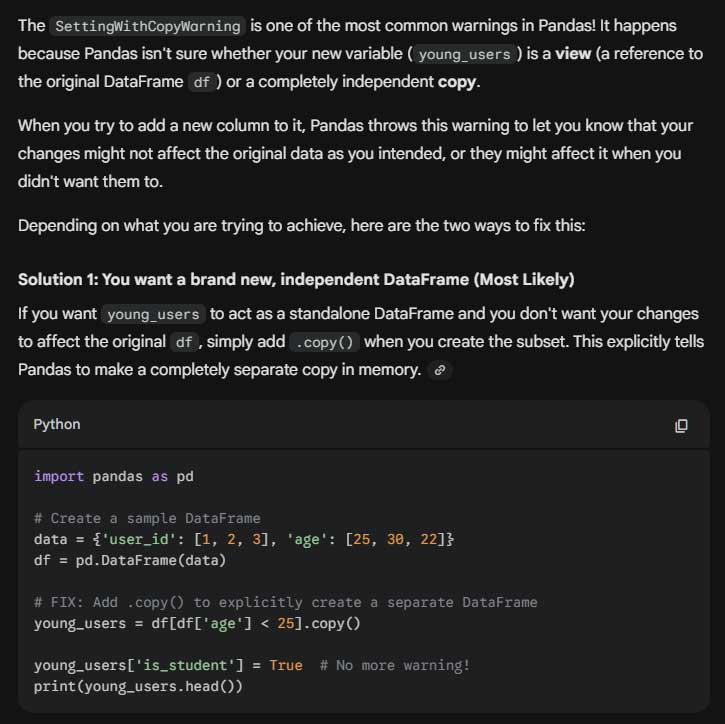
In practice, programmers often encounter frustrating errors when handling data, such as the SettingWithCopyWarning in the pandas library.
Instead of simply providing a single line of code to fix the error, Gemini 3 Deep Think will explain the cause of the warning, then suggest several different solutions, such as using .copy() or changing how you manipulate the DataFrame.
The difference here is that the model not only 'fixes errors', but also helps users understand the nature of the problem, thereby making choices that are appropriate to the context.
import pandas as pd # Create a sample DataFrame data = {'user_id': [1, 2, 3], 'age': [25, 30, 22]} df = pd.DataFrame(data) # mistake: Modifying a slice of a DataFrame young_users = df[df['age'] < 25] young_users['is_student'] = True # This triggers a SettingWithCopyWarning! print(young_users.head())
Optimizing SQL queries for greater efficiency
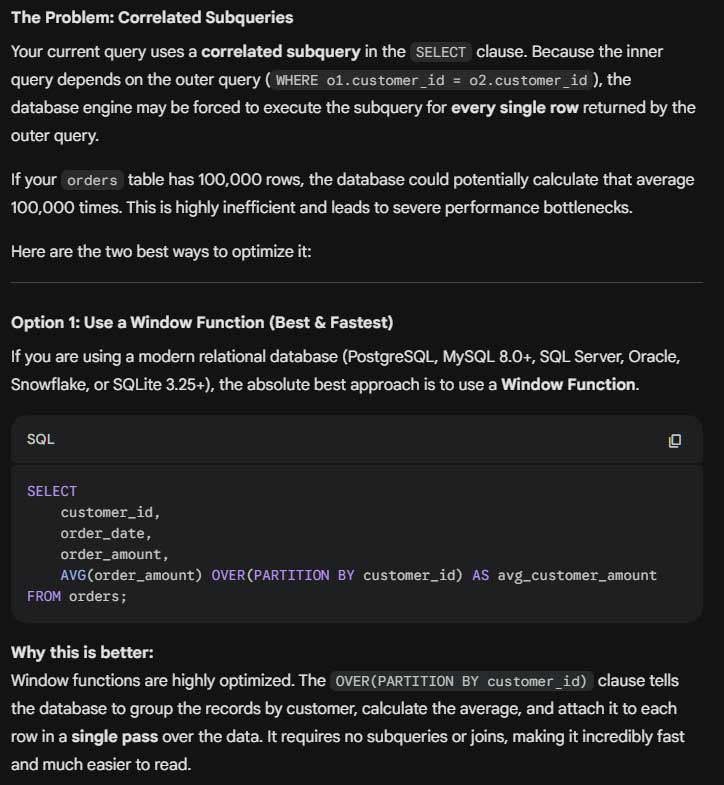
Another example is writing SQL queries. It's not difficult to write a query that produces the correct results, but optimizing performance is another matter entirely.
When encountering queries that use dependent subqueries, which can slow down the system on large datasets, Deep Think can identify the problem and suggest a more optimal solution, such as using window functions to reduce the number of table scans.
-- Junior approach: Using a slow dependent subquery SELECT customer_id, order_date, order_amount, (SELECT AVG(order_amount) FROM orders AS o2 WHERE o1.customer_id = o2.customer_id) AS avg_customer_amount FROM orders AS o1;It is noteworthy that this process not only provides a solution, but also explains why the new solution is more effective.
Support for statistical analysis in R
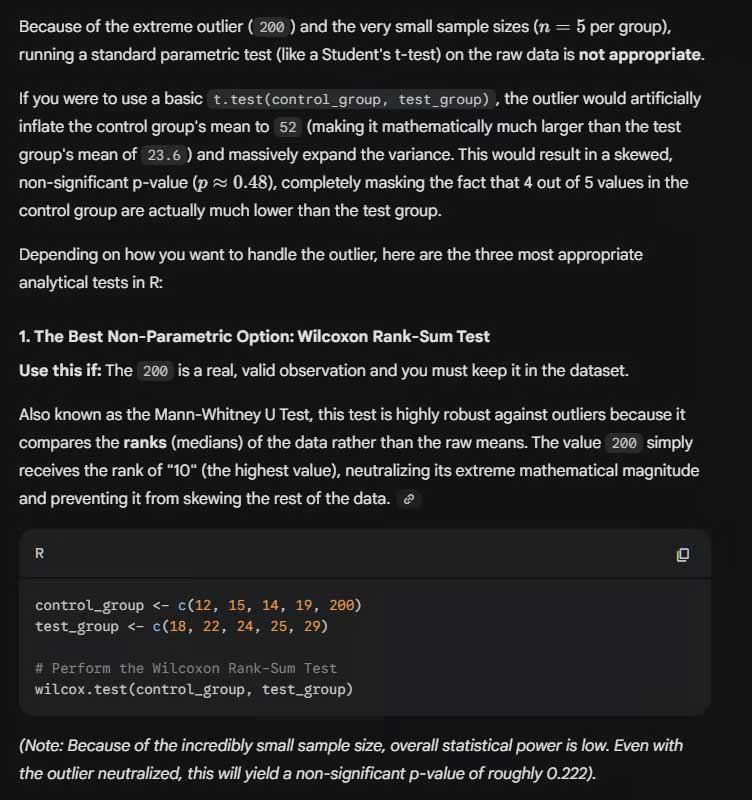
In the field of data science, choosing the right statistical method is crucial, especially when the data has outliers or skewed distributions.
Gemini 3 Deep Think can analyze a situation, suggest appropriate testing methods, and explain the reasoning behind the choice. This helps users not only get results but also understand the logic behind the decision.
# Define control and test group data with an outlier control_group An important point to note is that for problems like these, there is rarely a single correct answer. Deep Think has the ability to try multiple options and choose the solution deemed most reasonable.
Comparison with GPT-5.2 Thinking
When comparing Gemini 3 Deep Think with GPT-5.2 Thinking, it's clear that both belong to the 'Slow AI' group — prioritizing deep reasoning over rapid response.
Both utilize extended compute to construct internal thought processes, allowing for self-adjustment and refinement of results before answering. GPT-5.2 Thinking has a slight advantage in some logic and 'flexible intelligence' tests, while Gemini excels at handling large contexts.
With a context window of up to 1 million tokens, Gemini is better suited for tasks involving large codebases or analyzing multiple documents simultaneously. Furthermore, its tight integration with services like Google Cloud, BigQuery, and Vertex AI makes it a natural choice for large-scale data systems.
Conversely, GPT-5.2 Thinking, especially in xHigh mode, remains the benchmark for complex logic problems and algorithm design.
Summary
Gemini 3 Deep Think demonstrates a significant shift in how humans interact with AI. Instead of prioritizing speed and quantity of output, this model focuses on the quality of reasoning, allowing AI to consider, analyze, and build solutions in a more systematic way.
Although not as fast as traditional chatbots, Deep Think offers greater accuracy and reliability in complex problems. This opens up a new trend: AI is not just for quick answers, but also for 'thinking alongside humans'.
In the near future, AI tools with such deep reasoning capabilities are likely to become the standard in engineering workflows. And to make the most of them, users need to familiarize themselves with problem-solving, observe how AI thinks, and exploit these differences compared to conventional chatbots.
Related Articles
 Google Announces Gemini 2.5 Pro Deep Think, Beats OpenAI's O3 and O4 Models4 minutes read
 6 Tips to Help You Get the Most Out of Gemini Deep Research7 minutes read
 Google Launches Gemini 3: Surpasses GPT-5.1 on Many Important AI: Key Details4 minutes read
 Google Launches Gemini 2.5 Deep Think - Surpassing OpenAI o3 and3 minutes read
 How Gemini Get Data from Gmail, Drive Works?3 minutes read
 What Is Google Gemini? How Does Gemini Work?6 minutes read
Reader Comments 0
Sign in with email or Google to join the discussion.