Table of Contents
Agentic AI is becoming one of the hottest topics in the AI field today. If you regularly follow technology content on social media, you've likely come across countless posts mentioning this concept. The reason Agentic AI is attracting so much attention is that many believe it will be the next step in AI — where systems not only respond, but can also act independently.
However, precisely because of this rapid popularity, many people are easily swept up in the 'hype wave' without truly understanding the nature of the technology. Before adopting or investing in further research, there are some important points to understand to avoid common misunderstandings.
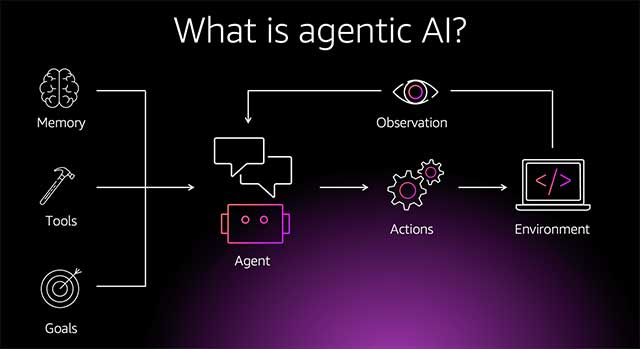
What exactly is Artificial AI?
To understand Agentic AI, it's first necessary to clarify the concept of 'agency'. This refers to the ability to act independently with minimal human supervision to achieve a specific goal.
Unlike simple automation systems or software that follows fixed rules, Agentic AI can independently develop action plans to solve problems. In other words, it doesn't just follow a pre-set script, but can also 'think' and adjust its approach based on context.
The workings of Agentic AI typically involve multiple steps: understanding the surrounding environment, reasoning to create a plan, executing that plan, and then learning from the results. Internally, this system often combines various machine learning techniques such as reinforcement learning, deep learning, and natural language processing. As a result, it can handle complex workflows and is far more flexible than traditional AI.
The difference between traditional AI and generative AI
Agentic AI is often referred to as a form of 'autonomous' AI, but the difference from previous systems lies not only in the level of automation, but also in the approach.
Traditional AI systems rely primarily on predefined rules and require human intervention to execute tasks. They are suitable for repetitive, highly predictable, and low-variability jobs. In contrast, Agentic AI is capable of adapting to its environment, independently planning, and handling unforeseen situations.
Compared to generative AI like ChatGPT or Stable Diffusion, the differences are quite clear. Generative AI can generate content (text, images, etc.) when requested, but it cannot act autonomously without a prompt. Meanwhile, agentic AI can use the output of generative models as part of the planning and execution of more complex tasks.
In other words, if generative AI is the 'content creator', then agentic AI is like the 'executor', capable of being more proactive and responding more flexibly to the environment.
Where does Artificial AI technology stand?
Artificial AI isn't entirely new, but it has only recently exploded in popularity thanks to advancements in the reasoning capabilities of modern AI models.
Over the past few years, numerous experiments have been conducted, particularly with open-source frameworks such as AutoGPT and BabyAGI. These systems demonstrate that LLM can be used to plan and execute multi-step tasks with minimal human intervention.
However, it's important to recognize that this technology is still in its early stages. The number of businesses implementing Artificial AI into their real-world production systems remains limited, primarily due to the high demands for stability and control.
Nevertheless, its potential applications are beginning to become clear. Companies are experimenting with Agentic AI in various fields such as software development support, customer service automation, and internal process optimization. A prominent example often cited is self-driving cars, where AI agents must constantly understand their environment and make decisions in real time.
Impact and issues to consider
With its autonomous capabilities, Agentic AI has the potential to significantly change how humans work and operate systems.
Currently, many work processes remain static and haven't adapted well to the environment. Introducing AI into automation has helped increase efficiency, but if the system can make complex decisions and operate continuously, this efficiency could increase even more dramatically. This also means freeing people from repetitive tasks, allowing them to focus on strategic tasks.
However, this comes with many challenges that need to be addressed. One of the biggest issues is reliability in decision-making. When empowering AI, it is crucial to ensure that its decisions align with business objectives and adhere to ethical principles.
In addition, there's the issue of transparency. A sufficiently powerful AI system needs to be able to explain why it makes decisions, but in reality, this isn't always easy, especially with complex models.
Security is also a major concern. Agentic AI often connects with many sensitive tools and data sources, so without proper control mechanisms, the risks can be very high. Therefore, issues of reliability, transparency, and security must be considered fundamental if we want to seriously deploy Agentic AI.
Common misconceptions about Artificial AI
The rapid popularity of Artificial AI has also led to many misunderstandings.
One common misconception is that Agentic AI is simply an 'upgraded' chatbot. In reality, while it can communicate in natural language like a chatbot, Agentic AI differs in that it can perform tasks and complete jobs without detailed step-by-step instructions.
Another misconception is that AI will replace humans in the short term. While its automation capabilities are very powerful, most current systems still play a supporting role rather than completely replacing humans. Agentic AI is best suited for handling repetitive or data-intensive tasks, allowing humans to focus on higher-value tasks.
Furthermore, there is also the view that once the system is running, humans no longer have control. In reality, AI systems are all built with 'guardrails'—that is, control mechanisms—to ensure they operate within safe limits. Despite their autonomy, they are still tools designed and controlled by humans.
Artificial AI is a major trend with high expectations, but it also comes with a number of misconceptions. Before applying it in practice, a thorough understanding of the technology's nature, capabilities, and limitations is essential.
When viewed correctly, Agentic AI is not a 'miracle' that replaces humans, but rather a step forward in building smarter, more flexible systems that can more effectively support humans in their work.
Related Articles
 minutes read
 What Is Agentic OS? How Will the Future of Windows Change as AI Begins to 'Do the Work for the User'8 minutes read
 The Highest Jumping Robot on the Planet, 30m from the Ground Into4 minutes read
 5 Things Happen to the Brain While You Dance7 minutes read
 minutes read
 The Best Chrome Extensions for Agentic AI7 minutes read
Reader Comments 0
Sign in with email or Google to join the discussion.