Table of Contents
Samsung moved from HBM4 demonstrations to commercial shipments in February 2026, according to its official announcement. The relevant update is the production milestone and published specifications—not the earlier claim that a reported logic-die yield guaranteed a trouble-free launch.
What Samsung announced
In its February 12, 2026 statement, Samsung said HBM4 had entered mass production and commercial products had shipped to customers.
The company specified a 1c DRAM process and 4 nm logic base die, with 11.7 Gbps transfer speed and headroom up to 13 Gbps. It listed 12-layer capacity options from 24 GB to 36 GB and maximum per-stack bandwidth of 3.3 TB/s. These are vendor specifications, not an independent benchmark of a complete AI system.
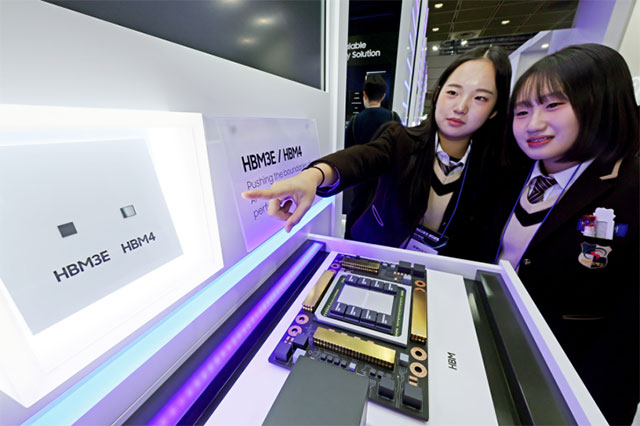
Why HBM4 matters for AI hardware
High-bandwidth memory places stacked memory close to an accelerator through advanced packaging. The goal is to supply data quickly enough for demanding workloads. A faster processor can still be constrained when its memory cannot deliver data at the required rate.
Capacity, bandwidth, power, thermal behavior, and integration all matter. A single pin-speed number does not determine which memory product is best for a particular accelerator.
Read the units carefully
Gbps expresses a data rate in gigabits per second, typically per pin in this context. TB/s expresses aggregate bandwidth in terabytes per second. GB capacity tells you how much data can be stored, not how fast it moves.
Compare like-for-like figures and operating conditions. Do not compare a maximum future configuration with another supplier's shipping baseline and call it a measured performance win.
What the earlier yield claim did not establish
The source article repeated a reported 90% logic-die yield. Without a clear measurement definition and primary confirmation, that number should not be treated as the production yield of a finished HBM stack.
Producing a usable base die, assembling the memory stack, qualifying it with customers, and delivering volume are different milestones. None alone guarantees that later stages have no delays.
HBM4 and HBM4E are separate stages
Samsung later announced HBM4E sample shipments in May 2026. Sampling gives customers hardware for evaluation; it should not be described as equivalent to mass production of every planned configuration.
The company's GTC 2026 announcement also identifies HBM4's role in the NVIDIA Vera Rubin platform. This is firmer context than the older article's speculation about future customer approval.
How to assess the competition
Samsung, SK hynix, and Micron compete in high-bandwidth memory, but Micron is a US company, not a Korean manufacturer. Compare dated supplier announcements, qualified configurations, customer deployments, and delivered capacity. Avoid treating promotional superlatives or an unverified price strategy as proof of market leadership.
Related Articles
 Micron launches the world's first PCIe Gen 6 SSD, 26GBps speed
 Samsung announced the new LPDDR5X memory chip with extremely fast speed and excellent energy saving capabilities
 Samsung's new memory chip incorporates EUFS 3.0 technology, recording speed of 2100MB / s, copying Full HD movies in just 3 seconds
 SK Hynix Reportedly Supplies HBM3E for Microsoft Maia 200
 The world's 4th largest chip maker is banned in China, the global technology supply chain is in danger of major disturbance
 Samsung launches a series of new memory standards: 'Shinebolt' HBM3E 9.8Gbps, GDDR7 32Gbps, LPDDR5x CAMM2 7.5Gbps
Reader Comments 0
Sign in with email or Google to join the discussion.