Table of Contents
This updated guide examines How to Extract a Jar File and organizes the essential facts, background, and practical takeaways in clear American English.
Method 1of 4:
Using ExtractMe
 Understand when to use this method. ExtractMe is a website that will extract your JAR files for you; however, even though ExtractMe is secure, you shouldn't use it to extract JAR files which contain sensitive or private information.
 Open ExtractMe. Go to https://extract.me/ in your computer's web browser.
 ClickChoose file. It's in the middle of the page. Doing so opens a File Explorer (Windows) or Finder (Mac) window.
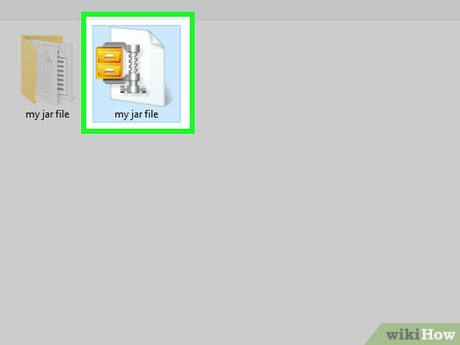 Select your JAR file. Go to the location of the JAR file you want to extract, then click it once to select it.
 ClickOpen. It's in the lower-right side of the window. Your JAR file will be uploaded to ExtractMe, which will begin extracting the file.
 Wait for your JAR file to extract. Once you see the "Archive successfully extracted" message appear, you can proceed.
 ClickSave all as ZIP. It's a blue button at the top of the list of archive files.
- Depending on your browser's settings, you may have to select a download location or enter a save name before the ZIP folder will download.
- If your browser alerts you that downloading a ZIP folder from online is potentially dangerous, confirm that you want to download the folder.
Method 2of 4:
Using WinRAR on Windows
 Install WinRAR. Make sure you check the "JAR" box if it's unchecked when selecting file types to use.
 Find the JAR file you want to extract. Go to the location of the JAR file that you want to extract.
 Right-click the JAR file. Doing so prompts a drop-down menu.
 SelectOpen with. It's in the drop-down menu. A pop-out menu will appear.
- If you don't see this option, click once the JAR file, then right-click it again and select Open with .
 ClickWinRAR archiver. This is in the pop-out menu. Your JAR file will open in a WinRAR window.
 ClickExtract To. It's a blue folder icon at the top of the WinRAR folder.
 Select an extraction location. If necessary, click one of the folders on the right side of the window to select it as the location to which you want to extract your JAR file.
 ClickOK. It's at the bottom of the WinRAR window. Doing so will extract your JAR file to the selected folder.
Method 3of 4:
Using Java on Windows
 Make sure you have Java SE installed. If you don't have Java SE (the Java Developer Kit) installed, you won't be able to use the "jar" extraction command, and your file will be impossible to extract with this method:
- Open the JDK 10 download page.
- Check the "Accept License Agreement" box.
- Click the download link next to your computer's operating system.
- Double-click the downloaded setup file.
- Follow the on-screen installation prompts.
 Open File Explorer
 . Click the folder-shaped File Explorer app icon in the taskbar that's at the bottom of your computer's screen.
 Go to the JAR file's location. Find the JAR file that you want to unzip.
 Select the JAR file's path. Click a blank space in the address bar at the top of the File Explorer window to do so.
 Copy the path. PressCtrl+C. This will save the path to your JAR file.
 Open Start
 . Click the Windows logo in the bottom-left corner of the screen.
 Open Command Prompt. Type incommand prompt, then click
 Command Prompt at the top of the Start window to open it.
 Switch to the JAR file's location. Type incdand press the space bar, paste in the copied address by pressingCtrl+V, and press↵Enter.
 Enter the "extract" command and your JAR file's name. Type injar xfand press the space bar, type in your JAR file's name followed by ".jar" (e.g., a file called "mods" would bemods.jar), and press↵Enter.
- For example, to extract a JAR file called "minecraft", you would type injar xf minecraft.jarand press↵Enter.
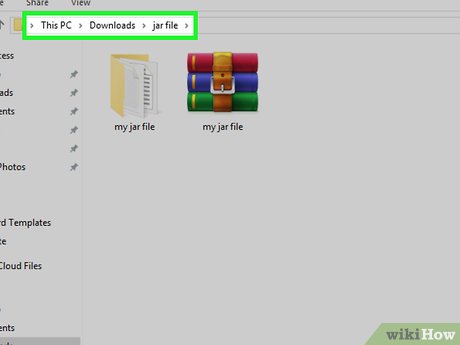 Go back to the JAR file's location. You should now see the JAR file's extracted contents here.
Method 4of 4:
Using Java on Mac
 Make sure you have Java SE installed. If you don't have Java SE (the Java Developer Kit) installed, you won't be able to use the "jar" extraction command, and your file will be impossible to extract with this method:
- Open the JDK 10 download page.
- Check the "Accept License Agreement" box.
- Click the download link next to your computer's operating system.
- Double-click the downloaded setup file.
- Follow the on-screen installation prompts.
 Open
Open Finder. Click the Finder app icon, which resembles a blue face, in your Mac's Dock.
 Find your JAR file. Go to the location of the JAR file that you want to extract.
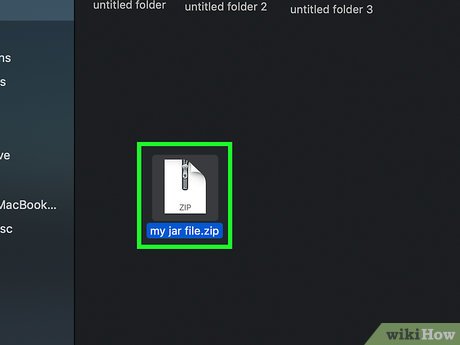 Select your JAR file. Click once the JAR file to do so.
 Copy the JAR file's path. Press⌘Command+⌥Option+Cto do so. This will copy the file path to the JAR file along with the JAR file's name and extension.
 Open Spotlight
 . Click the magnifying glass-shaped Spotlight icon in the top-right corner of the screen to do so.
 Open Terminal. Typeterminalinto the Spotlight text box, then double-click
 Terminal in the resulting drop-down menu. This will open a Terminal window.
 Enter the "extract" command and your JAR file's path. Type injar xfand press the space bar, press⌘Command+Vto paste in your JAR file's path, and press⏎Return.
 Go back to the JAR file's location. You should now see the JAR file's extracted contents here.
FAQ
What is How to Extract a Jar File about?
It provides a structured overview of file, explains the main context, and highlights practical takeaways for readers.
Why does this topic matter?
Understanding the main concepts helps readers evaluate the issue, avoid common mistakes, and make better-informed decisions.
How should readers use this information?
Use the guidance as a practical starting point, confirm details that may have changed, and follow current product, safety, or security recommendations.
Related Articles
 How to Extract Zip Files on Your Computer10 minutes read
 How to Decompress IMG Files in Windows and macOS: Practical Guide7 minutes read
 How to Quickly Extract. Tar. Gz File on Windows 107 minutes read
 How to Extract a File or Folder from a TAR or Tar.gz File6 minutes read
 3 Simple Way to Extract ISO File3 minutes read
 How to Extract ZIP File on Computer Quickly3 minutes read
Reader Comments 0
Sign in with email or Google to join the discussion.