Table of Contents
Overview
This guide explains how to add/remove libraries in file explorer Windows 11 in clear, practical terms. It covers the key concepts, recommended steps, common limitations, and useful checks so you can make a better-informed decision.
This guide will show you how to add or remove Libraries in the File Explorer navigation pane for your account or all users in Windows 11.
Windows 7 introduces Libraries, which provide users with a single, coherent view of their files even when those files are stored in multiple locations. Users can configure and organize libraries. Libraries can contain folders found on the user's computer as well as folders that have been shared over a network. Libraries provide a simpler view of the underlying storage system because, for users, files and folders in Libraries are displayed in a single view, regardless of where they are actually stored.
In File Explorer, users interact with Libraries in the same way they interact with other folders. Libraries are built on top of old known folders (like Camera Roll, Documents, Music, Pictures, Saved Pictures, and Videos), and these known folders are automatically included in the default libraries and set as the default save locations.
The navigation pane is the leftmost pane in File Explorer that's used to find files, folders, and drives on your PC or network.
Note:
- If you turn on Show all folders in the navigation pane, Libraries will always be visible in the navigation pane.
- Your libraries are located in the hidden %AppData%MicrosoftWindowsLibraries folder.
Add/Remove Libraries in the File Explorer navigation pane in File Explorer
1. Open File Explorer ( Win + E ).
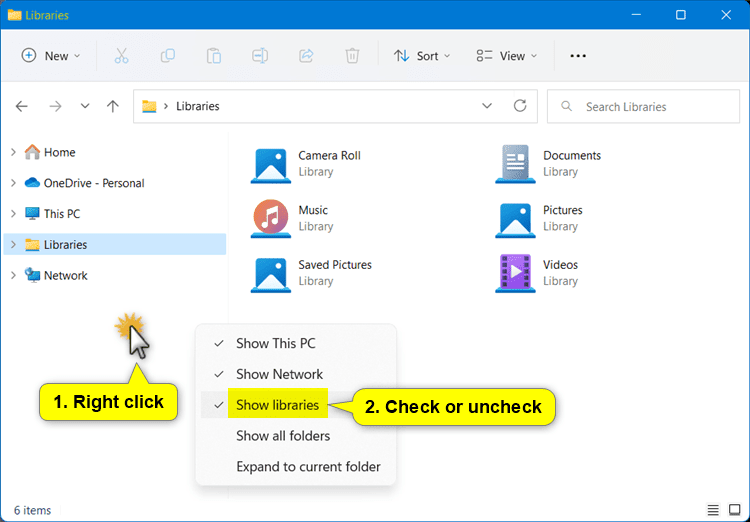
2. Right-click or press and hold on an empty area inside the navigation pane and click Show libraries to add (checked) or remove (unchecked - default) depending on what you want.
Add/remove Libraries in File Explorer navigation pane in Folder Options
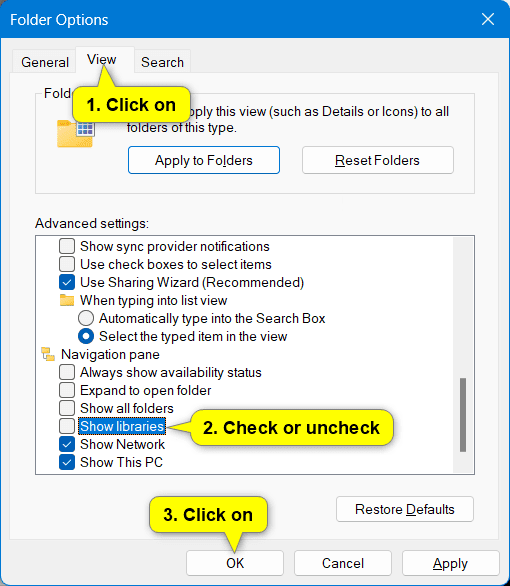
1. Open Folder Options.
2. Click the View tab.
3. In the Navigation pane section, select (add) or uncheck (remove - default) Show libraries depending on what you want.
4. Click OK.
Add/remove specific libraries under Libraries in the File Explorer navigation pane
Note: Removing a library from the Libraries section of the File Explorer navigation pane doesn't delete the actual library from the Libraries section.
1. Open Libraries in File Explorer ( Win + E ).
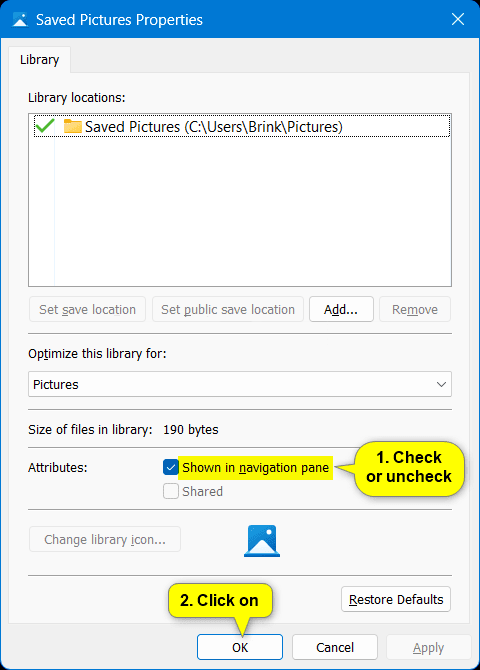
2. Right-click or press and hold on the library (e. g. "Saved Pictures") you want to add or remove, then click Properties.

3. Check (add - default) or uncheck (remove) Show in navigation pane under Attributes depending on what you want, then click OK.
Good luck!
Key Takeaways
Use the guidance above as a practical reference for add/remove libraries in file explorer Windows 11. Check compatibility, follow the steps carefully, and verify important details with official documentation when software, security, accounts, health, or purchases are involved.
FAQ
How do I add/remove libraries in file explorer Windows 11?
Follow the steps in this guide in order, confirm each setting before continuing, and save, restart, or reconnect the device when the instructions require it.
What should I check before I begin?
Confirm the correct device, account access, software version, compatibility, and a current backup whenever the process could affect files, settings, or security.
What should I do if the process does not work?
Repeat the steps carefully, check for model or version differences, install available updates, and consult the manufacturer's official support documentation.
Related Articles
 How to Display Libraries Folder on Windows 11: Step-by-Step Guide3 minutes read
 How to Remove Libraries from File Explorer on Windows 11: Step-by-Step Guide3 minutes read
 How to Fix File Explorer Lag on Windows 11: Step-by-Step Guide8 minutes read
 6 Windows File Explorer Add-ons That Make Life Easier7 minutes read
 Files Is a Windows File Explorer Alternative That Meets All User Needs6 minutes read
 7 Notable Changes in File Explorer Windows 117 minutes read
Reader Comments 0
Sign in with email or Google to join the discussion.