Table of Contents
Human–AI collaboration works when AI handles a well-defined part of a task and people retain the context, authority, and accountability needed to judge the result. It is not simply prompting a chatbot and accepting the first response.
A reliable workflow defines what the system may do, what evidence it must provide, where review occurs, and who owns the final decision. The higher the potential harm, the stronger those controls should be.
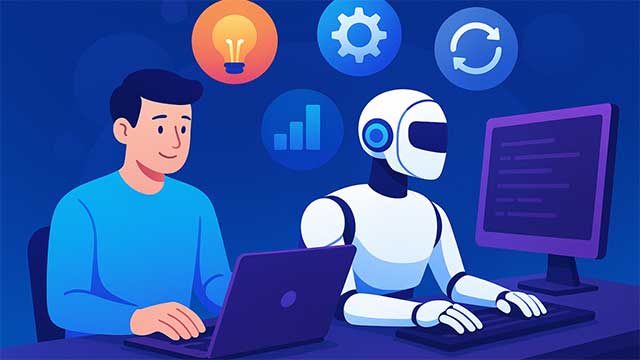
What each side contributes
| AI is often useful for | People remain responsible for |
|---|---|
| Searching, sorting, classifying, and summarizing large amounts of material | Defining the real problem and deciding which evidence is relevant |
| Generating options, drafts, code, queries, and test ideas | Setting constraints, checking assumptions, and choosing an acceptable option |
| Finding patterns or anomalies for investigation | Interpreting context, consequences, exceptions, and affected stakeholders |
| Applying a repeatable format at speed | Approving high-impact actions and accepting accountability |
This split is not fixed. A mature, low-risk, well-tested process may automate more than a new or high-stakes one. Human review is valuable only when the reviewer has enough time, authority, information, and expertise to challenge the system.
Where collaboration is useful
Research and analysis
AI can produce search terms, group sources, summarize a document, or identify gaps. The researcher should verify quotations, dates, calculations, and whether a source actually supports the claim. Tools with citations make checking easier but do not replace it. TipsMake's comparison of NotebookLM and ChatGPT shows why a source-grounded tool and a general assistant fit different research tasks.
Software development
An assistant can draft a function, explain an unfamiliar code path, generate test cases, or propose a patch. A developer should inspect the diff, check dependencies and licenses, run tests and security tools, and confirm that behavior has not changed outside the requested scope. Preview-and-approve interfaces help, but the existence of a diff does not prove the code is safe.
Business operations
AI can extract fields from contracts, categorize support requests, compare documents, or draft a response. The business must define the source of truth, confidence threshold, exception route, access controls, retention policy, and who approves unusual cases. Unsupported claims in older case studies—such as a universal percentage improvement—should not be used to justify deployment.
Science and health
Systems such as AlphaFold can generate useful predictions that help researchers choose what to investigate. A prediction is not the same as experimental validation, clinical evidence, or a treatment decision. In health settings, qualified professionals, approved processes, patient safety, privacy, and applicable regulation remain central. The World Health Organization's guidance emphasizes autonomy, safety, transparency, accountability, and equity.
A seven-step human–AI workflow
- Define the task. State the desired outcome, audience, allowed data, deadline, and conditions that make a result unacceptable.
- Classify the risk. Consider financial loss, safety, discrimination, privacy, security, legal effect, reversibility, and scale.
- Assign roles. Specify what the AI proposes or executes, who reviews it, who may approve it, and who handles exceptions.
- Require evidence. Ask for source links, quoted passages, calculations, test output, diffs, or confidence information appropriate to the task.
- Place a review gate. Stop before publishing, sending, merging, purchasing, diagnosing, or taking another consequential action.
- Record the decision. Preserve the input, relevant model or tool version, output, evidence, reviewer, changes, and final disposition when auditability matters.
- Measure and improve. Track error types, overrides, missed cases, time saved, user outcomes, and incidents—not just output volume.
How to review an AI output
Use a review method tied to the artifact rather than asking the model whether its own answer is correct.
- Facts: trace each consequential claim to a current, authoritative source.
- Numbers: recalculate them independently and confirm units, denominators, and time periods.
- Code: inspect the complete diff, run tests, scan dependencies, and test failure paths.
- Documents: compare the summary with the original text, including footnotes, tables, and exceptions.
- Recommendations: look for missing options, conflicts of interest, unsupported assumptions, and affected groups.
- Actions: verify the target, scope, permissions, reversibility, and cost before execution.
Conversational tools can help explore alternatives. TipsMake's ChatGPT and Microsoft Copilot comparison explains how integrations and available work context change the review experience.
Common failure modes
Automation bias
A polished answer can appear more reliable than it is. Requiring evidence and making reviewers identify one possible failure reduces passive approval, but independent testing is stronger than a ritual checklist.
Rubber-stamp review
A person cannot provide meaningful oversight if a queue is too large, the interface hides source material, or rejecting the output is discouraged. Sample audits and workload limits are necessary.
Unclear accountability
“The AI decided” is not an owner. Assign a person or team to the model, data, workflow, approvals, incidents, and user appeals.
Data leakage
Before uploading documents, confirm contractual terms, retention settings, regional requirements, access permissions, and whether prompts or files may be used for training. Remove secrets and personal information that the task does not require.
Skill erosion
If people stop practicing the underlying task, they may become less able to detect a bad answer. Preserve manual exercises, independent spot checks, and training for critical skills.
Choosing a tool for collaboration
Do not select a system only because it produces a fluent answer. Evaluate:
- source citations and access to the underlying evidence;
- change previews, approval controls, and action logs;
- permission boundaries and identity integration;
- data retention, export, deletion, and training policies;
- versioning and reproducibility;
- evaluation results on your own representative cases;
- fallback behavior when information is missing or tools fail;
- accessibility, latency, and total operating cost.
For research-oriented products, TipsMake's Perplexity and ChatGPT comparison illustrates why cited search and general-purpose workspaces should be evaluated differently.
Governance for teams
The NIST AI Risk Management Framework offers a voluntary structure organized around governing, mapping, measuring, and managing AI risks. Its guidance stresses clearly differentiated human roles and responsibilities. In health, the WHO guidance for large multimodal models provides additional safety and governance considerations.
A small team can apply the same principles without building a large bureaucracy: keep an approved-tool list, classify use cases by risk, document restricted data, require review for consequential actions, provide an incident route, and revisit the controls when the tool or workflow changes.
The goal is not to make every AI output explain its internal reasoning. It is to make the work verifiable: clear inputs, inspectable evidence, controlled actions, accountable decisions, and feedback that improves the process over time.
Related Articles
 Maximizing the Synergy Between Humans and AI in the Workplace6 minutes read
 AI Platforms Can Learn from Experience Just Like Humans11 minutes read
 Enterprise Communication Solutions to Create a Collaborative7 minutes read
 How to Create Collaborative Playlists in Apple Music: Practical Guide4 minutes read
 Lenovo's AI Assistant Advertisement Sparks Controversy for Making Humans Feel Like 'Superfluous'6 minutes read
 Research: AI Could Help Humans Become More Creative5 minutes read
Reader Comments 0
Sign in with email or Google to join the discussion.