Table of Contents
Dogs can learn from people, respond to social cues, and solve particular problems. Some unusually skilled dogs also learn object names rapidly. These findings do not establish that dogs think exactly like humans or are generally smarter than children.

Intelligence is not a single ranking
A puzzle task, response to a pointing gesture, and learning a toy's name measure different abilities. Performance depends on the task, the animal's experience, and how the experiment is designed. Comparing one result with a child's performance does not give a dog a human “mental age.”
A strong report should identify the study, its sample, what the subjects actually did, and the limits of the conclusion. Broad claims about language, arithmetic, perspective taking, and social reasoning should not be attributed to one unnamed “recent study.”
Dogs can learn from demonstrations
Researchers at Eötvös Loránd University tested puppies with a food puzzle after they watched a person or an adult dog demonstrate it. Puppies that saw a demonstration were more successful than those without one. The study also tested retention after a delay.
The research team's account supports social learning in this task. It does not show that puppies understand every human intention or acquire human-like language.
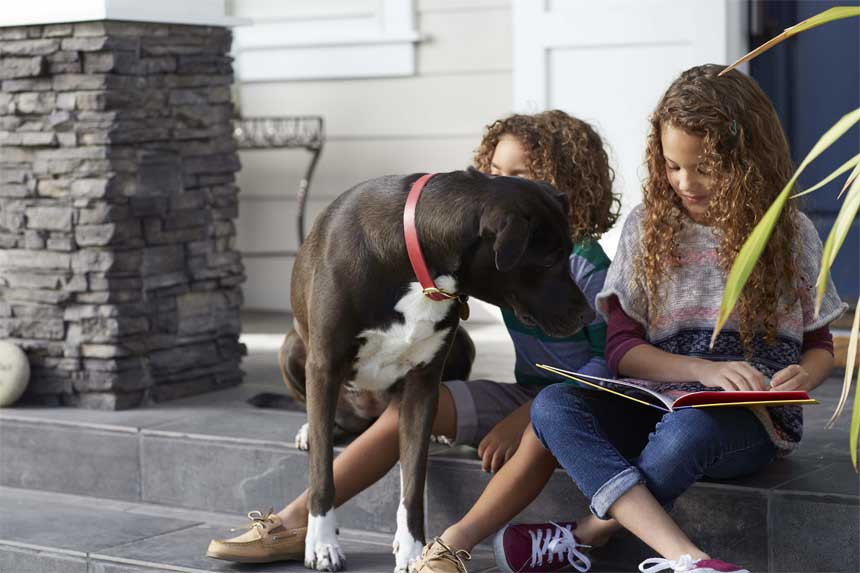
Some dogs are exceptional word learners
ELTE researchers distinguish learning action cues, such as “sit,” from learning labels for individual objects. A small group called Gifted Word Learners can acquire many toy names, but this ability is rare.
In a study of rapid word learning, two gifted dogs learned new labels in playful interaction with their owners. A comparison group did not show the same result under the tested conditions. The distinction matters: an impressive performance by selected dogs cannot be generalized to all dogs or every member of a breed.
The Gifted Dog Research Group investigates why these individuals differ and how their learning relates to aspects of early human word learning. That comparison concerns particular learning processes, not overall intelligence.
Different copying can serve different purposes
A Yale experiment found that dogs stopped copying an unnecessary lever action in a puzzle demonstration, whereas children in related research often copied irrelevant actions too. The Yale report explains that this difference can reveal features of human social learning.
Skipping an irrelevant step may help solve that puzzle efficiently. It does not make one species universally smarter: copying social conventions can also be useful in human learning.

What owners can take from the research
Notice which cues your dog responds to, keep learning activities manageable, and avoid treating a breed label or a viral performance as a promise. A dog that does not learn many toy names can still learn routines and participate in rewarding interaction.
The defensible conclusion is that canine cognition is varied and worth studying. Specific experiments can show similarities and differences with human learning; they do not justify a blanket claim that dogs reason like people or outperform children overall.
Related Articles
 Decipher the strange behavior often seen in dogs
 Vietnam owns one of the rarest and most expensive breeds in the world
 AI and Children: What Should Parents Do to Help Children Use AI Without Losing Their Thinking Ability?
 When the dogs act their 'gods' in front of the camera
 What does a dog's beard do? Do all dogs have beards?
 Chen Tianqiao's Plan to Build AI That Discovers New Knowledge
Reader Comments 0
Sign in with email or Google to join the discussion.