Table of Contents
Find a sequence's limit by analyzing its formula as the integer index n grows. A calculator can suggest a pattern, but evaluating one very large index does not prove convergence or identify an infinite limit.
What a finite limit means
A sequence un converges to L if its terms eventually stay as close to L as required. More precisely, for every ε > 0 there is an integer N such that |un − L| < ε whenever n ≥ N.
We write un → L as n → ∞. A sequence may instead grow without bound or fail to approach any one value.
Useful limits and algebraic laws
- A constant sequence un = c has limit c.
- 1/nk → 0 for every fixed positive integer k.
- qn → 0 when |q| < 1.
- nk → +∞ for fixed positive integers k, and qn → +∞ when q > 1.
If un → a and vn → b, with both limits finite:
| Expression | Limit | Condition |
|---|---|---|
| un + vn | a + b | Both limits exist |
| un − vn | a − b | Both limits exist |
| unvn | ab | Both limits exist |
| un/vn | a/b | b ≠ 0 |
| √un | √a | Terms are eventually nonnegative |
In particular, the difference law gives a − b, not ab. A zero denominator limit prevents direct use of the quotient law; it does not by itself determine the answer.
Worked example: a rational sequence
Consider un = (−2n2 + n + 2)/(3n4 + 5). Divide numerator and denominator by n4:
un = (−2/n2 + 1/n3 + 2/n4)/(3 + 5/n4).
Every reciprocal-power term tends to zero. The numerator tends to 0 and the denominator to 3, so the limit is 0.
For rational functions of n, comparing the highest powers is often useful. Equal degrees give the ratio of leading coefficients; a smaller numerator degree gives zero. If the numerator degree is larger, analyze the leading-term sign and growth.
Use a Casio calculator as a numerical check
The original screenshots use a Casio fx-580VN X. Menu names and evaluation controls differ between models; consult your own manual.
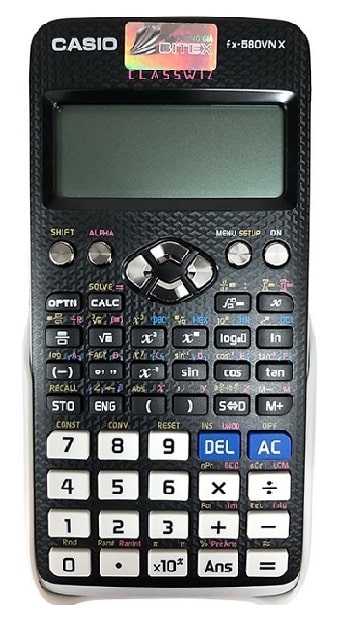 | 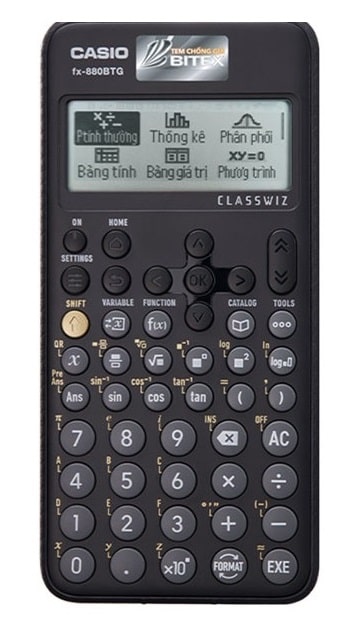 |
| Casio model illustration | Alternative calculator illustration |
 |  |
| Additional calculator images from the original lesson; no purchase is required to follow the algebra above. | |
- Enter the sequence expression using a calculator variable such as x in place of n. Check parentheses around the entire numerator and denominator.
- Use CALC, where available, to evaluate several positive integer values, such as 10, 100, and 1000.
- Compare the results with your algebraic prediction. For this example, values should be small and negative for sufficiently large indices, approaching zero.
- If a very large input causes overflow or suspicious rounding, use smaller values or the algebraically simplified expression.
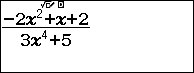
Entering the rational expression.
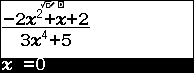
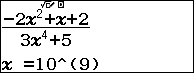
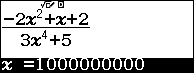
Evaluating a selected large input.
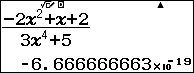
A tiny displayed number supports a numerical observation; the division-by-highest-power argument establishes the limit.
Why one large input can mislead
| Display | What it tells you |
|---|---|
| A tiny nonzero number | The sampled term is small; this alone does not prove a zero limit |
| A large positive or negative number | The sampled term is large; it does not prove divergence to infinity |
| A number near a | The sampled term is near a; other terms may behave differently |
| An error or zero from rounding | The numerical method may be outside its range or precision |
For example, (−1)n alternates between −1 and 1. Evaluating only large even indices can conceal the absence of a limit. Trigonometric expressions also require the intended angle unit and careful analysis; no universal “use 106 instead” rule proves convergence.
A related result: geometric-series sums
A sequence and a series are different. For the series a + aq + aq2 + …, the sum is a/(1 − q) when |q| < 1. Negative ratios can alternate, so this condition does not mean every term decreases monotonically.
For calculator operations, see the Casio calculation guide; check model differences. Graphing tools can provide another visual check, but the formula and limit laws remain the justification.
Related Articles
 Formulas for calculating the number of terms, formulas for calculating the sum of the terms
 Instructions to turn on online calculator on PC, phone
 Instructions for rounding numbers on Casio calculators
 Instructions for resetting Casio calculator to its original state
 How to Open Your Calculator in Windows 7
 CASIO FX-570MS computer simulation software
Reader Comments 0
Sign in with email or Google to join the discussion.