Table of Contents
Bass is the low-frequency part of the audible spectrum. It carries the fundamentals and harmonics of bass guitar, kick drum, low piano notes, synthesizers, engines, explosions, and room ambience. In audio discussions, bass is often treated as roughly 20–250Hz, but the boundaries are conventions rather than universal standards.
Sub-bass, mid-bass, and upper bass
A practical division is:
- Sub-bass, about 20–60Hz: the deepest fundamentals and rumble, often felt as well as heard on capable speakers and subwoofers.
- Mid-bass, about 60–120Hz: much of the punch and body of kick drums and bass instruments.
- Upper bass, about 120–250Hz: warmth and weight that connects low frequencies to the lower midrange.
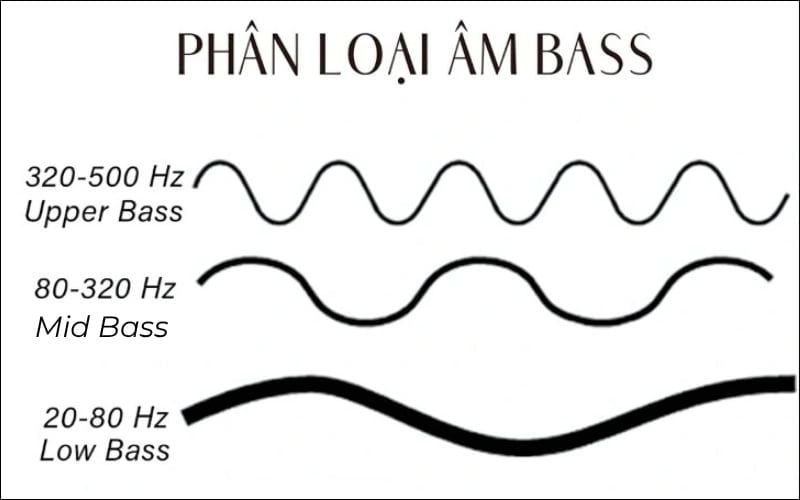
Sources use different crossover points. Calling 320–500Hz “high bass” is uncommon because much of that range is generally treated as lower midrange. The labels are useful only when the frequency boundaries are stated.
What bass contributes
Music
Bass establishes rhythm, harmonic foundation, scale, and physical impact. The desired balance depends on the recording and listener: a dance track may use strong sub-bass, while an acoustic bass recording may depend more on mid-bass fundamentals and midrange harmonics.
Film
Soundtracks use low frequencies for effects, tension, ambience, and scale. A surround system may send a dedicated low-frequency effects channel to a subwoofer, while bass management also redirects low frequencies from speakers that cannot reproduce them cleanly.

Games
Low-frequency effects add weight to engines, weather, weapons, and large environments. In competitive games, too much 60–200Hz energy can mask quieter details, but simply removing bass is not a guaranteed advantage. The game's mix, headphone response, HRTF, and individual hearing all matter.

Loud bass is not necessarily good bass
Bass quality has several dimensions:
- Extension: how low the system maintains useful output.
- Level: how much bass exists relative to the midrange and treble.
- Smoothness: whether large peaks and dips make individual notes uneven.
- Distortion: unwanted harmonics or noises added by the driver, amplifier, or room interaction.
- Time behavior: resonances, ringing, and room decay that can make notes linger.
- Integration: how naturally the bass connects with the rest of the spectrum.
“Tight” commonly describes bass without obvious overhang or one-note emphasis. “Boomy” often comes from a broad or resonant mid-bass peak, room modes, boundary reinforcement, or poor subwoofer integration. Harmonic distortion is one possible problem, not the sole cause.
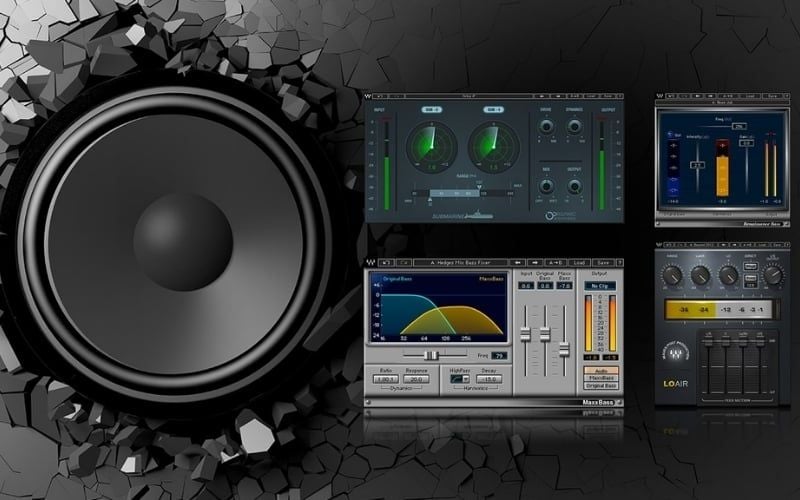
What controls headphone bass?
- Seal: leaks from glasses, hair, worn pads, or incorrect ear tips can sharply reduce low bass.
- Driver and enclosure: motor, diaphragm, vents, front volume, rear chamber, damping, and DSP shape response.
- Fit and anatomy: position and insertion depth change measured and perceived response.
- Source output: insufficient power can clip, but a more expensive DAC or amp does not automatically add bass.
- ANC mode: active processing can alter frequency response, especially when fit changes.
Larger drivers do not automatically go deeper. Read the headphone driver explanation before using diameter as a buying criterion.
What controls speaker bass?
A speaker's woofer, enclosure, port, amplifier, and protection processing set its basic capability. The room then changes the response dramatically. Walls and corners can reinforce low frequencies; room modes create seat-dependent peaks and nulls; furniture and construction affect decay.
A subwoofer usually extends deeper than small desktop speakers, but placement, crossover, polarity or phase, delay, and level must be integrated. More output is not the same as smoother output.
Bass-heavy and balanced tuning
| Approach | What it means | Possible benefit | Possible tradeoff |
|---|---|---|---|
| Bass-emphasized | Low frequencies are elevated relative to a chosen reference | More weight and impact at moderate listening levels | Can mask vocals or details if the boost is broad or excessive |
| Balanced or reference-oriented | Bass follows a target intended to balance the spectrum | More consistent translation and clearer midrange relationship | May feel lean to listeners accustomed to strong bass |
| Bass-light | Low frequencies roll off or are reduced | Less masking in some material | Music and effects lose fundamentals and scale |
Brands do not belong permanently in one column. The same company can sell bass-heavy, neutral, and bass-light models. Use measurements and reviews of the exact product.
How to use Bass Boost or EQ
Bass Boost is a fixed or adjustable low-frequency EQ. It can be useful when a headphone has adequate extension but less bass than preferred.
- Start with a broad, modest adjustment rather than a large narrow boost.
- If boosting frequencies, lower preamp or overall gain by a similar amount to preserve digital headroom.
- Listen for clipping, rattling, or compression; stop increasing the boost if the driver reaches its limit.
- Compare at matched loudness, because louder often sounds better in a quick test.
- Save separate profiles for music, games, and films only when they genuinely need different balance.
Manufacturer apps can provide convenient EQ, but presets are not universal. A DAC or amplifier cannot correct an acoustic null or extend a driver far beyond its clean capability simply by supplying more power.
How to evaluate bass before buying
- Use familiar tracks with distinct bass notes, kick transients, and sustained low tones.
- Test at moderate volume; loudness changes the perceived spectrum.
- For headphones, reseat them and test with glasses or several ear-tip sizes.
- For speakers, listen in more than one seat and test placement before blaming the hardware.
- Use independent frequency-response and distortion measurements alongside listening.
- A lossless file is not required to judge basic bass balance; a trusted, well-encoded source is sufficient.

Bass exists within the complete mix. The stereo and mono guide explains channel placement, while the Hi-Fi guide covers response, distortion, source, and amplification without equating quality with loudness.
Related Articles
 How to Enable Bass Boost on Windows 113 minutes read
 How to Drive a Bass Boat: Step-by-Step Guide12 minutes read
 Sony Extra Bass MDR-XB250: Super Bass Headphones for Bass Enthusiasts5 minutes read
 How to Increase the Bass in a Song Using Audacity3 minutes read
 How to Adjust a Double Bass Bridge: Step-by-Step Guide6 minutes read
 Extra Bass Technology on Sony Speakers and Headphones Explained14 minutes read
Reader Comments 0
Sign in with email or Google to join the discussion.