Table of Contents
AI can help teachers draft questions, organize a test blueprint and prepare an answer key. To get a usable result, supply the learning objectives, taught material, grade level, time allowance and scoring rules. The teacher still needs to solve and review the questions before giving them to students.
The seven templates below cover distinct tasks. Replace the bracketed fields and attach the relevant material. If you work under Vietnam's GDPT 2018 curriculum or another named curriculum, provide the applicable objectives and current assessment requirements; naming a curriculum alone does not establish compliance.
1. Draft a complete test
Use this after you have decided what the assessment should measure. Ask the model to flag missing requirements before generating a full paper.
Help me draft an assessment for teacher review.

Subject: [subject]
Grade or course: [level]
Time allowed: [minutes]
Topics and taught material: [attach or paste]
Learning objectives: [list]
Question types and counts: [specify]
Total marks: [number]
Required difficulty or cognitive-level distribution: [specify]
Permitted resources and accessibility requirements: [specify]

Use the supplied objectives and material. Do not invent curriculum
requirements or claim official approval. Ask about essential gaps.

Produce:
1. A brief blueprint mapping questions to objectives and marks.
2. A student paper with clear instructions and marks for each item.
3. A separate teacher answer key and marking guidance.

For single-answer multiple-choice questions, provide one defensible
correct option and plausible distractors. Avoid accidental clues,
trick wording and unnecessary reading complexity. Check that the
question counts and marks match the requested totals.
Label the result as a draft requiring teacher verification.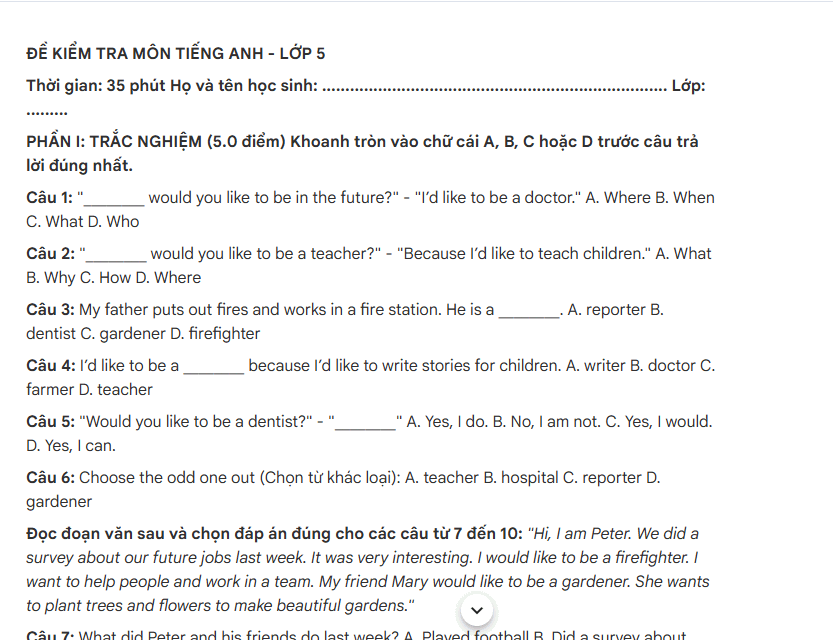
2. Find or prepare suitable source material
For reading comprehension or a scenario-based question, specify the length and reading level. Distinguish real sources from newly generated passages.
Suggest [number] source-material options for an assessment.
Subject: [subject]
Grade: [level]
Topic and learning objective: [details]
Question format: [reading comprehension / analysis / scenario]
Length and reading level: [limits]

For each option, give its main idea, why it fits, and possible
question types. If recommending an existing work, provide a
verifiable title, author and source link; do not invent references.
Do not reproduce lengthy copyrighted material. Prefer material
I supply, public-domain material or appropriately licensed sources.
If you write an original passage, label it as AI-generated and do
not attribute it to a real author.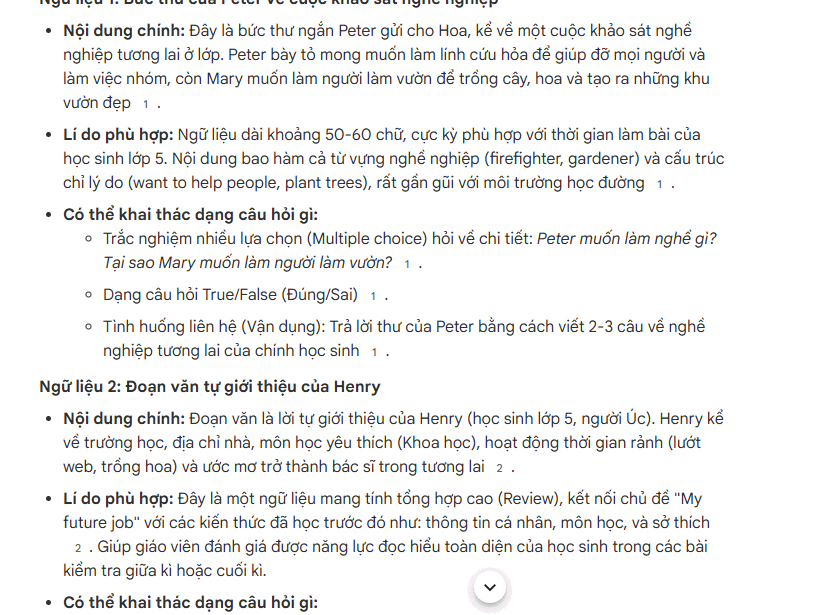
3. Add challenge without introducing tricks
Choose the items to revise or the intended distribution yourself. A fixed percentage of harder final questions is not appropriate for every assessment.
Review this draft test: [paste test].
Target learners: [level]
Objectives and required distribution: [details]
Items that may be revised: [numbers]

Propose questions that assess deeper understanding or application
of the taught material. Preserve the accessible core questions,
assessment time and total marks unless I authorize a change.
Do not increase difficulty through obscure wording or untaught facts.

For each revision, show the original item, revised item, objective,
reason for the change, answer and marking guidance. Flag any effect
on the blueprint. Do not claim that difficulty has been empirically
validated merely because the question looks more demanding.
4. Adapt wording and access for the class
Describe classroom needs in general terms. Avoid uploading identifiable student information when a summary is sufficient.
Adapt the following assessment for this class: [paste test].
Subject and grade: [details]
Taught vocabulary and common learning needs: [summary]
Required accommodations: [teacher-provided requirements]
Learning objectives that must remain unchanged: [list]

Identify unnecessary language complexity, ambiguous instructions,
unfamiliar contexts and layout barriers. Suggest revisions while
preserving what each item is intended to assess.

Show each change and explain whether it changes only access and
wording or also changes the assessed skill or difficulty. Do not
silently lower the learning objective or alter the marking standard.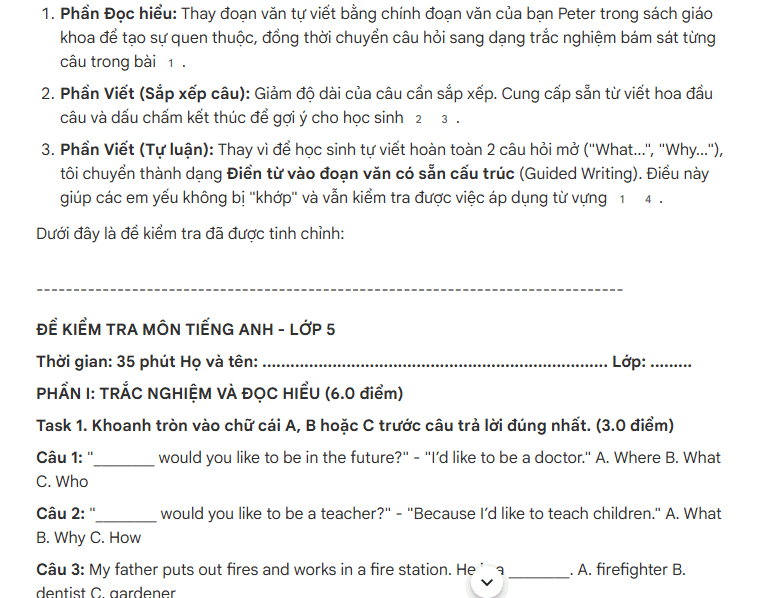
5. Create parallel practice questions
Changing numbers alone can produce impossible conditions, unintended rounding or a different difficulty level. Ask for solutions as well as the new items.
Create [number] practice questions based on this example:
[original question and verified solution]

Keep the same learning objective, question format and approximate
reasoning demands. Vary the content enough to avoid duplicates.
Use values and conditions that produce valid, age-appropriate tasks.

For every item, provide a separate worked solution and final answer.
Check units, domains, diagrams and any rounding instructions.
Flag anything that needs a teacher's decision. Do not assume the
new items are interchangeable exam forms without further review.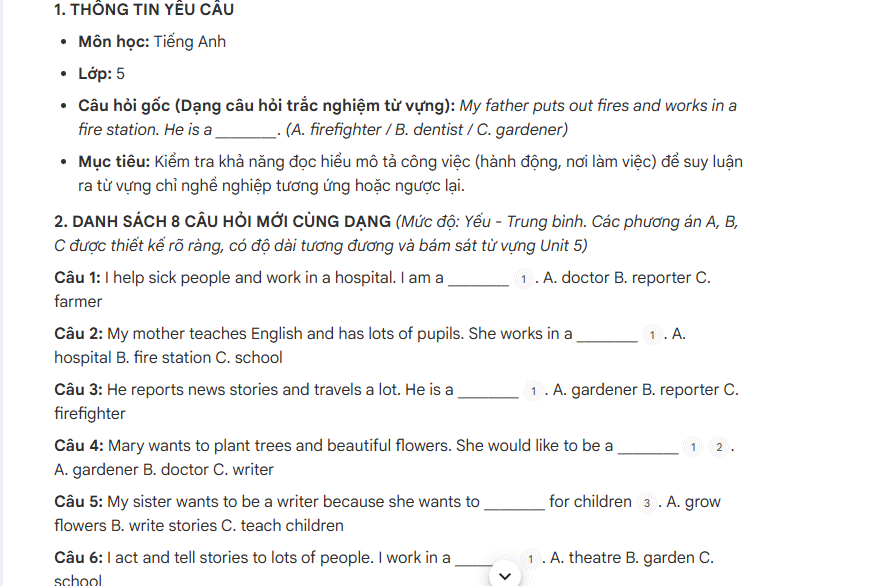
6. Build a test matrix and item specification
A matrix helps reveal gaps between the intended objectives and the questions actually written. Do not ask the model to invent the required category percentages.
Create a blueprint for this assessment: [paste test].
Learning objectives: [list]
Required categories and target distribution: [provide]
Total marks and time: [details]

Return a table with: question number, topic, objective, question
format, cognitive level, marks and brief justification.
Then summarize counts and marks by topic and cognitive level.

Check that every item appears once, the totals are correct, and
coverage matches the supplied requirements. Flag mismatches rather
than relabeling an item just to make the totals fit.
Provide a short specification describing the evidence each answer
should demonstrate.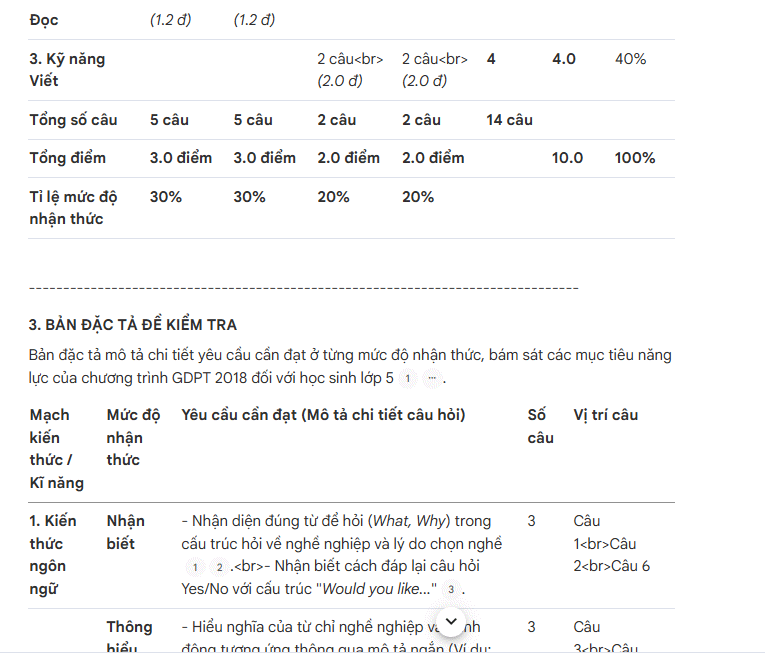
For more on the planning step, see creating an assessment matrix with AI.
7. Draft the answer key and scoring rubric
Provide the final question version and any required marking rules. For open responses, identify what makes an answer acceptable rather than relying on one model response.
Draft an answer key and rubric for this final test: [paste test].
Total marks: [number]
Existing marking rules: [provide]

Solve each item independently. If a question is ambiguous, lacks
information or has multiple valid answers, flag it before scoring.

For each item, provide the answer, essential reasoning or evidence,
marks for each criterion, and acceptable alternative responses.
Explain partial credit where appropriate and avoid double penalties
unless the supplied rules require them. Check all subtotals.

Keep the teacher key separate from the student paper. Identify
uncertain judgments for human review; do not grade real students
or change their records.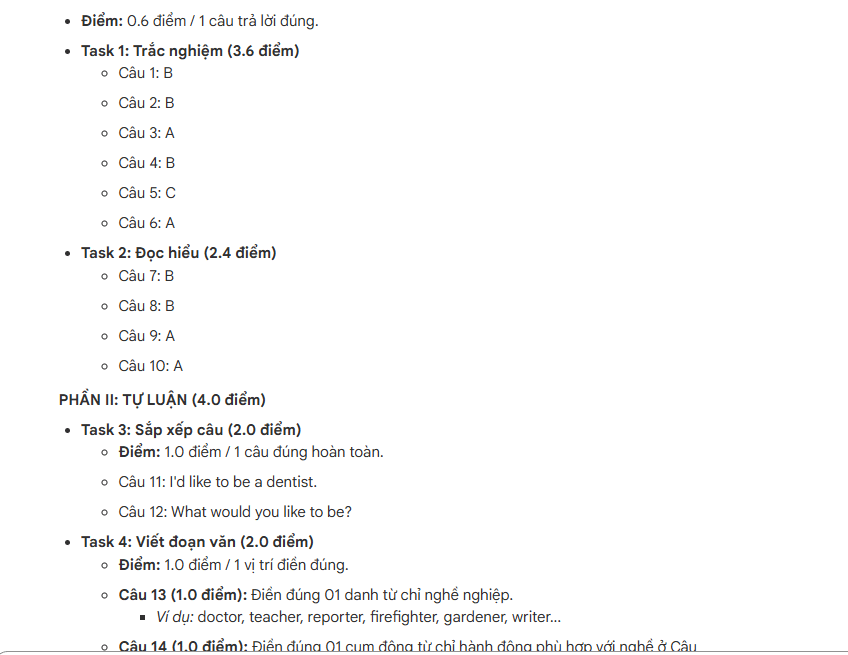
Check the paper before using it
- Solve every question yourself and verify factual source material.
- Check that required diagrams, passages and data are present and readable.
- Confirm one correct choice where that is the intended format.
- Recalculate total marks and compare the paper with its blueprint.
- Estimate completion time for the intended class, including reading time.
- Check that the student version does not reveal answers or teacher notes.
- Have another teacher review consequential assessments when possible.
If you need software to organize the workflow, this overview of AI tools for teachers provides options to compare. A well-structured prompt produces a draft more efficiently; the final assessment still depends on professional judgment and the requirements of your course.
Related Articles
 25 Multiple Choice Windows Command Prompt Questions5 minutes read
 Prompt Templates: Explained8 minutes read
 99+ Prompt AI Creates Detailed Videos of All Genres54 minutes read
 999+ AI Commands for Learning21 minutes read
 Choose the Right Output Format for an AI Prompt6 minutes read
 Accessibility Check Prompt for Code4 minutes read
Reader Comments 0
Sign in with email or Google to join the discussion.