Table of Contents
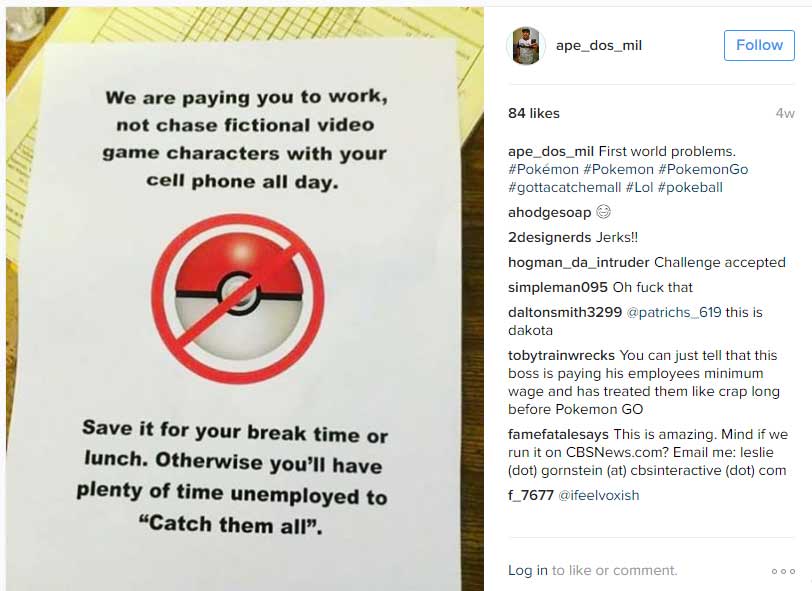
Managers should treat Pokémon GO like any other personal mobile activity at work: set clear, role-appropriate expectations and address observable performance or safety problems. A neutral policy is more practical than banning one game, and it remains useful when another app becomes popular.
Short personal breaks may be reasonable in many workplaces, but looking at a phone while driving, operating equipment, serving customers or entering restricted areas can create immediate risk. The correct response depends on the job, existing policy and local employment rules.

Focus on behavior, not the popularity of one game
An employee who checks Pokémon GO during an authorized break is different from an employee who misses deadlines, leaves a workstation without permission or uses a phone in a hazardous area. Evaluate the conduct and its impact instead of assuming that every player is unproductive.
Claims that a particular game has reduced productivity across an entire workforce require evidence. Managers should use the same attendance, output, quality and safety measures that apply to other distractions.

Build a practical personal-device policy
A useful policy explains when and where personal phones may be used, which roles have stricter restrictions and what happens when the rules are ignored. It should cover games, social media, messaging and other non-work activity instead of naming Pokémon GO alone.
Define permitted times and places
State whether personal use is allowed during scheduled breaks, lunch or before and after a shift. Identify areas where phones are prohibited for safety, privacy, security or customer-service reasons. Employees should not have to guess whether a five-minute check is acceptable.
Connect restrictions to a real business need
Different jobs justify different rules. A driver, machine operator, healthcare worker or employee handling confidential information may need tighter limits than someone working independently at a desk. Explain the reason so the rule appears consistent rather than arbitrary.
Address location-based risks
Pokémon GO uses location data and encourages movement. Employees must not enter private, hazardous or access-controlled areas to reach an in-game location. They also should not photograph, map or publicly discuss sensitive workplace areas.
Three steps when phone use affects work
1. Discuss the specific problem
Describe what was observed: for example, a missed task, delayed customer response or unsafe phone use. Avoid exaggeration and give the employee a chance to explain. The conversation should be about performance and expectations, not about whether the manager likes the game.
2. Apply existing rules consistently
Use the same process for comparable personal-device violations. Follow documented coaching or disciplinary steps and record material incidents according to company practice. Inconsistent enforcement can damage trust and may create avoidable HR problems.
3. Follow up on the agreed change
Set a clear expectation and a reasonable review point. If performance returns to the required standard, the issue may need no further action. If the conduct continues, use the normal escalation process rather than inventing a punishment for one app.
What managers should avoid
- Do not secretly monitor personal phones or collect location data without a lawful, documented basis.
- Do not install software, change passcodes or block features on an employee's personal device.
- Do not ban one game while ignoring equivalent non-work activity by other employees.
- Do not make unsupported accusations about addiction, motivation or intent.
- Do not encourage employees to play in unsafe areas as a team-building exercise.
For company-owned devices and networks, technical controls may be appropriate when they support a written security or acceptable-use policy. Coordinate those controls with IT, HR and, when needed, local legal advice.
Managers must follow the same expectations
Leaders undermine a phone-use policy if they play games, scroll social media or send non-urgent messages during times when employees are prohibited from doing the same. Role requirements can differ, but the standard should still be explainable and credible.
A balanced policy is easier to enforce
The goal is not to control employees' hobbies. It is to protect safety, service, security and agreed work results. Clear rules, consistent enforcement and respectful coaching handle Pokémon GO and future mobile distractions more effectively than a reactionary game-specific ban.
Related Articles
 How to Own the 'Pokémon' in Pokémon GO?6 minutes read
 What Will You Do When There Are Multiple Pokémon in Pokémon GO?5 minutes read
 Pokémon Systems When Fighting in Pokémon GO13 minutes read
 Things to Know to Upgrade Pokémon in Pokémon GO6 minutes read
 How to Transfer Pokémon GO Accounts from Old Phones to New iPhone Phones?5 minutes read
 Guide How to Revive Pokémon in Pokémon GO5 minutes read
Reader Comments 0
Sign in with email or Google to join the discussion.