Table of Contents
This guide provides a practical overview of Shortcut Sleep Win 10, including its main features, benefits, limitations, and important considerations.

Here are some Sleep shortcuts on Windows 10 that TipsMake. com collects and shares. Please follow along.
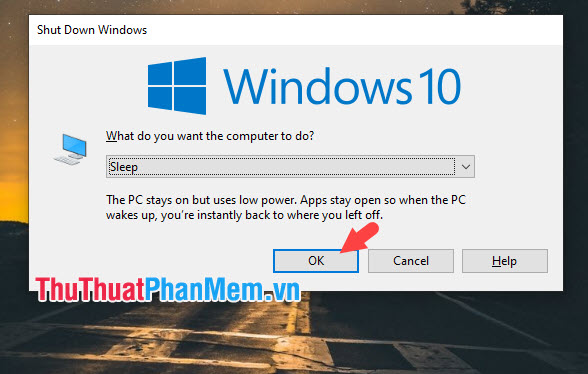
1. Put the computer to Sleep mode with the shortcut Alt + F4
To turn off this way, press the key combination Alt + F4 and press the up arrow key to select Sleep . Then you press Enter is the machine automatically Sleep.
2. Use the keyboard shortcut Windows + X
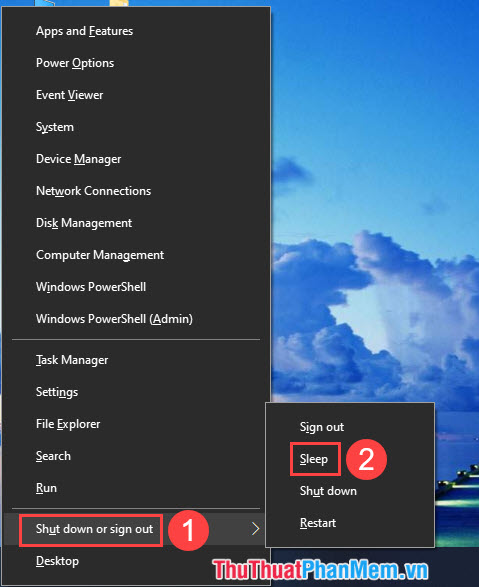
Quick access menu on start button is quite useful with many quick access options for users. To put your computer into Sleep mode, do the following:
Press Windows key combination + X => press the U key on the keyboard => press the S key on the keyboard.
3. Create the Sleep key in the Windows right-click menu
Step 1: You create a new Notepad by right-clicking on the Desktop and selecting New => Text Document .

Step 2: Enter the following code into Notepad.
Windows Registry Editor Version 5.00 [HKEY_CLASSES_ROOTDesktopBackgroundShellSleep Computer] "icon"="shell32.dll,-331" "Position"="Bottom" [HKEY_CLASSES_ROOTDesktopBackgroundShellSleep Computercommand] @="rundll32.exe powrprof.dll,SetSuspendState 0,1,0"
Step 3: You press Ctrl + Shift + S to save the file.
In the File name (1) section, name it as you like, but it must have a . reg extension. Item Save as type (2) you to All Files . Then click Save (3) to save.

Step 4: Click the . reg file you just created to add the registry to your computer.

If a message pops up, click Yes .

Step 5: You right-click the computer screen or use the option key on the keyboard. The position of the option key on the keyboard is described as shown below.

Next, select Sleep Computer (if using a mouse) or press the option key and press the up arrow key ↑ to finish.

To turn off the Sleep option in the right-click menu, access the registry links and delete them.
4. Put the computer to sleep mode with the shortcut key Fn
On a laptop line with integrated Sleep feature with shortcut key FN . If your laptop has the Sleep icon on the keyboard, just press FN + Sleep . As an example in the picture below, you press Fn + F4 is the computer automatically sleep mode.

5. Create Shorcut Sleep on Desktop
Step 1: Right-click on the Desktop and select New => Shortcut .

Step 2: Next, enter the following code and click Next
rundll32.exe powrprof.dll,SetSuspendState 0,1,0 
Step 3: You name the Shortcut in item (1) and click Finish (2) to complete.

Step 4: After creating the shortcut, simply click on the shortcut and the computer will automatically sleep.

With the sharing of the Sleep shortcut on Windows 10, you can save time to manipulate and improve your computer use "cool" than before. Good luck!
FAQ
What should I know about Shortcut Sleep Win 10?
Focus on the key features, requirements, limitations, and practical use cases explained in this guide.
How do I get the best results with Shortcut Sleep Win 10?
Follow the recommended steps, use current software or information, confirm compatibility, and review settings before major changes.
Are there any risks or limitations?
Potential limitations depend on compatibility, data quality, cost, privacy, support, and how the product or method is used.
Related Articles
 What You Need to Know About Sleep Needs by Age8 minutes read
 15 Truths Completely Wrong About Sleep (part 1)6 minutes read
 Sleep Better with the Sleep Mode Shortcut on iPhone, iPad7 minutes read
 Create Shortcuts, Restart Your Computer ... on the Desktop5 minutes read
 Summary of Useful Windows 7 Shortcuts9 minutes read
 5 Things You May Not Know About Sleep5 minutes read
Reader Comments 0
Sign in with email or Google to join the discussion.