Table of Contents
Start Firefox in Safe Mode

This practical guide explains how to start firefox in safe mode with clear steps and useful context. It also covers common requirements, potential problems, and the details that can help you get better results.
If Firefox fails to open due to a problem and you need to start Firefox in Safe Mode, see the method for Windows or Mac, depending on your computer type.

Click the ☰ -shaped button in the upper-right corner of the Firefox page. A drop-down menu will appear.

Click Help. This option is at the bottom of the drop-down menu.

Click Restart with Add-ons Disabled. The option is at the top of the "Help" section of the drop-down menu.

Click Restart when the option appears. Firefox will close.

Click Start in Safe Mode when the option appears. Firefox will reopen in Safe Mode.
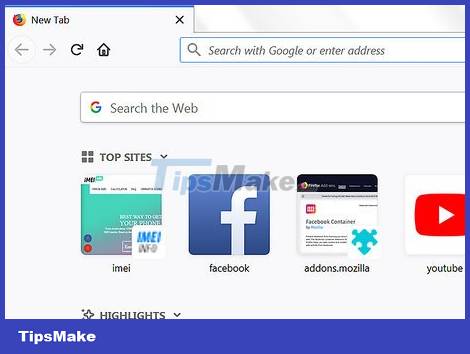
Review browser performance. If Firefox's problem no longer appears when opening in Safe Mode, it means that the cause lies in one or more add-ons you have installed.
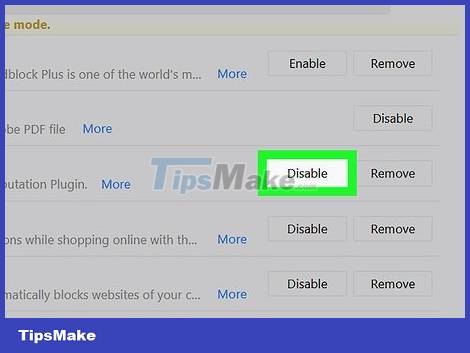
Disable add-ons if necessary. Go to the add-ons page by clicking the -shaped button, select Add-ons and click the Extensions tab, and then select Disable or Remove. ) to the right of an extension to disable or remove the option from Firefox.
You can also reset the entire browser to factory default settings by clicking Restart with Add-ons Disabled, selecting Refresh Firefox when the task appears, and clicking Refresh Firefox when prompted. again. This will delete all browser settings and add-ons.
Start Firefox in Safe Mode on Windows

Try using keyboard shortcuts. In most cases, you can use a keyboard shortcut to start Firefox into Safe Mode. Look for the Firefox icon on your desktop, taskbar, or Start menu; Once found, you need:
Hold down the ⇧ Shift key.
Click or double-click the Firefox application icon.
Release the ⇧ Shift key when Firefox opens.
Click Start in Safe Mode when the option appears.
Troubleshoot Firefox if necessary.

Open Start. Click the Windows icon in the lower left corner of the screen. A window will pop up.
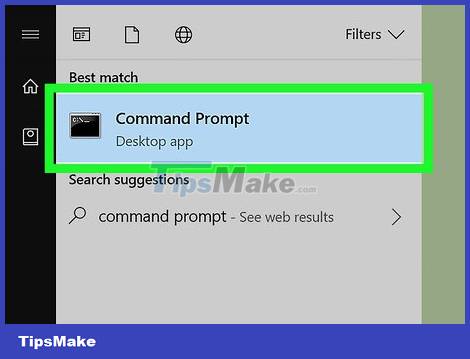
Open Command Prompt. You enter command prompt and then click the Command Prompt icon that appears at the top of the Start window.

Enter the command Firefox Safe Mode. Enter "C:/Program Files/Mozilla Firefox/firefox.exe" -safe-mode into the Command Prompt.
If you installed Firefox in a different directory than the example above, try entering the command start firefox -safe-mode.

Press ↵ Enter to execute the command.
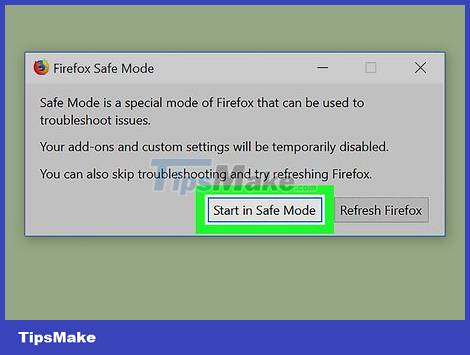
Click Start in Safe Mode when the option appears. This will confirm your choice and open Firefox in Safe Mode, at which point you can proceed to troubleshoot the extension if necessary.
If you get an error or cannot start Firefox in Safe Mode, try entering the command "C:/Program Files (x86)/Mozilla Firefox/firefox.exe" -safe-mode into the Command Prompt and press ↵ Enter.
Start Firefox in Safe Mode on Mac

Try using keyboard shortcuts. In most cases, you can use a keyboard shortcut to start Firefox into Safe Mode. Look for the Firefox icon in the Applications folder, Dock, or Launchpad on your Mac, then:
Hold down the ⌥ Option key.
Click (or double-click) Firefox.
Release the ⌥ Option key when Firefox opens.
Click Start in Safe Mode when the option appears.
Troubleshoot Firefox if necessary.

Open Spotlight. Click the magnifying glass icon in the upper right corner of the screen. A text frame will appear.

Open Terminal. Type terminal into Spotlight, then double-click Terminal when the program appears in the application list.

Enter the command Firefox Safe Mode. Enter the command /Applications/Firefox.app/Contents/MacOS/firefox -safe-mode into Terminal.

Press ⏎ Return to execute the command.
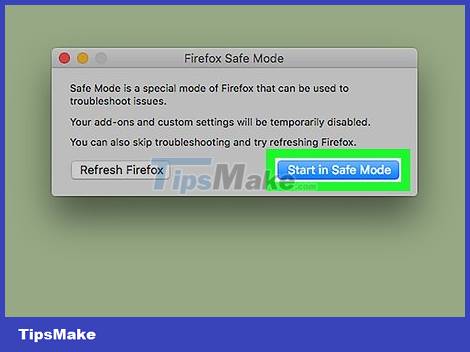
Click Start in Safe Mode when the option appears. This will confirm your choice and open Firefox in Safe Mode, at which point you can proceed to troubleshoot the extension if necessary.
Conclusion
Understanding Firefox makes it easier to compare options, avoid common mistakes, and apply the information in this guide more effectively. Review the relevant requirements before making changes or choosing a solution.
FAQ
How do you start firefox in safe mode?
Follow the steps in this guide in order, confirm the required settings or tools, and verify the result before making additional changes.
Is it safe to start firefox in safe mode?
It is generally safe when you follow the recommended instructions, use trusted tools, and avoid changing settings you do not understand.
What should you do if the process does not work?
Recheck the requirements, restart the device or application when appropriate, and review each step for missed settings or compatibility issues.
Related Articles
 All Problems with Starting Windows in Safe Mode8 minutes read
 Start Safe Mode on Windows XP: Explained4 minutes read
 Fix Firefox Browser Errors in Safe Mode3 minutes read
 The Procedure to Open Microsoft Office 2013/2016 in Safe Mode5 minutes read
 How to Access Safe Mode Windows 10 on Startup9 minutes read
 How to Start Windows in Safe Mode: Clear Instructions6 minutes read
Reader Comments 0
Sign in with email or Google to join the discussion.