Table of Contents
Besides the red-headed snake, you also have the red-necked snake. What kind of snake is the red grass snake, and is it venomous?
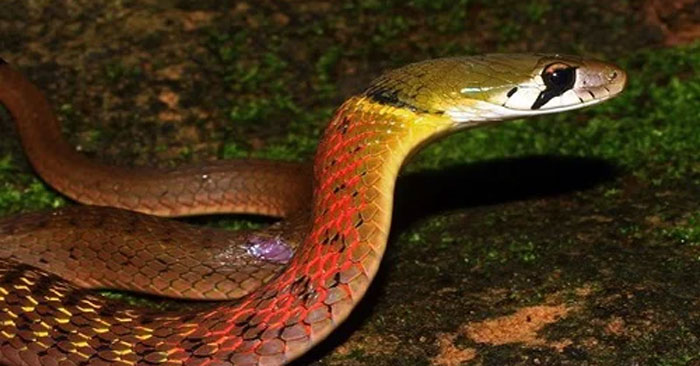
What kind of snake is the red-necked snake?
The scarab snake (Rhabdophis subminiatus) is a highly venomous snake native to Asia. The specific name 'subminiatus' refers to its distinctive red color and cannot be translated as 'bright red' or 'cinnabar'. The scarab snake is green with red and yellow markings near its head. It grows to 70 to 90 cm (27.5 to 35.5 in) in total length (including the tail). Females are significantly larger than males.
This species of red-necked snake can be found in Bangladesh, Indonesia (Sumatra, Borneo, Java, Sulawesi), Thailand, Vietnam, Cambodia, Laos, Myanmar, West Malaysia, Bhutan, Nepal, India (Tripura, Assam, Meghalaya, West Bengal, Sikkim, Arunachal Pradesh, Mizoram, Nagaland), and China (Yunnan, Guangxi, Guangdong, Fujian, Hong Kong, Hainan). They are easily found near water sources. Wet grasslands, swamps, rice paddies, and areas near ponds and rivers are preferred habitats for red-necked snakes.
The red-necked snake is a semi-aquatic reptile. They are diurnal and spend most of their time hunting prey. Although not inherently aggressive, red-necked snakes are still considered dangerous. They possess Duvernoy glands, located in their upper jaw, which secrete a highly potent venom. If disturbed or cornered, the snake will crush its body, and if provoked, it may attack.
Are red-necked snakes venomous?
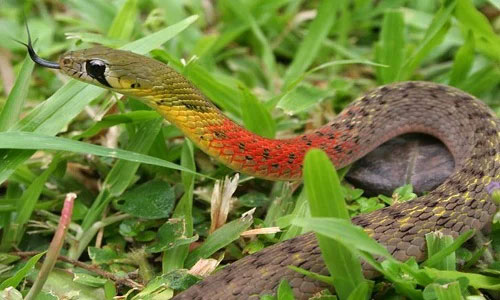
Normally, red-necked snakes are quite docile; they tolerate being touched or even held in the hand. However, in some cases, these snakes can become aggressive and ready to attack if touched.
This species of red-necked snake does not produce its own venom, but it is able to accumulate venom from the animals it preys on, such as toads, frogs, and poisonous centipedes.
The snake's nuchal glands (located behind the snake's head) filter and retain toxins when it eats venomous creatures, then synthesize and metabolize them into its own venom – a substance that activates a powerful clotting factor like factor X, which causes fibrinolysis and the formation of fibrin in the blood vessels. A deficiency of fibrin in the blood leads to uncontrollable bleeding, most severely causing cerebral hemorrhage, gastrointestinal bleeding, and renal hemorrhage, resulting in hemorrhagic shock and death.
This venom is used by them for defense and is potent enough to kill a person. Globally, the red-necked snake is classified as a venomous snake.
The venomous fangs of the red-necked viper are located in the innermost teeth, so the amount of venom injected varies depending on the bite. Therefore, poisoning only occurs if the bite is deep. If a large amount of venom from the red-necked viper enters the victim's body, it will cause very severe illness and blood clotting disorders. The victim may remain conscious but will experience hemorrhage, multi-organ bleeding, and death.
Currently, many countries, including Vietnam, do not have antivenom for the red-necked snake. In Asia, only Japan and South Korea possess this antivenom.
How to treat a red-necked snake bite
If bitten by a snake, quickly take the victim to the nearest hospital or medical facility, and try to keep the victim calm.
- Restrict movement, ideally by splinting the affected limbs to prevent movement, to slow the spread of the venom.
- Loosen tight clothing to avoid compressing the wound; adjust the position so that the bitten area is lower than the level of the heart, such as lying down, even while being transported to the hospital.
- Clean the wound with soap and saline solution; use a clean, dry gauze pad to cover the bitten area to prevent further bacterial infection.
- Do not use a tourniquet to tightly bind the bitten area, as this will both cause pain to the victim and restrict blood flow to the limbs, leading to necrosis, which is very dangerous.
- Do not apply cold compresses, chemicals, or herbal poultices to the wound, or take medication without a doctor's prescription.
- Do not cut, puncture, or attempt to remove the venom from the wound, as this will not help and may even worsen the infection.
- Avoid consuming beverages containing stimulants such as coffee or alcohol, as these can increase the rate at which the body absorbs venom.
- Do not attempt to catch the snake as this is very dangerous. Instead, remember its color and shape so you can report it to the doctor, as this information is crucial for treatment. If you have a phone, quickly take a picture of the snake from a safe distance to aid in identification.
According to recommendations, people should not keep this snake as a pet. If bitten by a red-necked snake and the wound is clean, take the patient to a medical facility as quickly as possible. Note that you should not apply a tourniquet to the wound or apply plant leaves to avoid causing infection.
FAQ
What Kind of Snake Is the Red-Necked Snake, and Is It Venomous?
Besides the red-headed snake, you also have the red-necked snake. What kind of snake is the red grass snake, and is it venomous?
What kind of snake is the red-necked snake?
The scarab snake (Rhabdophis subminiatus) is a highly venomous snake native to Asia. The specific name 'subminiatus' refers to its distinctive red color and cannot be translated as 'bright red' or 'cinnabar'.
Are red-necked snakes venomous?
Normally, red-necked snakes are quite docile; they tolerate being touched or even held in the hand.
Related Articles
 The Most Venomous Snake in Vietnam, the King Cobra Is Still Far Behind3 minutes read
 Going on the Wrong Road, the Rat Snake Is Re-eaten by the Tiger2 minutes read
 'immune to Poison' These 7 Predators Eat Poisonous Snake Meat5 minutes read
 Poisonous Snake: 9 Unique Snakes in the World5 minutes read
 Black Face the Enemy, the Poisonous Snake Viper North America Must2 minutes read
 The Death Bite of the Snake with the Longest Fangs3 minutes read
Reader Comments 0
Sign in with email or Google to join the discussion.