Table of Contents
OCSP (Online Certificate Status Protocol) is easier to understand when the core ideas are explained in practical terms. This guide covers what it means, how it works, why it matters, and the main details you should know.
Key Takeaways
- Understand what is OCSP (online certificate status protocol).
- Explore how does OCSP work.
- Understand the role of OCSP.
What Is OCSP (Online Certificate Status Protocol)?
OCSP (Online Certificate Status Protocol) is an Internet protocol (IP) used to determine the revocation status of X.509 digital certificates. The protocol is described in RFC 6960 and was developed as an alternative to certificate revocation lists (CRLs), to overcome the problems associated with the use of CRLs in public key infrastructure (PKI).
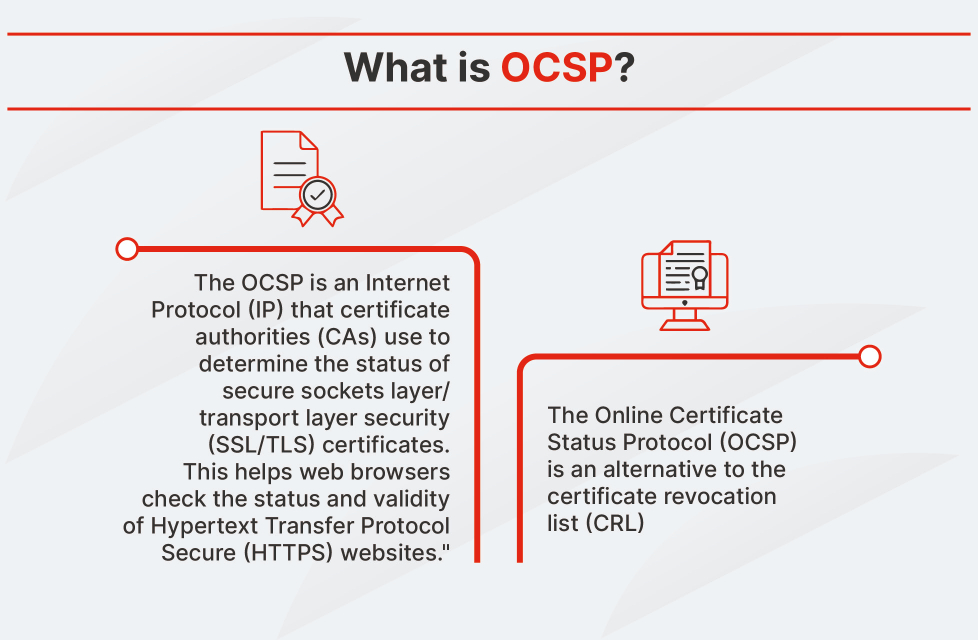
What is OCSP (Online Certificate Status Protocol)?
How Does OCSP Work?
OCSP allows servers or browsers to send online requests to an OCSP server to check whether a certificate is still valid or has been revoked. This process follows a client-server model:
- Client sends request to OCSP server.
- The server will respond with information about the certificate status. This response can be "good", "revoked", or "unknown".
The OCSP process works specifically as follows:
- It sends an OCSP request with the certificate serial number when a client wants to connect to a server.
- The OCSP server receives the request and verifies the certificate status from the certificate authority (CA) database.
- The OCSP responder retrieves the certificate serial number from the request.
- Verify revocation status from CA database.
- Returns a successfully signed response to the client if the certificate is valid.
- The client uses the CA's public key to verify the digitally signed response.
- The customer completes the transaction with the server.
The Role of OCSP
The primary role of OCSP is to check the current status of an SSL/TLS certificate to ensure that it is still valid at the time of the check. OCSP checks the validity of the certificate by sending a request to an OCSP server.
Additionally, OCSP was created as a replacement for the Certificate Revocation List (CRL) to address certain issues associated with the use of CRLs in public key infrastructure (PKI).
Advantages and Disadvantages of OCSP
Advantages of OCSP Stapling
- Check certificate status faster than using traditional certificate revocation lists (CRLs) that are responded to directly by the OCSP server.
- Provides a communication security mechanism between the requesting server and the OCSP server, ensuring that information is not tampered with.
- Save bandwidth, reduce the amount of data to download, because there is no need to download the entire CRL list, but only need to send requests for each specific certificate.
- Easily integrates into certificate validation workflows, adapting to a variety of security environments.
Disadvantages of OCSP Stapling
- Maintaining an OCSP server and providing certificate status information over time can increase costs for certification authorities (CAs).
- Depending on the performance of the OCSP server, this can cause problems if the server crashes or becomes unavailable.
- Checking the certificate status every time a user wants to connect to a website can slow down browsing speed, as it has to wait for a response from the OCSP server.
Conclude
With the information that this guide above, surely readers have understood what OCSP is. Compared to CRL, OCSP has outstanding advantages but still has limitations, so you need to learn and base on actual needs to decide which protocol to use.
Final Thoughts
The most reliable way to handle OCSP (online certificate status protocol) is to follow the process in order, verify each important setting, and test the result before moving on. Use the guidance above as a practical reference, then adjust the details for your device, software version, or specific goal.
FAQ
What is OCSP (Online Certificate Status Protocol)?
You can switch to using OCSP if you are using CRL but encounter some problems such as frequent periodic downloads or CRL is consuming too much bandwidth.
Why is OCSP (Online Certificate Status Protocol) important?
Understanding OCSP (online certificate status protocol) helps you evaluate its purpose, requirements, limitations, and practical impact before you use it or make a related decision.
Who should understand OCSP (Online Certificate Status Protocol)?
It is useful for beginners who need a clear overview and for experienced users who want to confirm terminology, requirements, or best practices.
Related Articles
 Advantages and Disadvantages of Dual Boot (Dual Boot)7 minutes read
 The Role and Advantages of Model Context Protocol (MCP) in Modern AI Models15 minutes read
 Instructions for Registering Birth Certificates Online6 minutes read
 What Is Root Certificate? How Is It Used for Online Monitoring?7 minutes read
 Voice over Internet Protocol (Voip): A Practical Guide12 minutes read
 What Is SSTP (Secure Socket Tunneling Protocol)?4 minutes read
Reader Comments 0
Sign in with email or Google to join the discussion.