Table of Contents
This updated guide examines Turn Off the Domain Password Request Feature in Windows Server and organizes the essential facts, background, and practical takeaways in clear American English.
Responsible-use note: Apply security techniques only to systems you own or are explicitly authorized to test.
The default password filter ( Passfilt.dll ) that is included with Windows Server 2003 requires that the password must contain the following elements:
- Does not match the account name in use
- At least 6 characters
- Must meet at least 3 of 4 options: uppercase (A - Z), lowercase (a - z), digit (0 - 9), special characters (for example! $ #%)
And with the system, this policy is enabled by default.
But when applied in certain cases such as testing, building tests, lectures. it is best to turn off this feature. But you should note that this is only applied at the domain level, and of course will reduce the overall security of the system. Choose Administrative tools> Default Domain Security Policy> Security Settings> Account Policies> Password Policy , right-click the Minimum Password Length> Properties option:

Keep the Define this policy Setting option selected, and enter the value 0 as shown below:

Next, double-click on the option Passwords Must Meet Complexity Requirements in the right window:
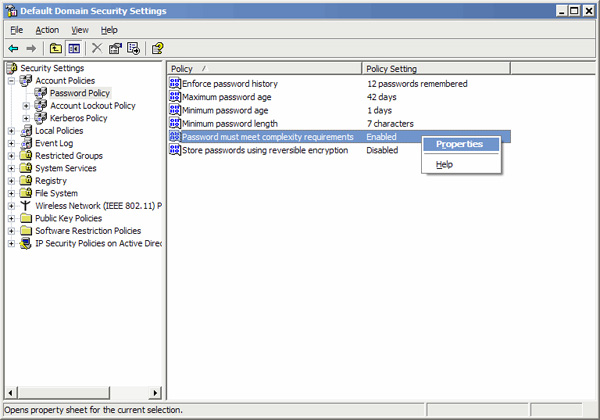
Keep the options of the Define this policy setting box selected and click Disable as follows:
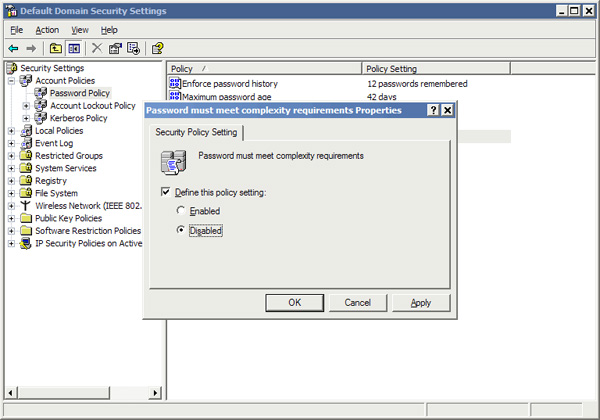
Note that in the previous step, if you do not see the Default Domain Security Policy icon, you can proceed to edit the snap-in section of AD Users and Computers or at GPMC (GPMC installation here).
Click OK to accept the change and close the GPO window. Then refresh the whole policy by typing the command:
gpupdate / force
Good luck!
FAQ
What is Turn Off the Domain Password Request Feature in Windows Server about?
It provides a structured overview of instructions, explains the main context, and highlights practical takeaways for readers.
Why does this topic matter?
Understanding the main concepts helps readers evaluate the issue, avoid common mistakes, and make better-informed decisions.
How should readers use this information?
Use the guidance as a practical starting point, confirm details that may have changed, and follow current product, safety, or security recommendations.
Related Articles
 How to Create a Windows Server 2012 R2 Domain10 minutes read
 Install Windows Server 2003 and Create a Backup Server1 minutes read
 How to Creating a Domain Controller -- Dc on Windows Server 20125 minutes read
 Fix the Problem When Removing Windows Server 2008 Server Core3 minutes read
 How to Turn Off Location Request Notifications on Windows 113 minutes read
 Turn on // Off Concurrent Connections to Both Non-domain Network5 minutes read
Reader Comments 0
Sign in with email or Google to join the discussion.