Table of Contents
Discover the top 10 AI tools for research in 2026, including ChatGPT, Deep Research, Consensus, Scite, SciSpace, and Perplexity, to help you find documents.
Choose the tool for the research stage
- Broad web research: ChatGPT Deep Research or Perplexity.
- Work from a controlled source set: NotebookLM.
- Find and compare academic papers: Consensus, Semantic Scholar, Elicit, or SciSpace.
- Inspect citation context: Scite.
- Map a field and follow related work: ResearchRabbit.
No AI tool makes a source credible. Check the paper, authors, venue, date, method, sample, limitations, corrections, and retractions. A generated citation may be wrong or may not support the sentence beside it.
TipsMake also explains foundational LLM papers, compares Perplexity and ChatGPT, and shows how NotebookLM differs from ChatGPT.
AI research tools at a glance
Before diving into the details, let's take a look at the top AI research tools, along with their uses, limitations, and prices.
| AI tools | Best suited for | Limit |
| ChatGPT Deep Research | Create in-depth research reports with citations. | The information may be inaccurate; the source needs to be verified. |
| Google NotebookLM | In-depth research and understanding of the topic with inline citations. | Sources from YouTube are sometimes unreliable. |
| Consensus | Answer based on scientific evidence and citations. | Less flexible than mainstream AI. |
| Scite | Fact-checking and academic literature review | Not relevant to current news or trending topics. |
| SciSpace | Understanding complex research papers | Stronger at explaining than at searching. |
| Semantic Scholar | Search for academic articles | Stronger at data exploration than citation generation. |
| Elicit | Systematic literature review | Ineffective for non-academic research. |
| ScholarGPT | Students and researchers need quick explanations. | In-depth analysis can be skipped. |
| ResearchRabbit | Follow research and explore new fields. | No peer-reviewed or confirmatory research is shown. |
| Perplexity | Rapid research with sources | In-depth analysis is limited. |
Top AI tools that best support research
A research tool isn't simply about searching for data on the internet like Google Search or Wikipedia. The key is the ability to synthesize reliable information and present it in an easily understandable way. After trying many different options, these are the most outstanding tools.
ChatGPT Deep Research
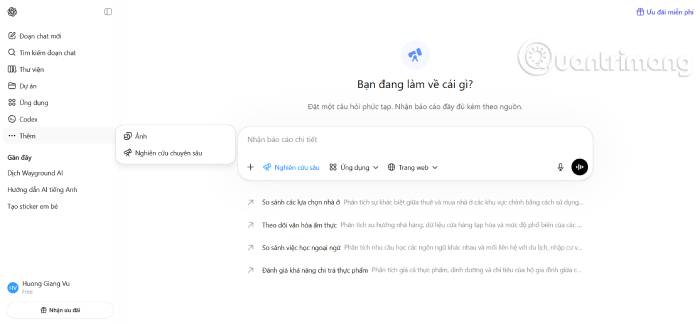
ChatGPT Deep Research is specifically designed for research and is very powerful at synthesizing information from multiple sources. You can upload files or let the AI automatically search the internet to gather references. The tool can create a structured report with citations after searching and analyzing sources. Completion time and depth depend on the task and mode.
Some research features have limited free access, while higher limits and advanced modes depend on the plan. This is an extremely useful tool for students due to its ability to present structured data and support project implementation.
The latest version of ChatGPT 5.2 is now open and free for everyone to use. However, you should still check the source and cite it to ensure accuracy.
Advantage
- Excellent for research, summarizing, and content writing.
- Real-time research is possible, along with access to the most up-to-date information.
- Very versatile.
- Easy to use and integrates well with other tools.
Disadvantages
The quality of the research depends on the commands and models used.
It is not as in-depth as specialized academic research tools.
Google NotebookLM
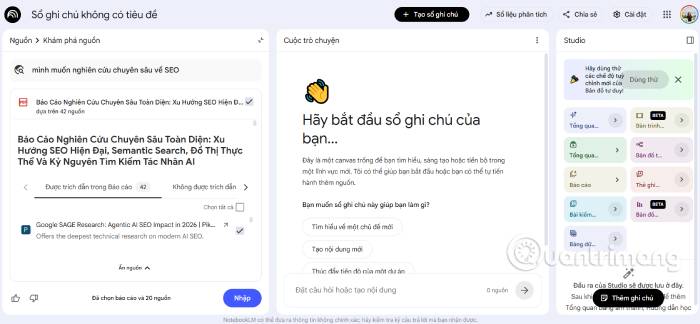
NotebookLM is Google's AI tool that helps users quickly understand PDF files, study materials, and many other types of documents. NotebookLM can help explain a controlled source set, and supported accounts may also use research features to find candidate sources. Add only sources you have reviewed.
Users simply upload documents or share links, and NotebookLM will generate summaries, flashcards, and other study tools.
The most notable feature is Audio Overview, which transforms uploaded data into a podcast-style conversation between two AIs, making content more accessible. Additionally, NotebookLM has apps for Android and iOS, allowing users to learn anytime, anywhere.
Advantage
- It's great for learning and understanding knowledge.
- Useful for students and researchers.
- You can create a summary using audio or video.
- Free access and limits can change; check the current plan.
Disadvantages
- Its core strength is work grounded in selected sources; current versions may also help discover or import additional sources.
- Use a dedicated academic database or research search when you need comprehensive source discovery, then bring reviewed sources into the notebook.
Consensus
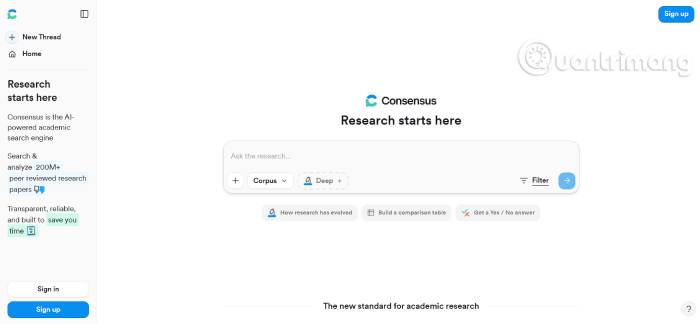
If you're conducting academic research, Consensus is one of the best AI tools available today. It's an AI-powered academic search engine that aggregates millions of research papers across a wide range of fields.
A key feature is the Consensus Meter, which shows the trend of research results on a specific question. The tool displays results such as "Yes, " "Possibly," or "No" based on data from published studies. The number of studies included in a synthesis depends on the feature and plan. Inspect which papers were selected and whether the sample is representative.
Consensus also provides a Study Snapshot feature to quickly summarize key information from scientific literature. Additionally, you can chat with Copilot to ask questions or request assistance in writing research.
Advantage
- Compare multiple papers in a structured evidence view, subject to current product limits.
- The Consensus Meter indicates research trends.
- Searches a large academic corpus; coverage and full-text access vary.
- Support is available for submitting follow-up questions via Copilot.
Disadvantages
- Some summaries may be too simplistic.
Scite
Scite is a powerful AI tool for students and researchers. It evaluates scientific studies to answer questions based on factual evidence and reliable citations.
The standout feature, Smart Citations, adds context to each citation and checks the reliability of the research. For each topic, Scite can display both studies that support and refute a point.
Scite is useful because Smart Citations show the context in which later papers cite a work, including whether the citation appears supporting, contrasting, or merely mentioning.
Advantage
- Smart Citation provides in-depth analysis.
- Useful for validating research results.
- Sources and data are clearly cited.
- Direct link to the source of the document.
Disadvantages
- The interface and citation classifications take time to learn, and automated labels still require inspection.
- Some features require payment.
SciSpace
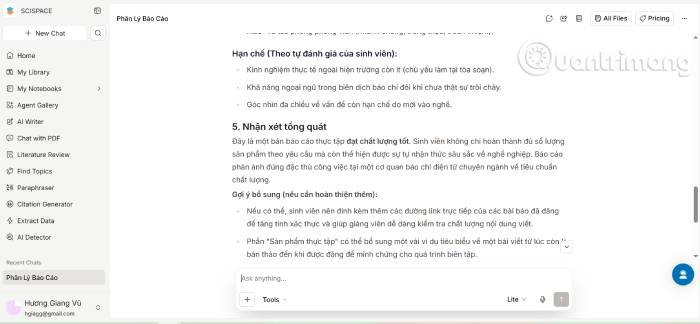
If you want to understand research papers in simpler language, SciSpace is a worthwhile option. Its Chat with PDF tool can explain and summarize research content in an easy-to-understand way.
You can also ask questions and receive summaries from the top 5 related research papers. SciSpace displays journal title, key findings, PDF links, and other useful information.
The diverse filter system allows searching by citation count, publication date, and many other criteria.
Advantage
- It helps to understand complex topics more easily.
- Many filters aid research.
- Providing AI analysis from top-performing articles.
Disadvantages
- Not very strong at finding new data.
- Sometimes information is oversimplified.
Semantic Scholar
Semantic Scholar is a free AI tool for searching scientific literature and academic articles. Semantic Scholar indexes a large cross-disciplinary literature database; coverage differs by field, venue, and document type.
It offers in-depth search functionality, displays the number of citations for each article, and supports advanced citation analysis to find related literature.
Advantage
- A powerful academic research tool.
- Provide information and intelligent summaries.
- Free access and limits can change; check the current plan.
- Supports advanced citation analysis.
Disadvantages
- The quality of the summaries is not yet consistent.
- The sheer volume of information can be overwhelming.
Elicit
In academic research, literature review is often a very time-consuming process. Elicit automates this process by summarizing articles, extracting data, and evaluating new findings.
You can submit research questions and receive results from over 125 million articles in the platform's database. Elicit also allows data to be exported in tabular form for easier analysis.
Advantage
- Excellent for structured research.
- Highlight the key findings.
- Be friendly to newcomers.
- It is possible to chat about uploaded PDF documents.
Disadvantages
- Not suitable for a topic requiring in-depth analysis.
- It doesn't provide good support for new news or trends.
Custom research GPTs, including ScholarGPT
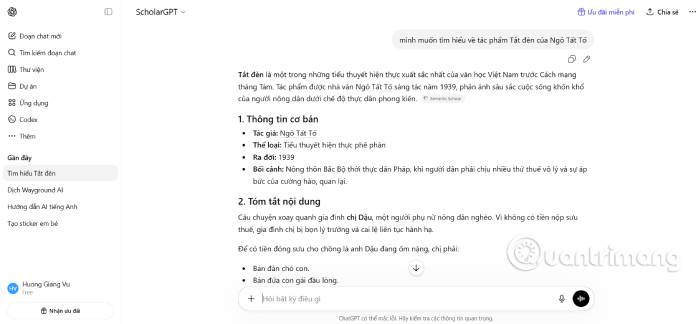
ScholarGPT is a custom GPT rather than a core scholarly database. Its builder, instructions, connected tools, and availability can change, so inspect the cited papers instead of assuming the GPT searches only reputable journals.
Access to custom GPTs and their tools depends on the current ChatGPT plan, regional rollout, and builder configuration.
Advantage
- Summarize many effective research papers.
- Easy to use for students.
- Find high-quality sources.
- Free access or a free tier may be available; current limits and paid features vary.
Disadvantages
- It doesn't provide much context for the quotation.
- The accuracy depends on how the question is phrased.
ResearchRabbit
ResearchRabbit is a tool widely used by researchers to search and review scientific literature. It allows for visualization of citation networks and relationships between research papers.
You can create their own collections of articles, and the system will learn from their preferences to provide better recommendations. The tool also integrates with Zotero for more convenient research document management.
Advantage
- Visualize the research network.
- Follow the topic and receive notifications about new research.
- Free access or a free tier may be available; current limits and paid features vary.
Disadvantages
- Don't focus on summarizing the content.
- It might be a bit complicated for beginners.
Perplexity
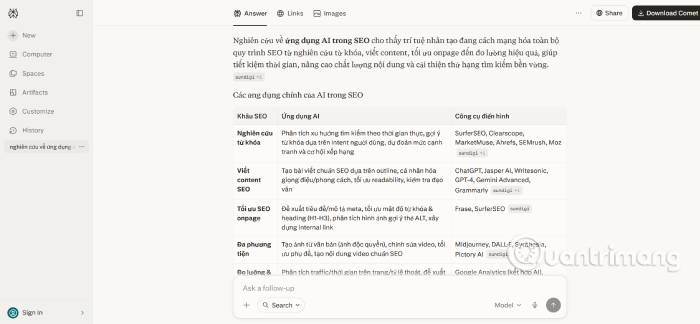
Perplexity is a very useful AI research tool because it can scan the internet and synthesize information from many different sources. Perplexity normally presents linked sources for web-grounded answers, but a link can be low quality, irrelevant, or insufficient to support the generated claim.
Perplexity emphasizes fast web search and citations, while ChatGPT offers broader research, file, and workflow tools. Compare them with the same query and source requirements before paying.
Advantage
- Fast web-grounded responses with visible source links.
- Real-time web search.
- Support in asking follow-up questions to delve deeper into the topic.
- Easy to use for beginners.
Disadvantages
- Not specifically intended for academic research.
- The quality of the results depends on the statement and the model used.
Related Articles
 6 Reasons Obsidian Is Used for In-Depth Research Projects7 minutes read
 5 Favorite AI Tools for Web Research8 minutes read
 What Is ChatGPT Deep Research?6 minutes read
 The Largest Depth in the Ocean Detected Living Organisms1 minutes read
 How to Add Depth Control to iPhone Camera Images5 minutes read
 Qualcomm Adds the Same Depth Sensor Kinect to All High-end Phones Next Year3 minutes read
Reader Comments 0
Sign in with email or Google to join the discussion.