Table of Contents
AI systems that act in the physical world need more than fluent answers. They need useful representations of their surroundings and ways to anticipate what an action might change. World-model research addresses that problem through several overlapping approaches.
Three useful categories are prediction in an abstract representation, construction of navigable 3D scenes, and generation of interactive sequences. They solve different problems; a convincing image, a stable 3D view, and an accurate prediction of a collision are not interchangeable achievements.
Why language ability is not enough
LLM stands for large language model, not a programming language. A language model can describe physical events, but that does not establish that a robot using it can reliably judge distance, predict contact, or execute a movement.
Physical tasks require evaluation against observations and actions. A useful world model might help a system compare possible next moves before choosing one. Language components can still help interpret instructions, while other components handle perception, prediction, and control.
1. JEPA: predict abstract representations
Joint Embedding Predictive Architecture, or JEPA, learns relationships in a representation space instead of requiring every prediction to reproduce all visible pixels. Meta describes V-JEPA as learning by predicting missing or masked parts of video in that abstract space.
The motivation is to focus learning on useful structure without having to recreate every visual detail. For example, the direction an object is moving may matter more for a task than the exact appearance of the background.
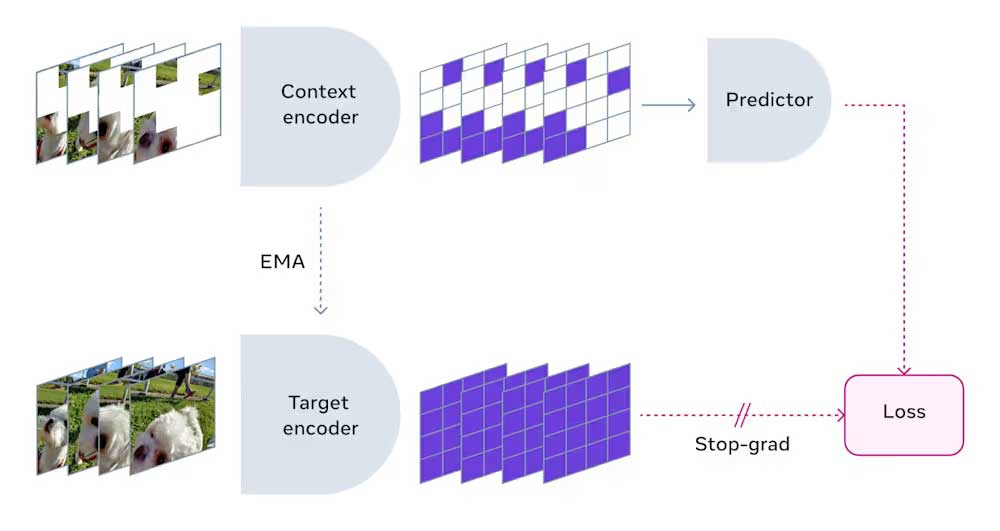
Meta's V-JEPA 2 research also reports robot planning experiments. Those results concern particular experimental settings; they do not establish that any JEPA model can control any robot or ignore every irrelevant change.
Main distinction: the prediction can support understanding or planning without producing a photorealistic video. Efficiency and usefulness still depend on the implementation and task.
2. 3D scene representations: make space navigable
Another strand of work constructs scenes that can be viewed from different positions. Gaussian splatting represents visual information with collections of spatial Gaussian primitives. It is a representation and rendering technique, not automatically a complete world model or physics engine.
Research on 3D Gaussian splatting describes its use for novel-view synthesis and real-time rendering, alongside memory challenges. A scene may come from captured images or a generative pipeline; the representation alone does not determine how it was created.
This matters because being able to move a camera around a scene does not tell you what happens if an object falls or is pushed. Collision handling, editable geometry, object behavior, and export compatibility may require additional components.
Main distinction: a stable spatial representation helps with visualization and scene exploration. Any use in simulation needs separate checks of the behavior being simulated.
3. Interactive generation: predict what appears next
Interactive generative models produce a changing environment in response to actions. DeepMind's Genie 3 is an example of this research direction, with documented limitations as well as demonstrations of interactive worlds.
These systems can generate plausible continuations without using the same explicit scene-and-physics pipeline as a traditional game. Plausibility is useful, but it is not a guarantee of object permanence, causal accuracy, or faithful physical laws.
NVIDIA's Cosmos world foundation models are another example of work supporting physical AI development. Cosmos is a broader platform and model family, so it should not be treated as identical to a particular Genie demonstration.
Main distinction: generated sequences can expand the situations developers explore. Their suitability for training or evaluation depends on whether they preserve the properties the downstream task requires.
How to compare a world-model demonstration
- Input: does it use text, images, video, actions, or a combination?
- Output: is it predicting a latent state, rendering a scene, or generating a sequence?
- Control: what actions can a user or agent actually take?
- Consistency: do objects and relationships persist through movement and time?
- Validation: has performance been checked on the intended task, beyond visual examples?
These approaches can be combined. None alone proves general understanding of the physical world, and synthetic testing does not eliminate the need to validate real-world behavior.
For background study, follow the data science and AI learning roadmap. For a related application, see TipsMake's discussion of translating language into physical motion.
Related Articles
 A 50-year Study Reveals When Humans Begin to Experience Physical Aging5 minutes read
 What Is Physical AI? Key Terms Explained12 minutes read
 Users Begin to Flee Windows 104 minutes read
 Physical AI Is Booming: the Robotics and AI Race Between the West and China Is Hotter Than Ever9 minutes read
 Top 10 Most Powerful Physical AI Robot-Controlling Models Of 20267 minutes read
 4 Reasons Esim Is More Secure Than Physical SIM Card7 minutes read
Reader Comments 0
Sign in with email or Google to join the discussion.