Table of Contents
Physical AI describes systems that perceive their surroundings, interpret what is happening, and take action through a machine such as a robot, vehicle, drone, or industrial arm. Unlike a chatbot that returns text, a physical AI system must cope with uncertain sensor data, moving objects, mechanical limits, and the consequences of a wrong action.
The field is also called embodied AI. Recent progress comes from combining better sensors and computing hardware with simulation, large training datasets, and models that can connect language or visual instructions to physical actions.
What makes physical AI different?
A useful physical system needs a continuous loop:
- Perception: Cameras, lidar, force sensors, microphones, or other devices capture the environment.
- World modeling: Software estimates where objects are, how they may move, and which constraints matter.
- Planning: The system chooses a sequence of actions that should reach a goal.
- Control: Commands are translated into precise movements while feedback corrects errors.
- Safety: Independent limits, monitoring, and emergency controls reduce the effect of failures.
A model may perform well in simulation yet fail when lighting changes, a surface is slippery, a component is worn, or a person behaves unexpectedly. That gap between a controlled training environment and the real world is one of the field’s central challenges.
The platform approach
Technology companies are building reusable components for robot development: simulation environments, pretrained models, edge computers, sensor-processing libraries, and fleet-management software. These platforms aim to reduce the amount of custom code needed for every machine.
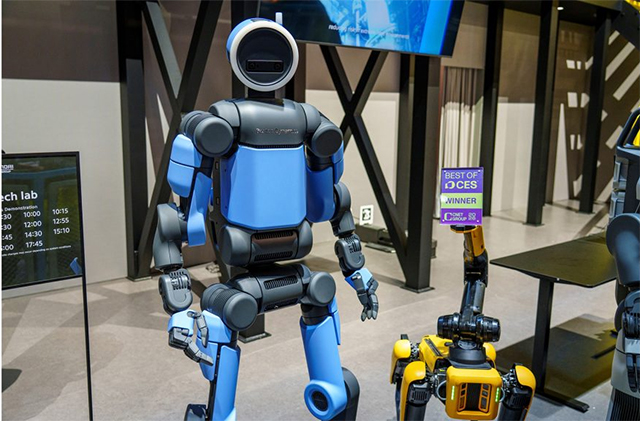
Simulation is particularly valuable. Developers can generate varied scenes, rehearse rare or dangerous situations, and test thousands of parameter combinations without risking equipment. The resulting policy still needs validation on real hardware, because a simulator cannot reproduce every material, sensor artifact, or human interaction.
Foundation models for robotics attempt to reuse knowledge across tasks or machines. A model might interpret an instruction, identify relevant objects, and propose actions. It does not eliminate the need for application-specific data, mechanical engineering, or safety validation.
Why manufacturing strength matters
Robotics progress depends on more than software. Motors, reducers, batteries, cameras, force sensors, semiconductors, and precision manufacturing determine a machine’s cost and reliability. Regions with deep electronics and manufacturing supply chains can prototype quickly and produce components at scale.
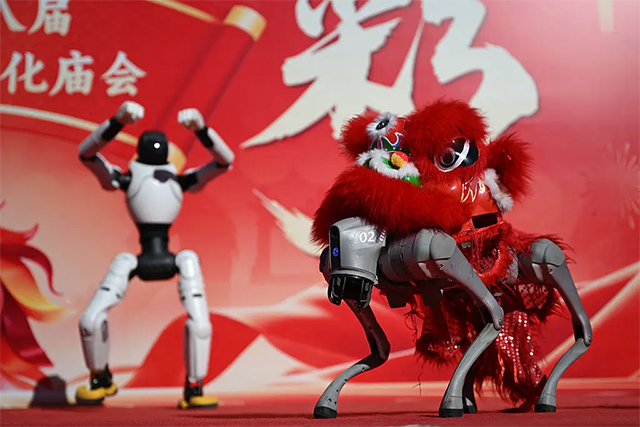
China has become a major center for industrial and humanoid robotics, while US and European companies remain influential in AI models, chips, industrial software, and automation platforms. Describing this only as a West-versus-China contest oversimplifies the market: robots frequently combine intellectual property, components, manufacturing, and customers from several regions.
Where physical AI is useful
- Factories: material handling, inspection, machine tending, and assembly in environments designed for automation;
- Warehouses: moving goods, sorting packages, and assisting with picking;
- Agriculture: monitoring crops, targeted spraying, and harvesting in suitable conditions;
- Transport: driver-assistance and autonomous operation within defined routes or sites;
- Healthcare and laboratories: carefully supervised handling, logistics, and repetitive procedures;
- Hazardous work: inspection or manipulation where heat, radiation, chemicals, or unstable structures endanger people.
Humanoid form is useful only when a task or environment benefits from it. A fixed arm, wheeled robot, or purpose-built machine is often cheaper, safer, and more efficient.
Questions to ask before deployment
Businesses should evaluate the whole operation rather than a polished demonstration. Important questions include:
- How often does the task vary, and what happens in an unfamiliar situation?
- What accuracy, speed, payload, and uptime are required?
- Can a person safely stop or take over the system?
- Who is liable for damage or injury?
- How are sensor recordings and operational data protected?
- What maintenance, calibration, connectivity, and specialist support are needed?
- Does the project still make economic sense after integration and downtime are included?
Physical AI is advancing, but deployment remains an engineering and operations problem as much as a model problem. The strongest applications are narrow enough to test, valuable enough to maintain, and designed with safe failure modes from the beginning.
Related Articles
 What Is Physical AI? Key Terms Explained12 minutes read
 How to Learn Robotics8 minutes read
 Top 10 Most Powerful Physical AI Robot-Controlling Models Of 20267 minutes read
 Not Only Did He Want to Create a Manned Robot Inside, He Wanted15 minutes read
 How Does Chinese Big Tech 'evade' the US Semiconductor Embargo?5 minutes read
 China: the Capital Beijing Builds a Robot Industrial Park: Complete Overview4 minutes read
Reader Comments 0
Sign in with email or Google to join the discussion.