Table of Contents
This updated guide examines Instructions to Scan the Network Port with Advanced Port Scanner and organizes the essential facts, background, and practical takeaways in clear American English.
Features and characteristics of Advanced port scanner
Advanced Port Scanner comes with the following features:
- It is supported by multi-threaded scanning technology, that is, it can scan hundreds of ports in seconds.
- This is a small program, only requires very little space on the user's computer.
- It can also scan predefined port ranges.
- Provides information about ports and network devices.
- Provides easy access to found resources such as HTTP, HTTPS, FTP and shared folders.
- Port scanning is fully configurable.
- You can choose to name the list of ports you are accessing to scan.
- Run commands on a remote computer with ping, tracert, telnet and SSH.
- Allow remote access to computers with RDP and Radmin
- Provides the flexibility of Wake-on-LAN and remote computer shutdown
- Scan results can be exported to.xml,.html and.csv formats.
- No manual installation is required because you can launch it directly from the installer.
- You can create favorite lists of computers you use regularly.
- Simplify the search for local networks
- Comes with a friendly and intuitive interface.
- Ideal for everyone, regardless of technical knowledge or platform
System requirements
Advanced Port Scanner works well in the following systems:
- Windows 7, 98, ME, NT, XP, 95, 2003 and Vista.
- A separate tool exists for Mac OS.
How to use it?
One of the highlights of Advanced Port Scanner is its intuitive user interface. As soon as you open the program, the main window will prompt you to enter the scan target. This can be a single IP address or the entire range. The same applies to ports, but in addition to scanning, this tool also comes with a default port list that includes many common ports used by Windows.
When you enter the scan target, Advanced Port Scanner will scan them. Each scanned target will display on the right of the main window in a dedicated control panel. The information displayed will include the number of ports scanned, opened and closed.
Besides the main window, Advanced Port Scanner also comes with a configuration screen that has some advanced options. In this screen, you can set the maximum number of threads, prioritize threads, scan port timeouts and even optionally ping computers before scanning them.
Price
- Advanced Port Scanner is 100% FREE software.
- Link download Advanced Port Scanner.
Screen shot illustrated


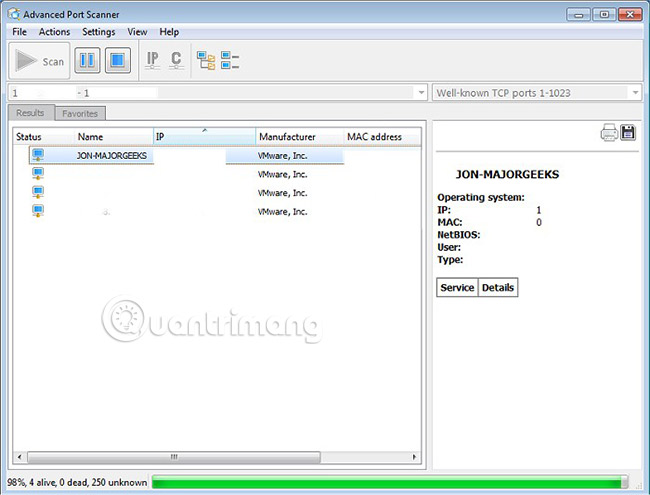

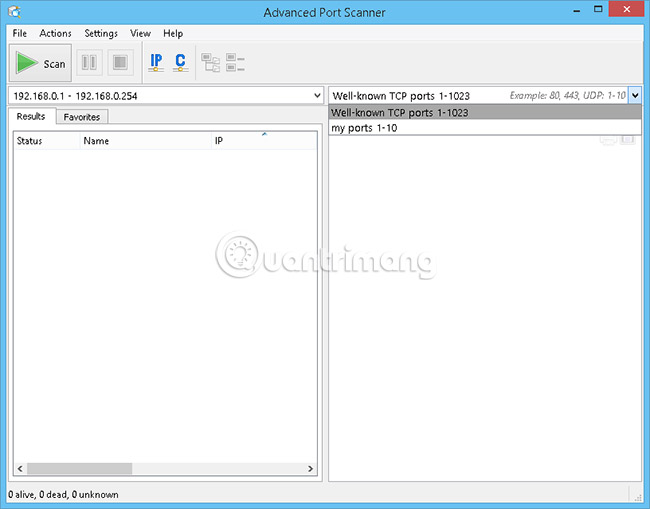
:
- Some free "hack" tools
- 6 simple steps to install Port Forwarding on the Router
- Instructions for installing diver for Intel graphics card on Surface Book
FAQ
What is Instructions to Scan the Network Port with Advanced Port Scanner about?
It provides a structured overview of Advanced Port Scanner, explains the main context, and highlights practical takeaways for readers.
Why does this topic matter?
Understanding the main concepts helps readers evaluate the issue, avoid common mistakes, and make better-informed decisions.
How should readers use this information?
Use the guidance as a practical starting point, confirm details that may have changed, and follow current product, safety, or security recommendations.
Related Articles
 Click: How to Scan on a Mac4 minutes read
 How to Choose a Scanner11 minutes read
 What Is Port 0 Used For?4 minutes read
 Some Tips with QR Scanner Feature on iOS 115 minutes read
 10 Ways to Fix the Error of Not Being Able to Scan QR Codes on iPhone7 minutes read
 Instructions for Scanning Documents with 3 Simple Steps4 minutes read
Reader Comments 0
Sign in with email or Google to join the discussion.