Table of Contents
This updated guide examines How to Create and Apply Master Page in an Adobe Framemaker and organizes the essential facts, background, and practical takeaways in clear American English.
Method 1of 1:
FrameMaker 7.0
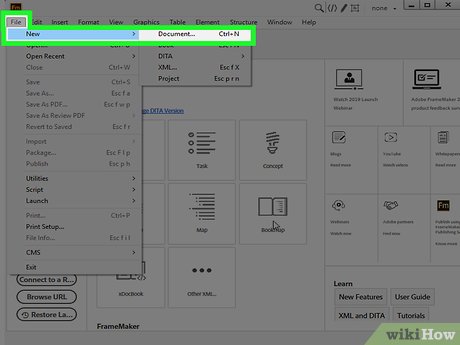 Create a new FrameMaker document. Start FrameMaker, point to New on the File menu, and then click Document . This displays the New dialog box.
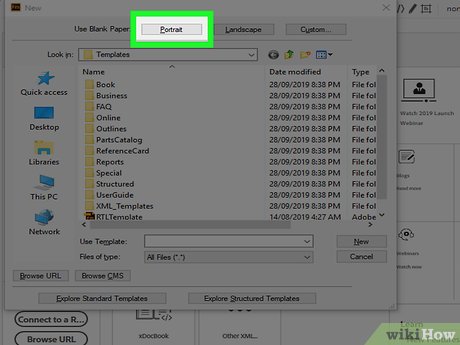 ClickPortraiton theNewdialog box. A new FrameMaker document is displayed.
 Enter some text. Type some text in your FrameMaker document or just copy some text from the Lorem Ispsum site.
 View default master page. On the View menu, click Master Pages . This displays the default master page for your newly created FrameMaker document. Note that a default master page is the master page for the right page and contains a header frame, a text frame, and a footer frame.
 Create a new master page. On the Format menu, point to Page Layout , and then click New Master Page . The Add Master Page dialog box appears.
 Enter an appropriate name for the master page. In the Name box, specify a name for the master page and then click the Add button. This adds a master page to your FrameMaker document.
 Select the header frame. Place the insertion point in the header frame and then press and hold the Ctrl key to select the header frame.
 Display the Scale dialog box. On the Graphics menu, click Scale . The Scale dialog box appears.
 Specify a new height. In the Height box, enter 0.65" and then click Scale . This increases the height of the header frame.
 Display the Tools palette. On the Graphics menu, click Tools .
 Draw a graphic frame. Click the Place a Graphic Frame Button and draw a small graphic frame inside the header frame.
 Import a file. On the File menu, point to Import , and then select File . The Import dialog box appears.
 Browse and locate an image on your computer and then clickImport. The Imported Graphic Scaling dialog box appears.
 SelectCustom dpiand type 96.
 Place an image inside the graphic frame. Click Set . This places the image inside the graphic frame.
 Select the text frame. Place the insertion point inside the text frame and then press and hold the Ctrl key to select the text frame.
 Display the Customize Text Frame dialog box. On the Format menu, point to Customize Layout , and then click Customize Text Frame . The Customize Text Frame dialog box appears.
 Specify a new height. In the Height box, enter 8.00" and then click Set . This decreases the height of the text frame.
 Reposition the text frame. With the text frame still selected, drag it downwards using the mouse; so that the text frame is equidistant from the header and footer frames.
 Enter variables in the footer frame. Now place the insertion point inside the footer frame and enter the text, Page.
 Display the Variable dialog box. On the Special menu, click Variable . The Variable dialog box appears.
 SelectCurrent Page #and then click theInsertbutton. This inserts the current page number into the footer frame.
 Again place the insertion point inside the footer frame and enter the text, of.
 On theSpecialmenu, clickVariable. The Variable dialog box appears.
 SelectPage Countand then click theInsertbutton. This inserts the count of total number of pages in the footer frame.
 Apply master page to body page. To apply the master page, to your body pages, on the View menu, click Body Pages .
 Display the Master Page Usage dialog box. On the Format menu, point to Page Layout , and then click Master Page Usage . The Master Page Usage dialog box appears.
 Select the master page to apply. In the Use Master Page section, from the Custom list, select MyMasterPage .
 Specify the pages to apply master page. In the Apply To section, specify the page numbers to which you want to apply the master page and then click the Apply button.
FAQ
What is How to Create and Apply Master Page in an Adobe Framemaker about?
It provides a structured overview of frame, explains the main context, and highlights practical takeaways for readers.
Why does this topic matter?
Understanding the main concepts helps readers evaluate the issue, avoid common mistakes, and make better-informed decisions.
How should readers use this information?
Use the guidance as a practical starting point, confirm details that may have changed, and follow current product, safety, or security recommendations.
Related Articles
 Create Master Document in Word 2010 from Many Word Files7 minutes read
 Use Slide Master in PowerPoint3 minutes read
 How to Make a Copy of a Page in a PDF Document: Practical Guide8 minutes read
 How to Create an Index in Word6 minutes read
 MS Word - Lesson 11: Formatting Word Pages8 minutes read
 Add Even and Odd Page Titles in Word 2007: Header2 minutes read
Reader Comments 0
Sign in with email or Google to join the discussion.