Table of Contents
Film noir images depend on controlled light more than a long list of vintage props. Deep shadow, a motivated light source, wet reflections, strong framing, and a restrained monochrome palette give a scene tension. The five Gemini prompts below turn those choices into specific compositions you can adapt.
Open the Gemini app or Gemini on the web, choose the image-creation option available to your account, and paste a prompt. Google's current Gemini image help explains how to generate an image, upload references, and request edits. Model names and availability can change, so use the image model shown in your own interface.
What to include in a film noir prompt
- Subject and action: one person doing something readable.
- Location: a window, alley, bar, office, stairwell, or street.
- Motivated light: a desk lamp, streetlight, doorway, or blinds.
- Composition: shot distance, angle, and where the subject sits in the frame.
- Monochrome treatment: deep blacks, controlled highlights, and fine grain.
- Constraints: aspect ratio and elements to avoid.
Lens descriptions can guide the look, but they are not guarantees of real optical behavior. Judge the final framing and anatomy rather than assuming a stated focal length makes the image technically correct.
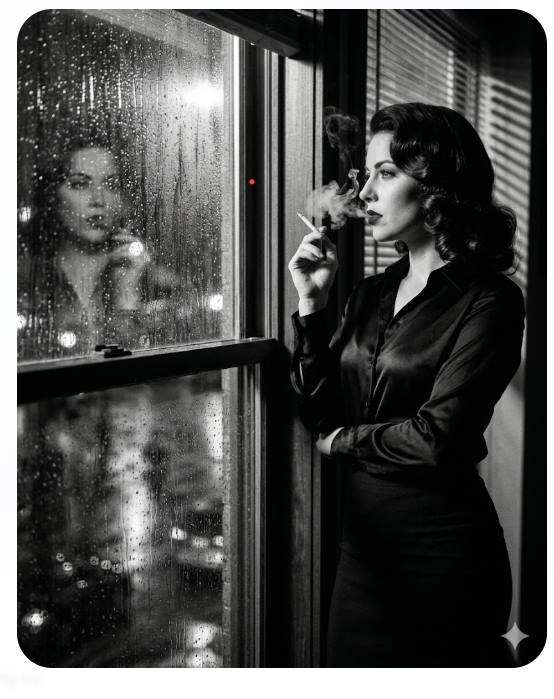
1. A figure beside a rain-streaked window
This setup uses window light and diagonal shadows to separate the face from a nearly black room.
Create a black-and-white film noir portrait of a fictional woman in her 30s standing beside a rain-streaked window at night. She wears a dark satin blouse and high-waisted skirt; her hair is pinned to one side. One hand rests lightly against the glass as she watches the street with a guarded expression. Three-quarter portrait from chest height. A single streetlight outside casts sharp diagonal blind shadows across her face and clothing. The room behind her is almost black, with only the outline of a small table visible. High-contrast monochrome, deep blacks, controlled silver highlights, fine 35mm-style grain, shallow depth of field, vertical 4:5. No cigarette, text, logos, extra fingers, or duplicate reflections.
2. A detective in a wet alley
Use a low camera position, one overhead lamp, and reflective pavement to create depth without filling the alley with unrelated details.
Create a black-and-white film noir photograph of a fictional private detective leaning against a wet brick wall in a narrow city alley at night. Dark double-breasted coat, plain fedora casting shadow over the eyes, leather gloves, folded newspaper under one arm. Waist-height camera angled slightly upward, medium-full shot. One overhead lamp creates hard top light, dense shadow beneath the brim, and a bright pool reflected on cobblestones. Thin fog recedes toward the far end of the alley. High contrast, silver highlights, subtle film grain, 35mm documentary composition, vertical 4:5. No readable newspaper text, weapons, logos, modern vehicles, or distorted limbs.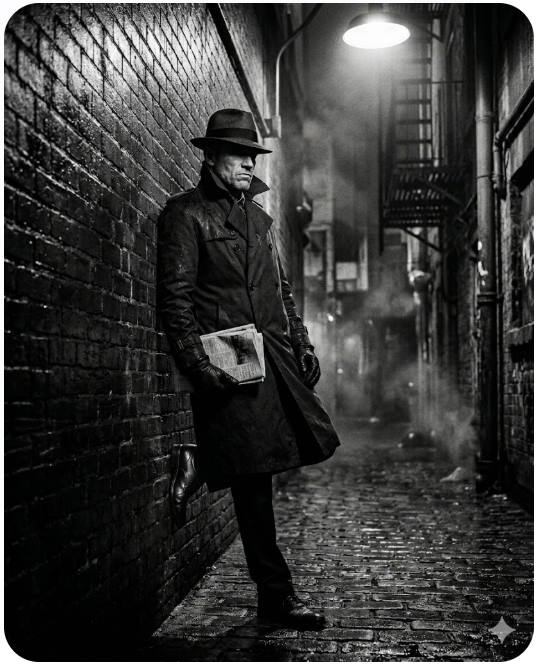
3. A solitary customer at a dim bar
Reflections and negative space make this scene work. Keep the background secondary so the image does not turn into a catalog of bottles.
Create a cinematic black-and-white photograph of a fictional woman sitting alone at the far end of a dim cocktail bar. She faces partly away from the camera, one elbow on the polished counter, a simple glass beside her. Long-sleeved dark velvet dress and a single pearl necklace; restrained, unreadable expression as she glances toward the entrance. Camera placed at bar height several seats away, creating foreground depth and generous negative space. Soft practical light reflects in a few glasses behind her while the rest of the room falls into shadow. High-contrast monochrome, fine grain, 50mm-style perspective, vertical 4:5. No brand labels, readable signs, smoke, or extra people.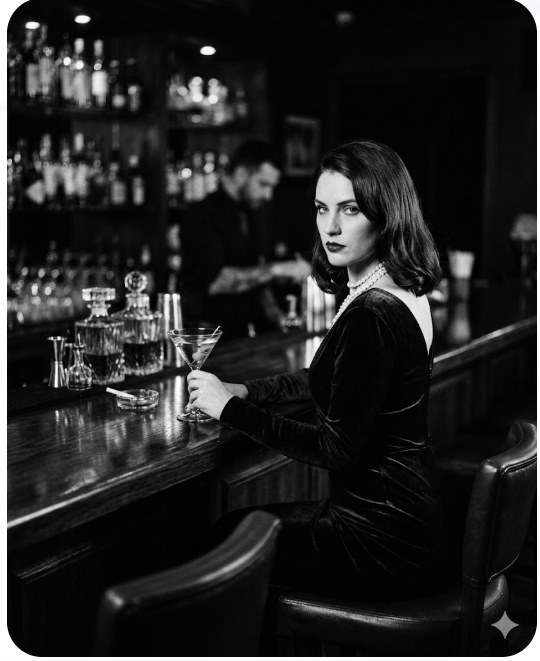
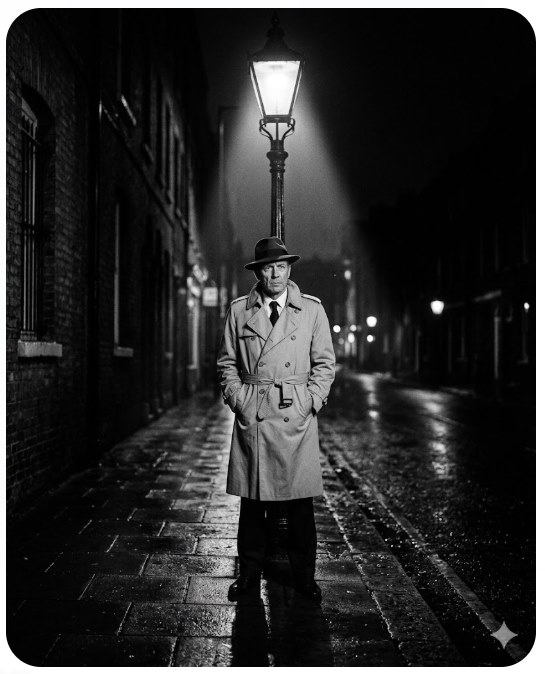
4. A person beneath a lamppost
A wide shot makes the pool of light and surrounding darkness part of the story.
Create a black-and-white film noir street photograph of a fictional man standing beneath a single lamppost on an empty city sidewalk after rain. Long belted trench coat over a dark suit, broad-brimmed hat, hands in coat pockets, tense posture. Camera across the street at eye level, full-body wide composition. The lamp forms a tight cone of hard light; the sidewalk beyond disappears into darkness. Wet pavement reflects one broken streak of white light. Deep monochrome blacks, restrained midtones, subtle halation and film grain, medium depth of field, vertical 4:5. No vehicles, text, logos, other people, or modern street furniture.
5. Venetian-blind shadow portrait
This close-up is an exercise in precise shadow placement. Describe the light direction and crop so the model has fewer composition decisions to invent.
Create a striking black-and-white close-up of a fictional woman's face crossed by horizontal shadows from Venetian blinds. Hair arranged in a simple low bun, defined eyebrows, calm but wary expression, eyes looking just past the camera. Crop from forehead to chin with one cheek slightly closer to the lens. Hard light enters from the left through the blinds, producing parallel bands of light and shadow across the cheekbones, nose, and lips. Background completely black. Extremely high-contrast monochrome with detail retained in the bright skin, crisp focus on the near eye, very shallow depth of field, square 1:1. No jewelry, text, logos, duplicated facial features, or broken shadow lines.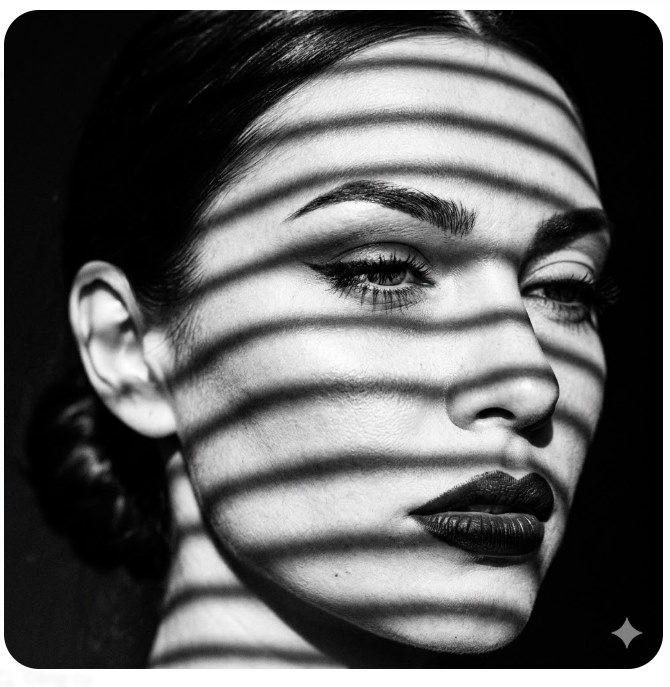
How to refine the result
- If the image is gray and flat, request one harder light source, darker negative fill, and fewer visible background details.
- If the face is too hidden, ask to retain detail in the eyes while keeping the room dark.
- If props multiply, remove them from the prompt and add only one back in per edit.
- If the composition drifts, upload the best generated version and request one localized change.
- If the grain looks like digital noise, ask for fine, restrained grain and clean facial detail.
When using a reference photo, upload only an image you are authorized to use and state which traits should remain consistent. Do not use Gemini to impersonate a real person or fabricate a real event. Google says images generated or edited with its current models include provenance signals such as SynthID; disclosure may also be required by the publishing platform or context.
For more ways to learn prompt structure from existing visual examples, see How to find and study AI image prompts on Lexica.
Related Articles
 Top Best Black and White Wallpaper for Phones3 minutes read
 How to Convert Black and White Photos to Color Images with4 minutes read
 Make Artistic Black and White Photos with Photoscape3 minutes read
 How to Create Illustrator-Style Icons in Gemini3 minutes read
 Prompt Cartoon Creation Using Gemini for You: Explained7 minutes read
 How to Create a Black and White Image in Word Is Very Simple3 minutes read
Reader Comments 0
Sign in with email or Google to join the discussion.