Table of Contents
Learn what is microsoft purview? what are its benefits and applications for businesses means.
What is Microsoft Purview?
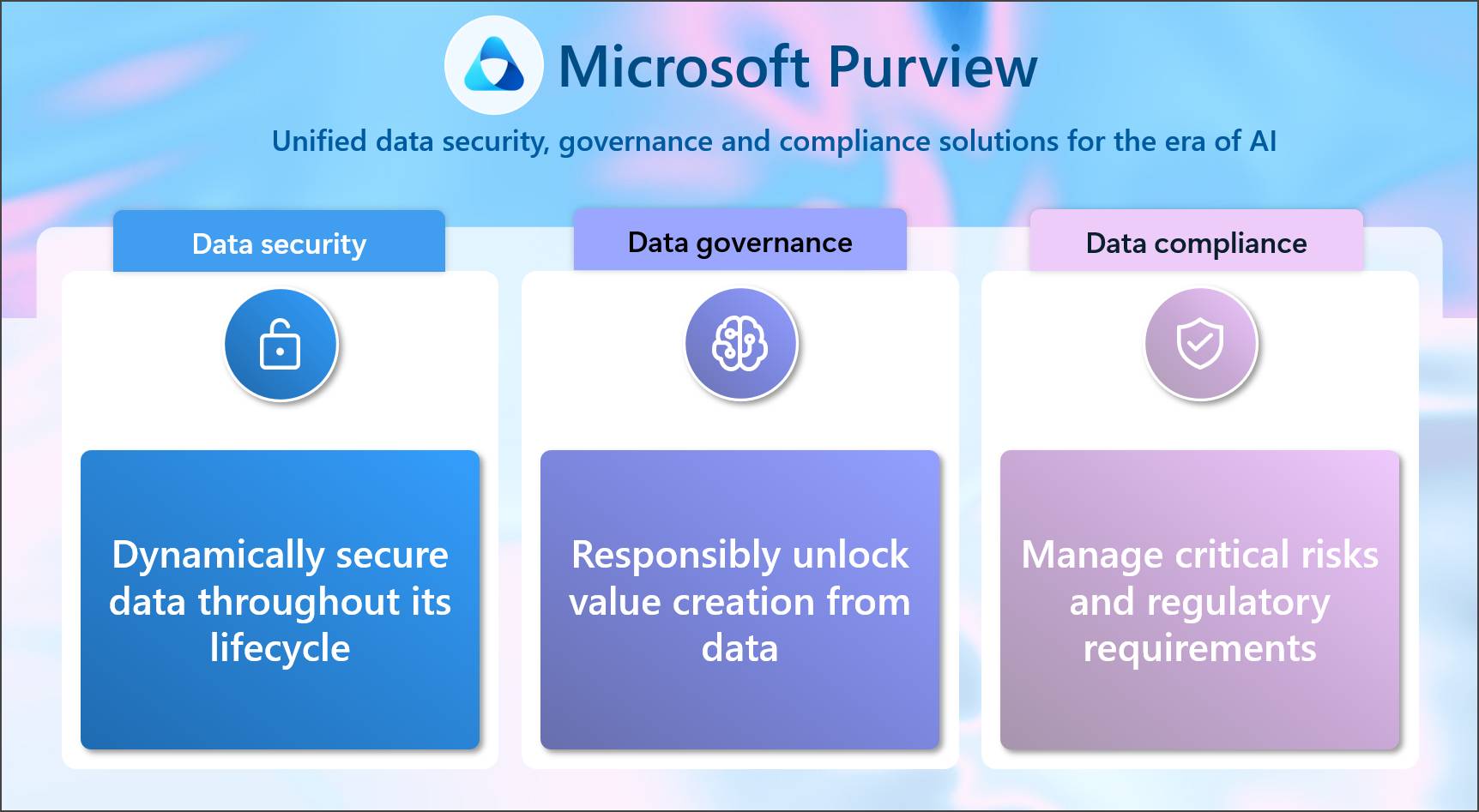
Microsoft Purview is a comprehensive suite of solutions that helps your organization govern, protect, and manage data in the AI era, no matter where that data is located. Microsoft Purview solutions offer integrated coverage and help address data fragmentation across the organization, the lack of visibility hindering data protection and governance, the rapid acceleration of AI transformation, and the blurring of traditional IT management roles.
Microsoft Purview combines solutions and services into a unified platform to help your organization:
- Gaining visibility into data across the entire organization.
- Protect and manage sensitive data throughout its lifecycle, regardless of its location.
- Seamless data management in comprehensive new ways.
- Managing critical data risks and legal requirements.
- Protect against accidental over-sharing and leakage of sensitive data in Generative AI.
What features does Microsoft View offer?
By combining aspects of Azure and Microsoft 365 compliance solutions, Purview delivers SaaS functionalities through several key features, including:
- Data cataloging - Purview automatically scans, categorizes, and catalogs data assets across an organization's entire data system.
- Data origin tracking - Monitoring data sources, movement, and transfer between systems.
- Data classification and governance - Classify data according to sensitivity labels and compliance requirements as needed for data governance.
- Azure Service Integration - Integration with other Azure services.
- Third-party system integration - Although primarily a Microsoft product, Purview can integrate with a number of selected third-party systems.
- Data insights and analysis - Users can create insights into data usage, patterns, and compliance metrics to support decision-making and data governance strategies.

What can you do with Microsoft Purview?
Purview provides organizations with the ability to preserve and manage data throughout its lifecycle with policies and controls that ensure data integrity and security in compliance with regulatory requirements.
In the Microsoft Purview portal, this is accomplished through three feature groups: Data security, data governance, and risk & compliance.
Data security
The data security features in the Purview portal are crucial for ensuring regulatory compliance and mitigating risks to sensitive data.
- Data Loss Prevention (DLP) - Prevents the unauthorized disclosure of sensitive information by monitoring data access and usage and implementing security policies to prevent data leaks.
- Information barriers – Restrictions on communication and collaboration between groups or individuals to prevent conflicts of interest, unauthorized data sharing, or non-compliance with regulations.
- Information protection - Protecting sensitive data through encryption, access control, and permission management to ensure only authorized users can access the data.
- Internal risk management - Mitigating internal threats by identifying risky or suspicious behavior by employees, contractors, or partners who may intentionally or unintentionally misuse or disclose data.
- Privileged Access Management (PAM) - Manage sensitive resources and privileged accounts within your company's IT infrastructure by restricting access, enforcing privilege rules, and auditing privileged activities to prevent abuse and misuse.
Data management
Purview's data governance features provide organizations with the tools to manage data quality, integrity, security, and compliance across their entire data ecosystem.
- Data cataloging - Gathering data from multiple sources into a centralized repository to improve data visibility and accessibility for data governance.
- Data System Insights - Provides detailed information and analysis of an organization's data ecosystem, revealing data usage, access patterns, quality metrics, and compliance status across the entire system to support governance strategies, resource allocation, and data management optimization.
- Data mapping - Visualizes the relationships between different data assets, systems, and processes in a graphical representation of data origin, showing how data flows through the organization and how dependencies are formed.
- Data Policy - Implementing data governance policies and standards related to data classification, data discovery, access control, data protection, retention, and compliance.
- Data sharing - Facilitating secure and compliant data sharing with access rights, sharing agreements, and consent mechanisms to ensure data is transferred only between authorized users.
Risk and compliance
These features of Microsoft Purview provide capabilities for auditing, compliance communications, data lifecycle management, and eDiscovery to enhance governance, reduce compliance risks, and build stakeholder trust.
- Auditing - Monitoring user activity, system events, and data modifications to ensure compliance with regulations and policies, and identifying incidents and security breaches using audit logs.
- Compliance Communication - Monitoring and enforcing policies across multiple channels, detecting and preventing inappropriate behavior, and promoting a safe work environment.
- Compliance management - Assessing the status of compliance, identifying gaps, and prioritizing corrective efforts across legal frameworks such as GDPR, HIPAA, and ISO.
- Data lifecycle management - Create policies and procedures to manage data throughout its lifecycle, managing data retention, storage, and deletion while reducing storage costs and ensuring data security.
- eDiscovery - Identifying, preserving, and retrieving electronically stored information (ESI) for legal, investigative, and administrative purposes, and exporting relevant data to respond to litigation.
What are the benefits of using Microsoft Purview?
Microsoft Purview helps organizations meet a wide range of safe workspace and regulatory compliance requirements. The software's systematic approach to data compliance makes it easy for companies to categorize data, enforce policies, and audit data usage.
Purview also simplifies regulatory compliance, enabling companies to comply with regulations such as GDPR, HIPAA, ISO, etc.
With Purview, data can be searched and explored across the entire Microsoft 365 suite, including Microsoft Teams, SharePoint, Outlook, OneDrive, and many others. This supports informed decision-making and builds trust with stakeholders.
In addition, Purview's powerful analytics features allow organizations to gain valuable insights into their data ecosystem to better understand how data flows, its dependencies, and how to optimize data management.
Purview integrates with the Azure environment, including Azure Data Lake Storage, Azure Synapse Analytics, and other services. This provides a unified platform for data governance and leverages existing investments in Azure infrastructure.

What are the challenges of using Microsoft Purview?
Although Purview is a powerful tool, users may encounter some frustrating limitations. For example, Purview's e-data search and discovery solutions lack features such as advanced search or legal data retention. Users are also limited to searching by only one parameter at a time and must combine the results of multiple searches when refining results by various attributes.
When searching through large datasets, results can take hours or even days to appear. This can be costly for organizations, especially if the e-data discovery investigation has a tight deadline.
In addition to the usual Purview licensing requirements, there are further costs involved in running electronic data discovery searches. First, each data manager involved in the search must have an E5 license or equivalent add-on. Second, there are additional Azure processing and storage fees. Furthermore, to perform native analysis on the search index, companies need Microsoft consultants or third-party analytics solutions.
Ultimately, Purview is only capable of searching across Microsoft products. Most companies have branching data ecosystems that extend beyond a single suite of programs, meaning Zoom, Google Drive, Slack, or MetaWorkplace would be blind spots in Purview's search capabilities.
Purview's complexity, additional fees, and lack of support for non-Microsoft products can increase the total cost of ownership and create problems for organizations seeking a comprehensive and cost-effective solution for data governance and eDiscovery. This complexity is further exacerbated by Microsoft's recent move to separate Teams and Office globally following an EU antitrust investigation.
Final Thoughts
Understanding what is microsoft purview? what are its benefits and applications for businesses makes it easier to evaluate the information and apply the most relevant recommendations. Focus on the key points above and verify details that may change over time.
FAQ
What is what is microsoft purview? what are its benefits and applications for businesses?
Learn what is microsoft purview? what are its benefits and applications for businesses means.
What key points does this article cover?
The article focuses on What is Microsoft Purview?, What features does Microsoft View offer?, What can you do with Microsoft Purview?, with practical explanations and examples.
How can you use this information in practice?
Use the explanations to compare options, verify important details, and make a more informed decision. Apply the recommendations that best match your goals and situation.
Related Articles
 Online Scheduling and Its Benefits for Businesses: What to Know12 minutes read
 Microsoft Launches New Marketplace Platform Dedicated to Selling AI Apps And4 minutes read
 3 Benefits of AI with Businesses in the Future6 minutes read
 Microsoft Kills Office Online Server, Encourages Businesses to Switch To4 minutes read
 Applying AI in Accounting24 minutes read
 Green Bond Benefits for Proactive Investors5 minutes read
Reader Comments 0
Sign in with email or Google to join the discussion.