Table of Contents
This guide provides a practical overview of T. INV.2T - the Function Returns the Two-sided Inverse of the Student's, including its main features, benefits, limitations, and important considerations.

Description: The function returns the two-sided inverse of the Student's t-distribution. Support functions from Excel 2010 onwards.
Syntax: T. INV (probability, deg_freedom)
Inside:
- probability: Probability associated with t value of Student's t-distribution, which is a required parameter.
- deg_freedom: Number of degrees of freedom of the distribution, is a required parameter.
Attention:
- Any argument that is not a number -> the function returns the #VALUE! Error value
- If probability ≤ 0 or probability> 1 -> the function returns the #NUM! Error value
- If deg_freedom <1 -> the function returns the #NUM! Error value
- The minimum value of deg_freedom must be equal to 1.
- If deg_freedom is not an integer -> it is truncated to an integer.
- T. INV.2T returns the value of t , such that P (| X |> t) = probability with X being a random variable depending on the distribution and P (| X |> t) = P (X < -t or X> t).
For example:
Calculate the two-tailed inverse value of the Student 's t-distribution of values in the following data table:
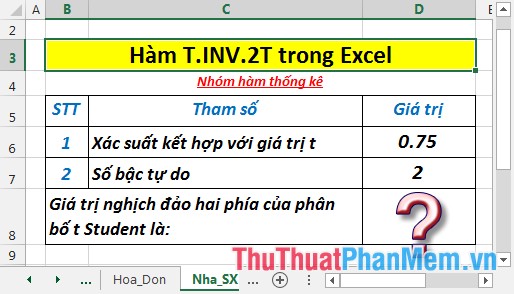
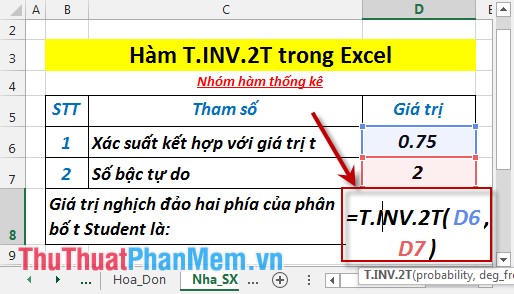
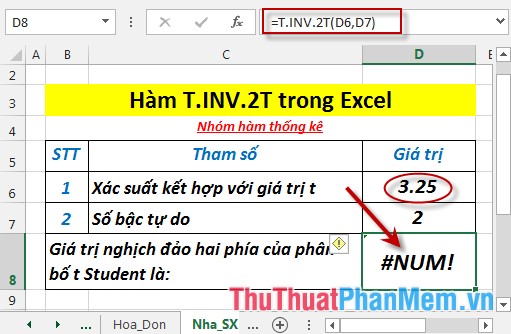
- In the cell to calculate, enter the formula : = T. INV.2T (D6, D7)
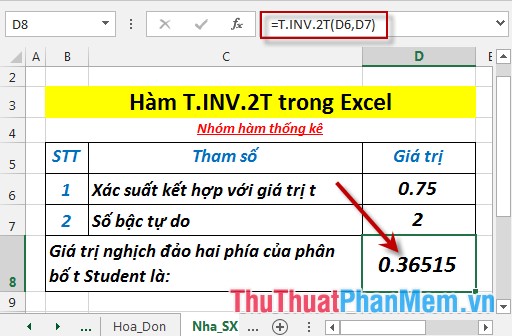
- Press Enter -> the two-tailed inverse value of the Student 's t-distribution is:
- If the number of degrees of freedom is less than 1 -> the function returns the #NUM! Error value
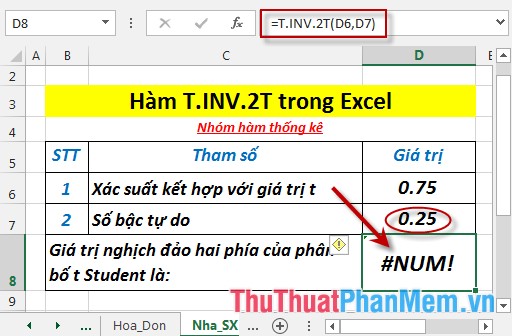
- Where the probability of combining with the t value is greater than 1 -> the function returns the #NUM! Error value
Above are instructions and some specific examples when using T. INV.2T in Excel.
Good luck!
FAQ
What should I know about T. INV.2T - the Function Returns the Two-sided Inverse of the Student's?
Focus on the key features, requirements, limitations, and practical use cases explained in this guide.
How do I get the best results with T. INV.2T - the Function Returns the Two-sided Inverse of the Student's?
Follow the recommended steps, use current software or information, confirm compatibility, and review settings before major changes.
Are there any risks or limitations?
Potential limitations depend on compatibility, data quality, cost, privacy, support, and how the product or method is used.





Reader Comments 0
Sign in with email or Google to join the discussion.