Table of Contents
AI is booming, but there's a power shortage. The report suggests that renewable energy is the most attractive investment in the AI era.
Over the past five years, venture capital funds have poured more than half a trillion dollars into AI startups. However, according to a new report from Sightline Climate, the most attractive investment opportunity in the current AI era may lie in the energy sector.
The reason is quite clear: AI is consuming enormous amounts of electricity, while the power supply infrastructure hasn't kept pace.
For more context before choosing a tool, compare Claude and ChatGPT and review these practical AI tools for students.
AI is booming, but there isn't enough electricity to meet the demand.
The report indicates that up to 50% of announced data center projects are at risk of delays, and one of the biggest reasons is power shortages.
Of the 190 gigawatts of data center capacity tracked in the U.S., only about 5 gigawatts are actually under construction. While an additional 6 gigawatts came online last year, 36% of projects have been delayed until 2025. This could have a ripple effect on businesses that rely on AI, as infrastructure resources fail to keep up with demand.
This imbalance between supply and demand actually creates great opportunities for investors. Large technology corporations like Google and Meta have begun investing heavily in renewable energy projects such as wind power, solar power, and even nuclear power.
They also invest in new technologies such as Form Energy's 100-hour battery storage, and collaborate with power companies to accelerate deployment.
Meanwhile, numerous startups are seeking solutions to the power problem. Some focus on power conversion technology, while others develop power management software to optimize the system.
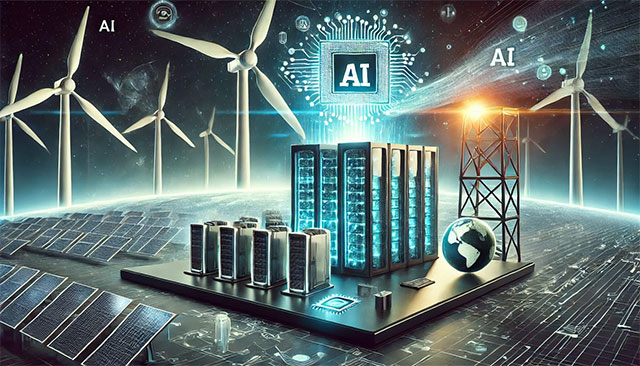
Electricity demand for AI will increase sharply.
According to Goldman Sachs, AI could increase data center electricity consumption by up to 175% by 2030. Meanwhile, the current power grid infrastructure is facing unprecedented overload, leading to higher electricity prices and forcing technology companies to seek alternative solutions.
Many large businesses are even considering building their own power sources instead of relying entirely on the national grid. Companies like Amazon, Google, and Oracle are gradually shifting to data center models that use on-site power or a combination of self-generated electricity and grid power.
A prime example is Google's new project in Minnesota, where the company combines wind power, solar power, and large-scale battery systems to ensure a stable power supply.
Simultaneously, the large-scale battery storage market is also booming. According to the US Energy Information Administration, total battery storage capacity in the US could reach nearly 65 gigawatts by the end of this year.
Beyond just the power supply, power management is also a major issue. Currently, most systems still use traditional transformers—a technology that has been around for over 100 years. While reliable, they are becoming increasingly cumbersome as data center power demands skyrocket.
In the future, when server power density reaches 1 megawatt per rack, the accompanying electrical equipment could occupy twice the space of the server itself. That's why investors are pouring money into solid-state transformer technology, using semiconductor components to replace the traditional iron-copper structure. Although the initial cost is higher, they are more flexible and can replace many devices simultaneously, optimizing overall costs.
Compared to the massive funding rounds in the AI sector, energy startups are still on a much smaller scale. But that's precisely what makes them more attractive to investors. With every sector electrifying—from transportation to industry—energy demand will continue to surge, regardless of whether AI cools down or not.
Therefore, a paradox is gradually emerging: The best investment in AI… may not be in the AI itself, but in the energy infrastructure behind it.
Related Articles
 How to Use All Items in Boom Mobile7 minutes read
 How to Receive Lucci Purple, Diamond and Gold in Boom Mobile5 minutes read
 How to See the Probability of Spin Characters3 minutes read
 How to Renaming Characters for Free in Boom M3 minutes read
 How to Installing and Playing Boom Mobile on Your Computer6 minutes read
 How to Unlock Characters in Boom Mobile4 minutes read
Reader Comments 0
Sign in with email or Google to join the discussion.