Table of Contents
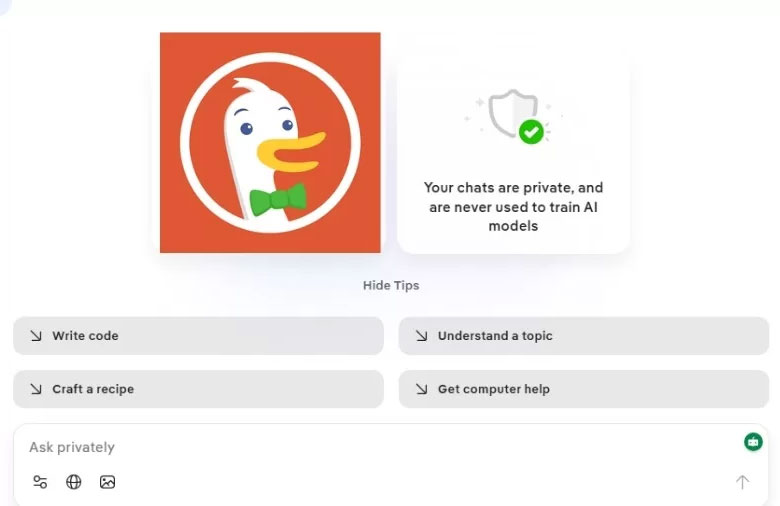
Don't want Big Tech to collect your data? Duck.ai lets you use powerful AI like ChatGPT while still maintaining your privacy.
AI chatbots can be incredibly useful: from finding information and generating ideas to assisting with tasks. But a major concern for many is privacy.
Major players like OpenAI, Google, and Meta are not known for absolutely protecting user data. When you type in a prompt, there's always a possibility that data could be used to build user profiles, serve advertisements, or track behavior.
Therefore, several alternatives are starting to gain attention — including Duck.ai.
For more context before choosing a tool, compare Claude and ChatGPT and review these practical AI tools for students.
Duck.ai: Chat with GPT but without worrying about data leaks.
Duck.ai is a chatbot developed by DuckDuckGo — a company known for its privacy-focused search engine.
Unlike having to 'trust completely' with large platforms, Duck.ai offers a different approach: you can still use powerful AI models, but without being tracked.
What's unique is that Duck.ai doesn't own its own AI models. Instead, it acts as an 'aggregator,' allowing you to select multiple different models within a single interface.
Users can use several models for free, such as the GPT-4o mini, GPT-5 mini, Claude Haiku, and Llama 4 Scout. Subscribing to a DuckDuckGo VPN package unlocks more advanced models like the GPT-5.2 and Claude Sonnet.
This saves you from switching back and forth between multiple platforms while keeping your entire conversation history in one place.
How Duck.ai protects privacy.
Duck.ai's greatest strength lies in its data processing methods.
When you send a prompt, DuckDuckGo removes all metadata before forwarding the request to the AI provider. This includes the IP address—a crucial element that helps companies identify users.
Therefore, even if you use models from OpenAI or Meta, these companies won't know who you are (unless you disclose the information yourself in the content).
Furthermore, DuckDuckGo is committed to not using your data to train its AI. Additionally, model providers are required to delete prompt data within 30 days (unless legally required).
Another interesting feature is that you can save your chat history without creating an account. Instead of saving it to a server, Duck.ai saves the data directly to your device (computer or phone). This means:
- No copy on the server
- No one but you can access it.
- You have the right to delete the data at any time.
Additionally, Duck.ai has a 'burn' button to quickly delete an entire conversation with a single click.
Despite its attractive privacy features, Duck.ai has some limitations. First, the free models are often not the latest version. If you need the most powerful and up-to-date AI, Duck.ai may not be able to meet your needs.
Even with a paid plan, models like GPT-5.2 have been surpassed by newer versions. Furthermore, the platform doesn't fully support all popular chatbots. Names like Gemini, Perplexity, and DeepSeek are currently unavailable.
Should you use Duck.ai?
If you're a general user who just needs a powerful chatbot to support your daily tasks and is particularly concerned about privacy, Duck.ai is a very worthwhile option to consider.
Conversely, if you need the latest, most powerful model, or depend on a specific ecosystem, you may still need to rely on traditional platforms.
Duck.ai demonstrates a new direction for AI: not only powerful, but also respectful of privacy. In a context where users are increasingly concerned about personal data, solutions like this could become the trend of the future.
Related Articles
 ChatGPT vs Microsoft Copilot: Which AI Is Best?16 minutes read
 Meta AI vs ChatGPT (2026): Which Assistant Is Better?17 minutes read
 9 Key Differences Between ChatGPT and Bing's AI Chatbot: Top Picks and Buying8 minutes read
 DeepSeek vs ChatGPT: Comparing the Best AI Chatbots to Use11 minutes read
 Is Chatgpt Plus or Perplexity the Better AI Chatbot?9 minutes read
 Claude vs ChatGPT: Which AI Assistant Should You Use?10 minutes read
Reader Comments 0
Sign in with email or Google to join the discussion.