Table of Contents
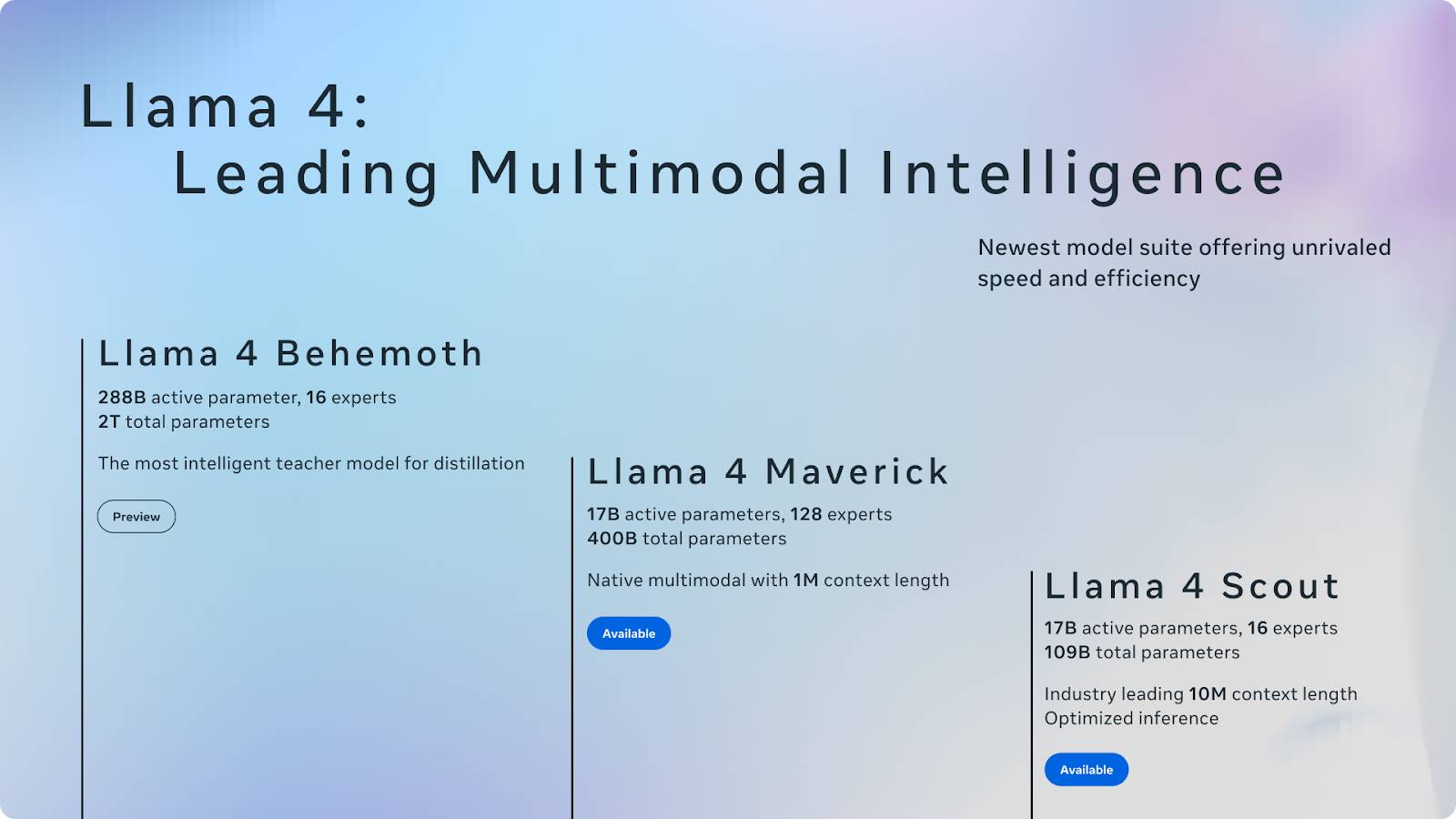
Meta released Llama 4 Scout and Llama 4 Maverick on April 5, 2025. Both are downloadable, open-weight, natively multimodal models that accept text and images and generate text or code. Meta also previewed a much larger teacher model called Llama 4 Behemoth, but did not release its weights in the launch announcement.
“Open-weight” is the precise description: users can obtain and adapt the weights under Meta's custom Llama 4 Community License, which is not the same as a conventional open-source software license.
| Model | Active / total parameters | Published context | Best fit |
|---|---|---|---|
| Llama 4 Scout | 17B / 109B | 10 million tokens | Long-document, codebase, and multimodal workloads when its lower total size is preferable |
| Llama 4 Maverick | 17B / 400B | 1 million tokens | General assistant, image understanding, creative writing, reasoning, and coding |
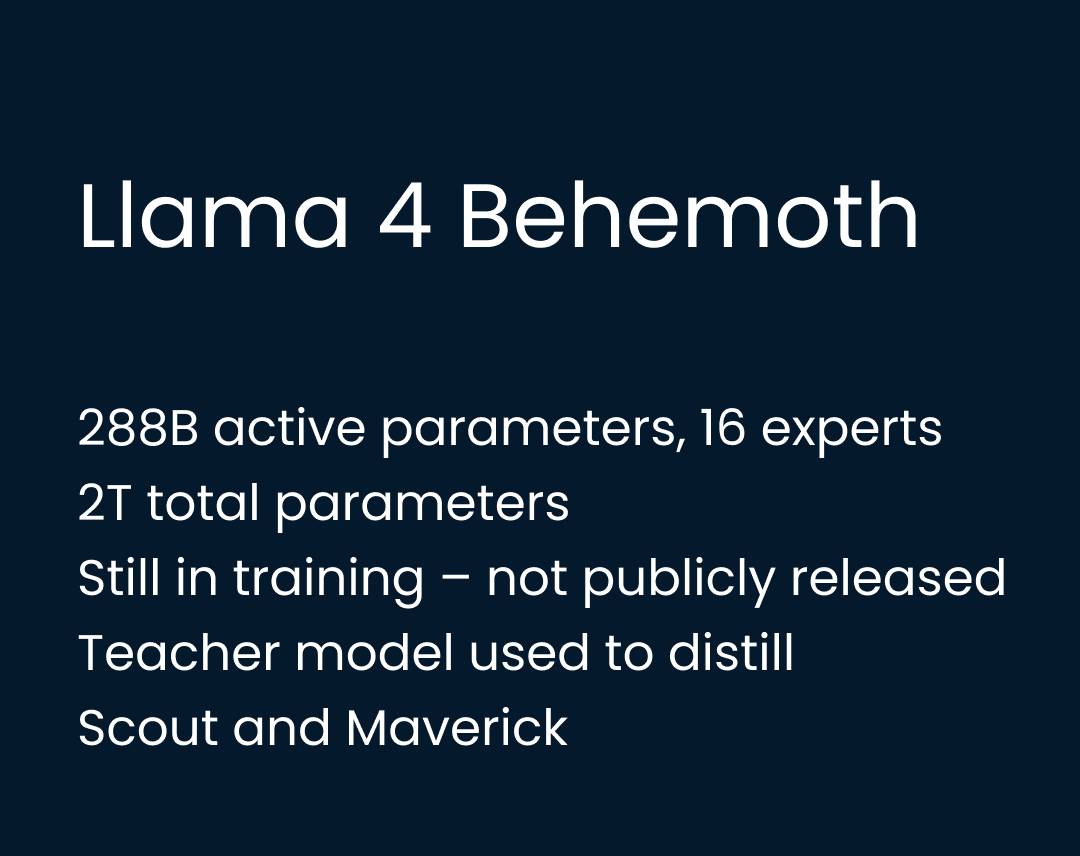
| Llama 4 Behemoth | 288B active / nearly 2T total, as previewed | Not released at launch | Teacher model used by Meta during development |
The Scout and Maverick figures above come from Meta's model cards. A maximum context window is a capability limit, not a promise that every serving stack can process that amount affordably or with consistent accuracy.
What changed in Llama 4?
Native text-and-image processing
Llama 4 uses early fusion, placing text and vision tokens in one model backbone during training. The instruction-tuned releases are intended for chat, visual question answering, image reasoning, captioning, and related text tasks. They generate text and code; they are not image generators.
Mixture-of-experts architecture
Scout and Maverick store many expert parameters but activate only a fraction for each token. Both use 17 billion active parameters, while Scout has 109 billion total parameters and Maverick has 400 billion. This can improve serving efficiency compared with activating the whole model for every token, but all weights still require storage and memory planning.
Multilingual support
The official model cards list 12 supported languages: Arabic, English, French, German, Hindi, Indonesian, Italian, Portuguese, Spanish, Tagalog, Thai, and Vietnamese. Meta says pretraining included more languages, but developers are responsible for evaluation and safeguards outside the explicitly supported set.
Llama 4 Scout
Scout is the smaller of the two released models. Its headline feature is a published 10-million-token context window. Meta says the model was trained and post-trained at 256K context and uses length-generalization techniques for longer inputs, so developers should test retrieval and answer quality at the lengths their application actually uses.
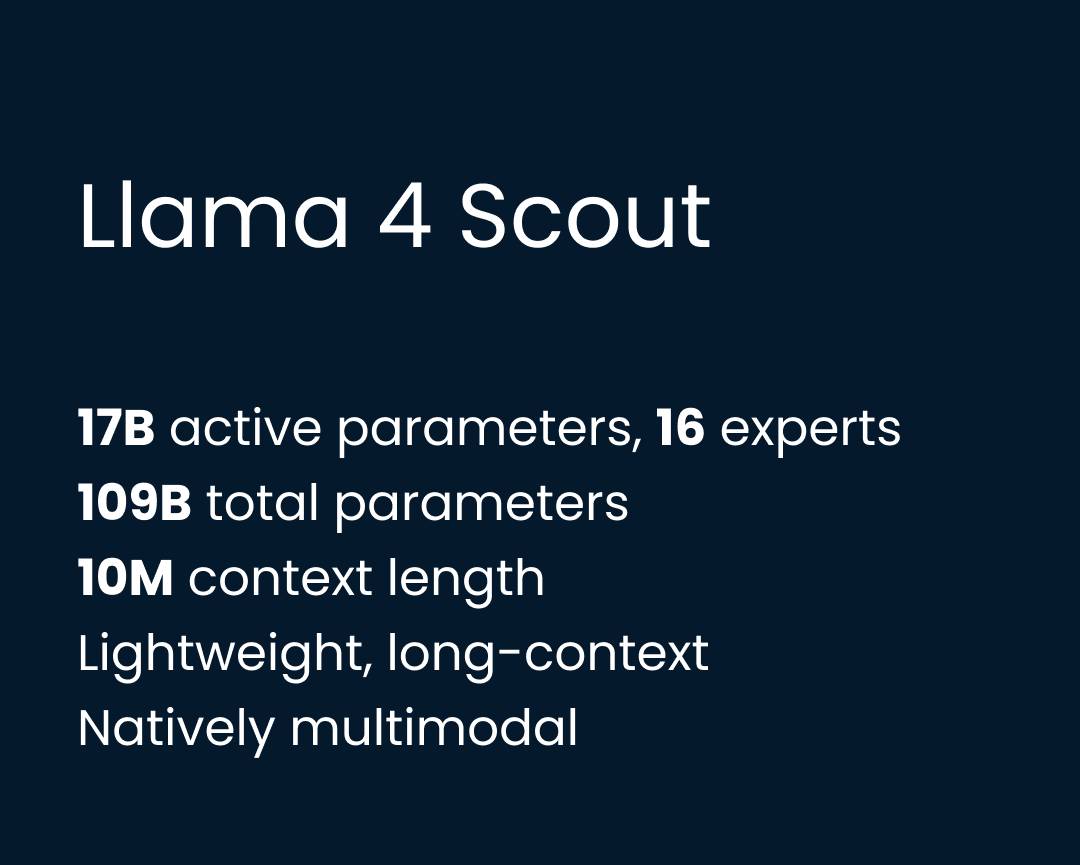
Meta's statement that Scout can fit on one NVIDIA H100 refers to Int4 quantization. That does not make it a typical laptop model. Runtime memory also depends on quantization, cache size, context length, batch size, and inference software.
Llama 4 Maverick
Maverick has 128 routed experts and 400 billion total parameters, with 17 billion active per token. Meta positioned it as the more capable general-purpose workhorse for text and image understanding. Its 1-million-token context is smaller than Scout's maximum but still large enough for many multi-document applications.
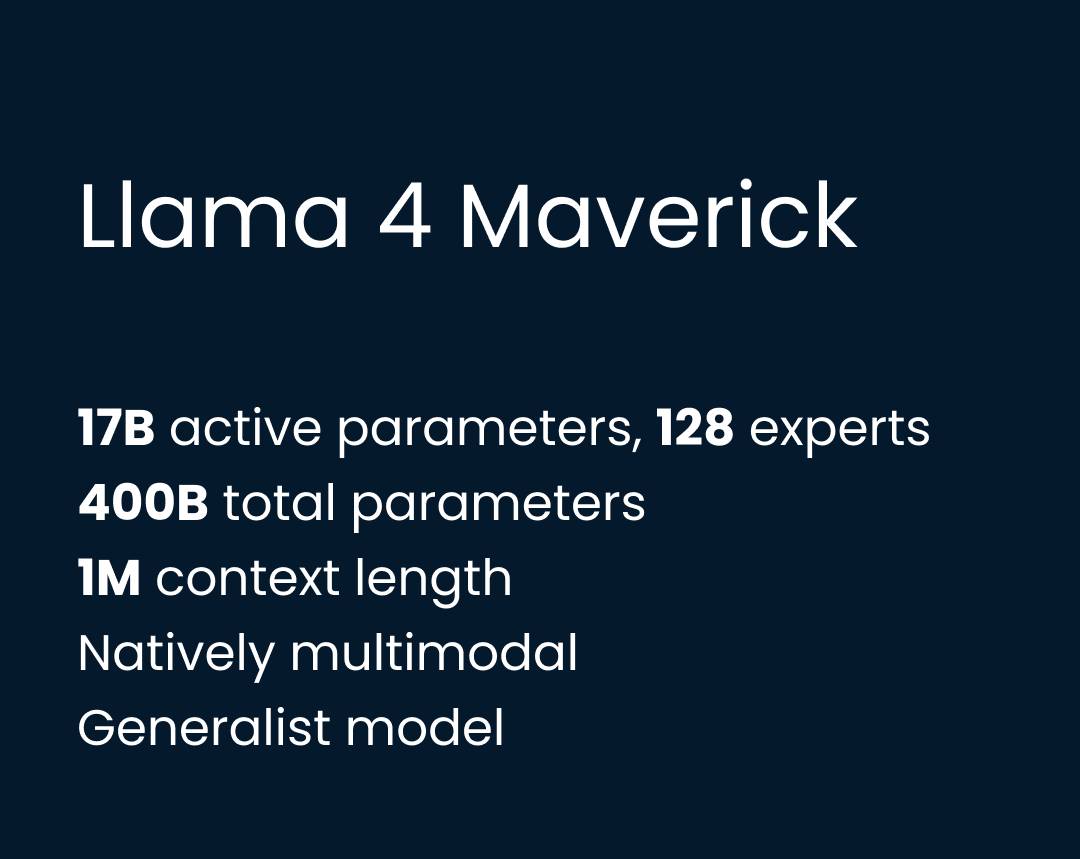
Meta says Maverick can run on a single H100 DGX host—a multi-GPU server—not a single H100 GPU. Teams evaluating self-hosting should calculate weight memory, key-value cache, concurrency, latency, and power costs before choosing it.
What about Llama 4 Behemoth?
At the original announcement, Behemoth was still in training and served as a teacher for the smaller models. Its specifications and benchmark images describe a preview, not a generally downloadable product. Do not plan a deployment around it unless Meta publishes weights, a model card, and licensing terms for a released checkpoint.
How to access Llama 4
Try a hosted Meta experience
Meta's launch post said Llama 4 powered Meta AI experiences on the web and in WhatsApp, Messenger, and Instagram Direct. The consumer product can change independently of the downloadable checkpoints, so it is not a controlled way to benchmark Scout or Maverick.
Download the model weights
Use Meta's official Llama download flow or the verified Meta Llama repositories on Hugging Face:
Access requires accepting the license and may require sharing contact information with Meta. Follow the model card's current framework and hardware instructions instead of copying an old installation snippet.
Use a cloud or inference provider
A provider can remove the need to own large GPU systems, but it introduces different costs and data-handling questions. Confirm the exact checkpoint, quantization, context limit, regional availability, retention policy, and rate limits.
Understand the license before deployment
The Llama 4 Community License allows broad research and commercial use subject to its terms and acceptable-use policy. Redistribution requires notices and “Built with Llama” attribution. It also contains naming requirements for certain models improved with Llama materials.
A separate commercial term applies when a licensee or its affiliates had more than 700 million monthly active users in the month before the Llama 4 release date: those organizations must request a license from Meta and are not authorized until Meta grants one. Read the complete current license; this summary is not legal advice.
How to interpret Meta's benchmarks
The following graphics preserve Meta's launch comparisons for Scout, Maverick, and the Behemoth preview.
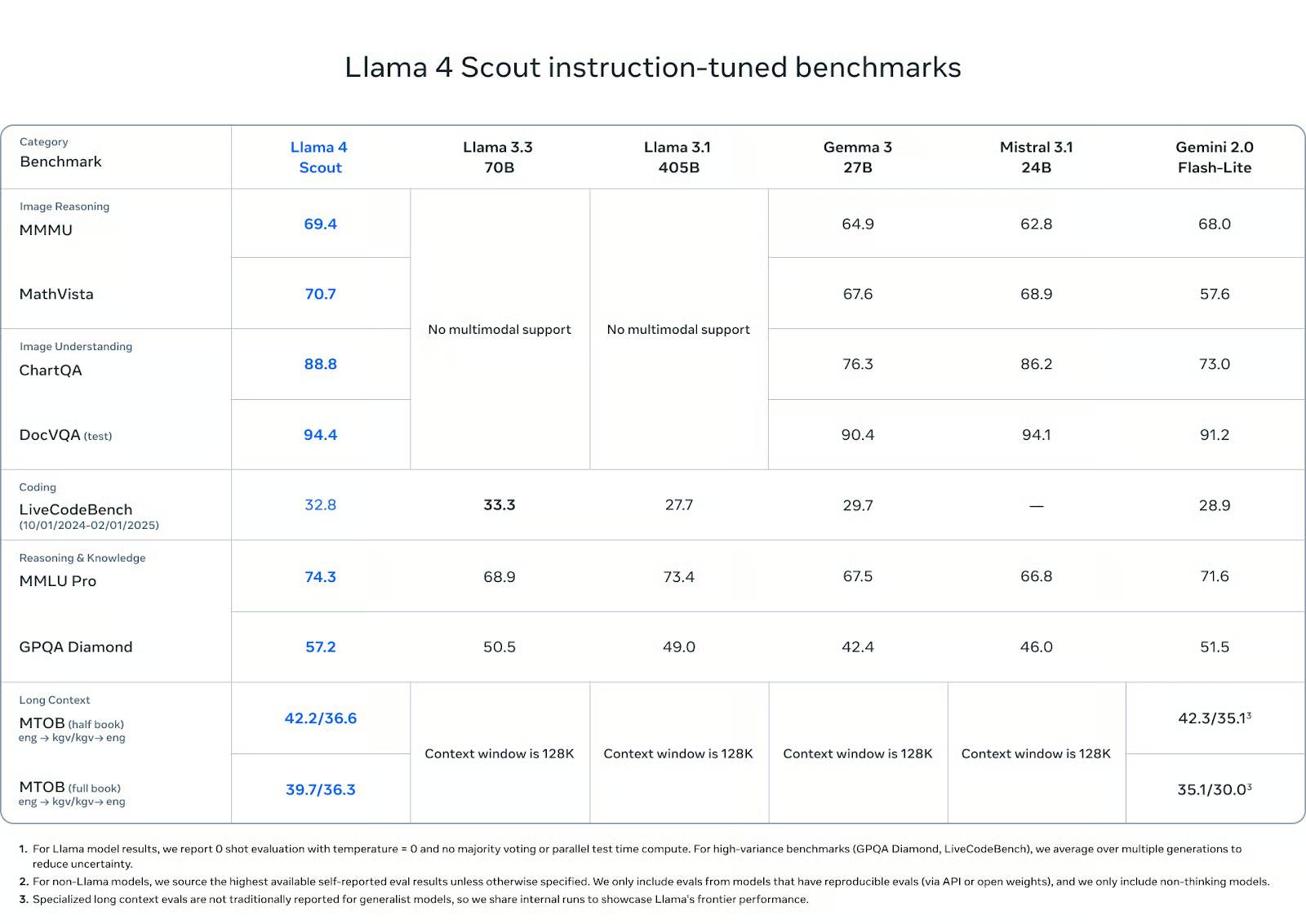
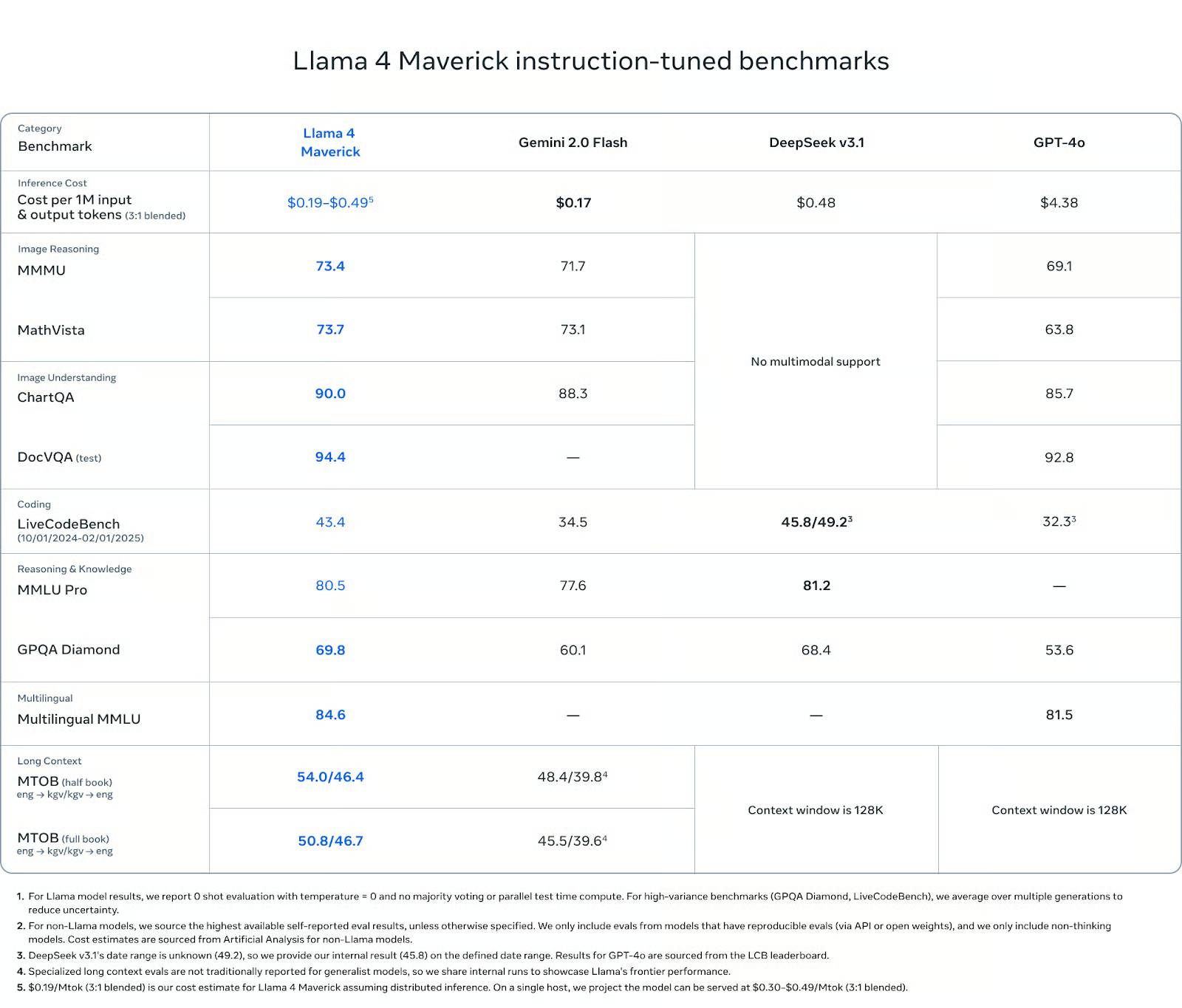
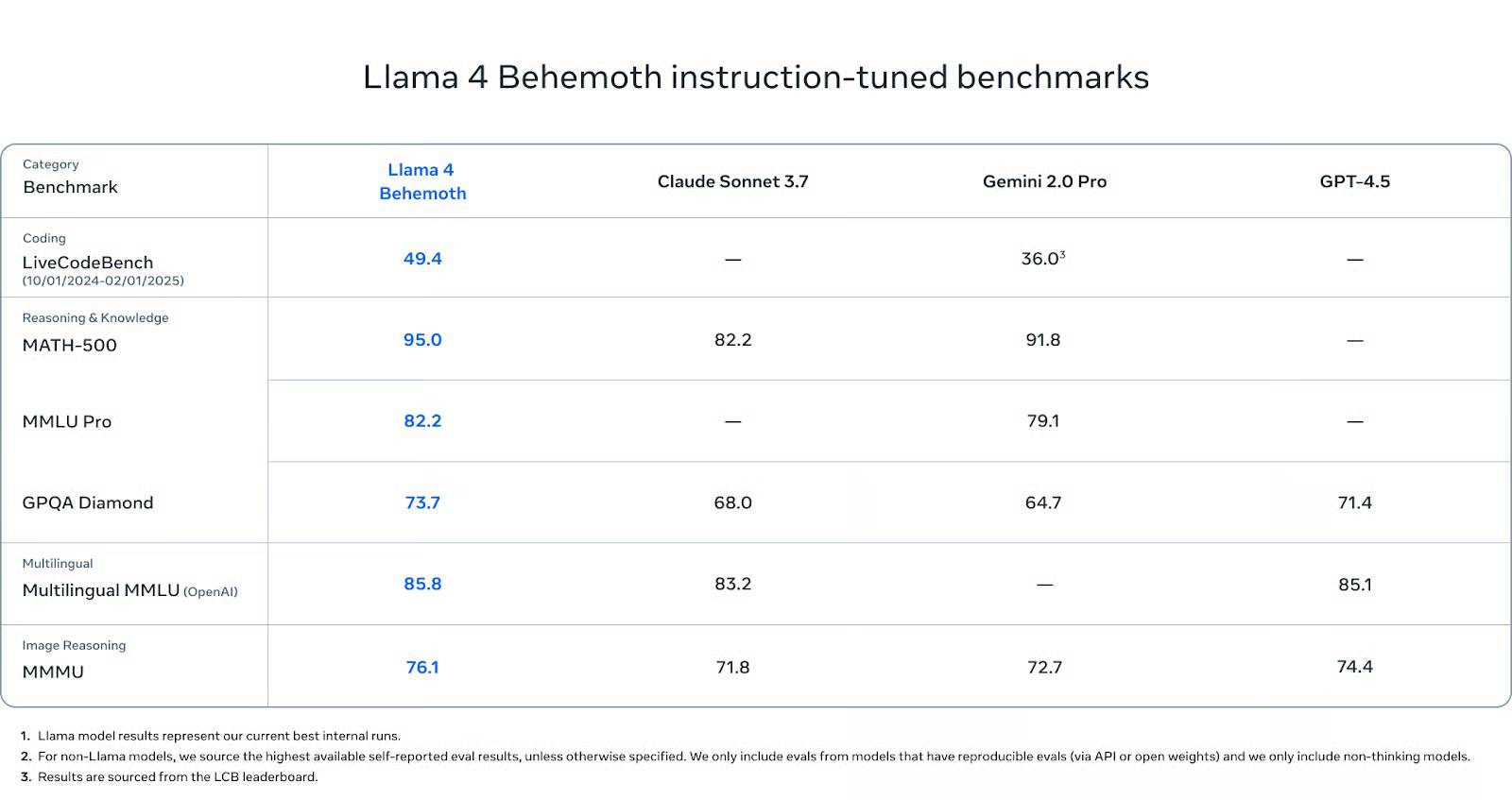
These are vendor-reported results from the 2025 release and compare models available at that time. Benchmark score, prompt format, inference settings, and evaluator design all affect results. Run a representative evaluation with your own documents, languages, latency requirements, safety policy, and budget before selecting a model.
Deployment checklist
- Choose Scout for context-heavy work only after testing retrieval quality at the required length.
- Choose Maverick when broader multimodal capability justifies the larger stored model.
- Verify hardware and serving-software support for the exact checkpoint and quantization.
- Review the license, acceptable-use policy, attribution, and model naming rules.
- Add application-level input, output, privacy, and abuse safeguards; model weights alone are not a complete product.
- Evaluate hallucination, bias, prompt injection, data leakage, and task-specific failure modes before production use.
Meta's Llama 4 launch article and the individual model cards are the primary references for the specifications above.
Related Articles
 The Latest Features in Meta Llama AI's Major Upgrade: What You Need to Know6 minutes read
 What Is a Llama? Why Is It Important?12 minutes read
 Qualcomm Partners with Meta to Bring Llama 2 to Smartphones and PCs4 minutes read
 Meta Launched Llama 3, Claiming to Be the Top AI Platform Available: Top Picks6 minutes read
 Meta Starts Releasing Llama ''super Ai'' Language Model to Researchers4 minutes read
 What Is Llama 2? How to Use Llama 2?6 minutes read
Reader Comments 0
Sign in with email or Google to join the discussion.