Japan launches Buddharoid – an AI 'monk' robot capable of preaching.
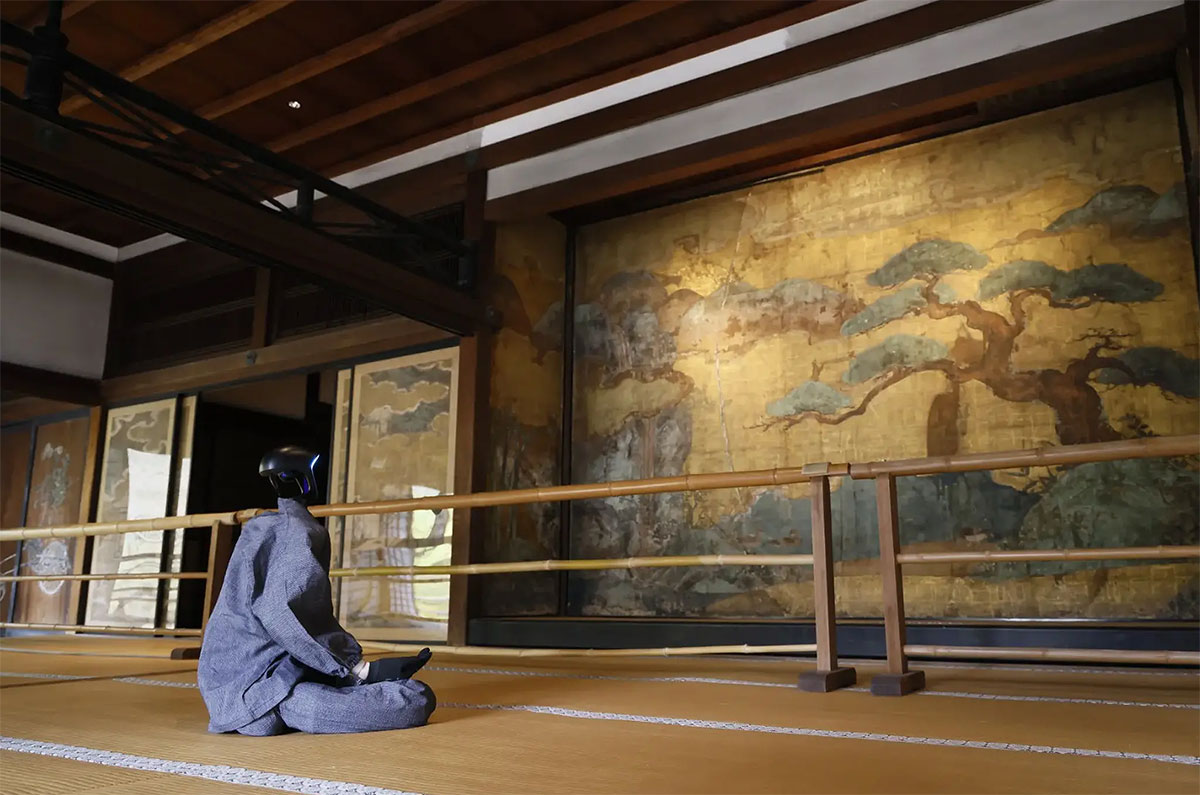
Researchers at Kyoto University introduced Buddharoid, an AI-integrated Buddhist monk robot capable of conversing and offering spiritual advice, at Shoren-in Temple in Kyoto.
Table of Contents
A new technology-religion project at Kyoto University is attracting attention with the introduction of Buddharoid—a Buddhist monk robot integrated with artificial intelligence. The robot was recently unveiled at Shoren-in Temple in Kyoto.
The project was developed by a research team at Kyoto University, in collaboration with two technology companies, Teraverse and XNOVA. Their goal was to create a robot that could assist monks in the context of Japan's declining traditional religious system.
Robots can converse and offer spiritual advice.
Buddharoid is powered by an AI system called BuddhaBot-Plus, an artificial intelligence model developed based on ChatGPT.
This system is extensively trained in Buddhist scriptures, allowing the robot to understand and discuss personal or social issues from a Buddhist perspective. As a result, Buddharoid can offer spiritual advice, much like a monk conversing with Buddhists.
In addition to its conversational abilities, the robot is equipped with hardware developed by Unitree Robotics. Thanks to this, Buddharoid can perform typical actions of a monk, such as walking slowly, bowing, or performing the gassho gesture—hands clasped in front of the chest during prayer.
Japanese Buddhism is changing in the digital age.
The appearance of a 'robot monk' is not just a technological demonstration. In fact, it is seen as a solution to adapt to social changes in Japan.
Over the years, the country has been facing a declining population and a decrease in religious devotion. This has made it difficult for many traditional religious establishments to remain operational. According to some forecasts, around 30% of Buddhist temples in Japan could disappear before 2040.
The aging population also makes it difficult for many temples, especially in rural areas, to find successors to continue religious activities.
Technology and spirituality are increasingly intersecting.
Buddharoid is not the first time robotic technology has been introduced into religious spaces in Kyoto.
Previously, in 2019, Kodai-ji Temple introduced Mindar, a humanoid robot representing Kannon Bodhisattva—the Bodhisattva of compassion.
The Mindar robot primarily plays back pre-recorded sermons. Buddharoid, on the other hand, was developed with a more ambitious goal: to enable direct dialogue and real-time interaction with attendees.
Developers argue that robots with human-like physical forms and gestures will create a stronger sense of presence compared to on-screen chat applications or augmented reality technology.
In the context of rapidly developing AI technology, projects like Buddharoid demonstrate how the boundaries between technology, culture, and religion are becoming increasingly fluid — especially in a country known for its blend of tradition and innovation like Japan.
Was this article helpful?
Your feedback helps us improve.
Related Articles
 Japan develops 'monk' version of a new generation robot with many 'strange' improvements2 minutes read
 What is Monk Mode? How to use monk mode to complete goals8 minutes read
 The giant robot war between the US and Japan will take place on October 182 minutes read
 Giant Robot War: America wins Japan2 minutes read
 Japan introduced assistant robots for the Olympics 20205 minutes read
 Xiaomi launched the vacuum cleaner robot Mi Robot 1S capable of memorizing maps, scanning each room according to the installation schedule2 minutes read
Reader Comments 0
Sign in with email or Google to join the discussion.