Table of Contents
AI-powered predictive maintenance uses equipment data to identify signs of wear or abnormal operation before a machine fails. Instead of repairing equipment only after a breakdown or servicing every asset on a fixed calendar, maintenance teams can prioritize work according to the machine's condition and the risk of failure.
The approach can reduce unplanned downtime and unnecessary inspections, but it is not automatic. Useful results depend on reliable sensors, accurate maintenance records, models suited to each asset, and technicians who can verify and act on an alert.
From reactive repairs to condition-based decisions
Industrial equipment can be monitored through vibration, temperature, electrical current, pressure, sound, oil quality, and other signals. Software establishes a normal operating range and looks for changes that may indicate looseness, misalignment, overheating, leaks, or component degradation.
A predictive system typically follows this process:
- Collect sensor readings and maintenance history.
- Clean and synchronize data from different systems.
- Detect an anomaly or estimate the likelihood of a failure.
- Combine the alert with the asset's criticality and operating schedule.
- Create an inspection or maintenance recommendation.
- Record the technician's finding so the model and workflow can improve.
An alert should support a maintenance decision, not replace engineering judgment. A false alarm wastes labor, while a missed warning can still lead to a costly shutdown.
Examples in manufacturing and process industries
Volkswagen has deployed AI across its production network and connected factories through its Digital Production Platform with Amazon Web Services. One application, KI4UPS, is described as helping workers diagnose electronic faults without searching manually through extensive documentation.
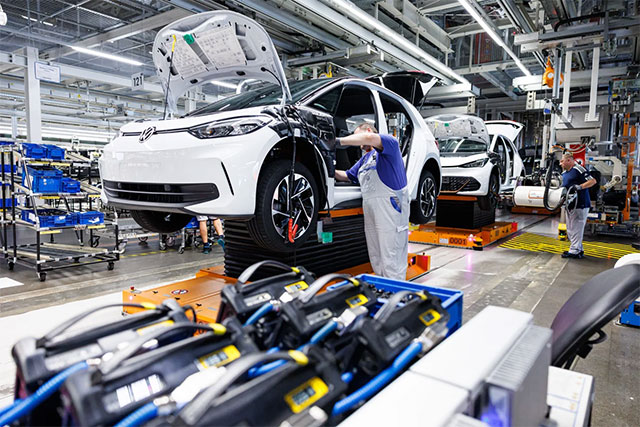
At a large automotive plant, an unexpected line stoppage can affect many downstream processes. Standardizing factory data makes it easier to reuse monitoring and diagnostic tools across locations, although machines still require asset-specific thresholds and validation.
William Grant & Sons has also been cited as a user of IFS Resolve for plant maintenance. The platform combines engineering information with sensor and technician data. Its supplier says the system can analyze sources such as diagrams, audio, video, pressure, and temperature, then help route work to an appropriate technician. Savings estimates supplied for such deployments should be understood as projections or vendor-reported results unless independently audited.
Robots can extend inspection coverage
Mobile robots can collect condition data in areas that are repetitive, difficult, or hazardous for people to inspect. Boston Dynamics' Spot robot, for example, can carry thermal cameras, acoustic sensors, and conventional cameras.
A robot may detect an unusual heat pattern, listen for a compressed-air leak, or read an analog gauge. The collected data can then be analyzed by a maintenance platform. This does not eliminate the need for technicians: people still define safe routes, confirm anomalies, isolate equipment, and perform repairs.
Predictive maintenance and energy use
Equipment faults often waste energy before they cause a breakdown. A poorly operating fan, pump, cooling unit, or compressed-air system may draw excess power while still appearing functional. Monitoring energy alongside condition data can reveal both maintenance and efficiency problems.
Schneider Electric's Energy Command Centre is an example of a platform that combines data from building systems such as cooling, lighting, and data-center infrastructure. Case studies from Schneider and its customers report lower electricity use, fewer manual inspections, and reduced operating costs, but results vary with the site's baseline, equipment, and measurement method.

Common implementation problems
Incomplete or inconsistent data
Older equipment may lack sensors or use proprietary interfaces. Even newer facilities can have inconsistent asset names, missing maintenance records, or readings stored at different intervals. Data preparation is often a larger job than training the model.
Too many alerts
A model that flags every small deviation quickly loses the trust of technicians. Alerts need severity levels, evidence, and a clear recommended inspection. Teams should track which alerts led to confirmed faults and adjust thresholds accordingly.
Limited failure examples
Serious failures are relatively rare, which is good for operations but difficult for supervised machine learning. Anomaly detection, engineering rules, simulations, and knowledge from similar assets may be needed when labeled examples are scarce.
Workflow and security gaps
An accurate prediction has little value if it never reaches the person who schedules or performs the work. The system should connect with existing asset-management processes and maintain an audit trail. Connected sensors and robots also expand the cyber-security surface, so access controls and network segmentation are essential.
A practical rollout plan
Start with a small group of critical assets where a failure has a clear operational cost and where useful condition data is already available. Establish baseline performance, define how an alert will be verified, and measure outcomes such as avoided downtime, inspection hours, false positives, and repair lead time.
After the pilot, expand only the parts that show reliable value. Models should be monitored for drift when equipment, production schedules, or operating conditions change.
Edge computing can shorten response times by processing sensor data near the machine, while private 5G may improve connectivity in some facilities. Neither technology is required for every maintenance application; the architecture should match the speed, coverage, reliability, and security needs of the specific plant.
What makes predictive maintenance successful
The strongest programs combine three elements: trustworthy condition data, engineering knowledge, and a maintenance organization prepared to act. AI can help teams find patterns across more signals than a person could review continuously, but the business value comes from preventing a real failure or scheduling work more intelligently—not from the model alone.
Related Articles
 Predictive AI Explained8 minutes read
 How to Remove Words from Predictive Text on iPhone3 minutes read
 Industrial Dehumidifier Good Kind, Cheap?8 minutes read
 Solving the Problem of Electrical Maintenance: What Do Experts from5 minutes read
 Review 3 Best Industrial Vacuum Cleaners Today8 minutes read
 Which Time Is Reasonable for Automobile Maintenance: Car Maintenance4 minutes read
Reader Comments 0
Sign in with email or Google to join the discussion.