Table of Contents
This updated guide examines File: How to Import Models into Blender on PC or Mac and organizes the essential facts, background, and practical takeaways in clear American English.
Method 1of 2:
Importing Files
 Open Blender on your computer. The Blender icon looks like a blue dot inside an orange circle with three arms. You can find it on your Start menu on Windows or in your Applications folder on Mac.
 Click theFilemenu on the top-left. You can find this button on Blender's menu bar in the upper-left corner. It will open a drop-down menu.
 Hover overImporton the menu. A sub-menu will pop up with a list of the compatible file formats.
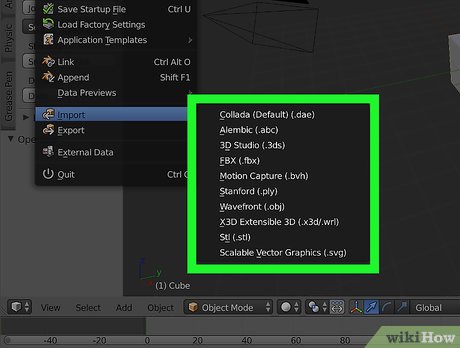 Select the format of the file you want to import. This will open Blender's file navigator, and allow you to select the file you want to import. Each of the following formats are supported:
- Collada (.dae) This is the default format.
- 3D Studio (.3ds)
- FBX (.fbx)
- Motion Capture (.bvh)
- Stanford (.ply)
- Wavefront (.obj)
- X3D Extensible 3D (.x3d/.wrl)
- Stl (.stl)
- Scalable Vector Graphics (.svg)
 Find and select the file you want to import. Use Blender's file navigator panel to find your file, and click on its name.
 Click theImportbutton. You can find it above the Cancel button in the upper-right corner. This will instantly import and open the selected file in Blender.
Method 2of 2:
Importing Individual Objects
 Open Blender on your computer. The Blender icon looks like a blue dot inside an orange circle with three arms. You can find it on your Start menu on Windows or in your Applications folder on Mac.
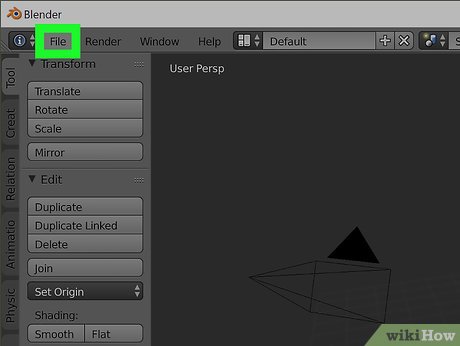 Click theFilemenu. This button is located on a menu bar in the upper-left corner. It will open a drop-down menu.
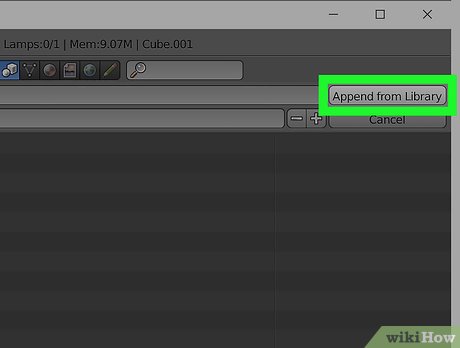
 ClickAppendon the File menu. This will open a new menu panel, and allow you to navigate the files on your computer to select the object to import.
- Alternatively, press⇧Shift+F1on your keyboard. This keyboard shortcut will open the Append menu.
 Find and click the blend file you want to import from. Use the file navigator in the Append window to find your blend file, and click on it to view its components.
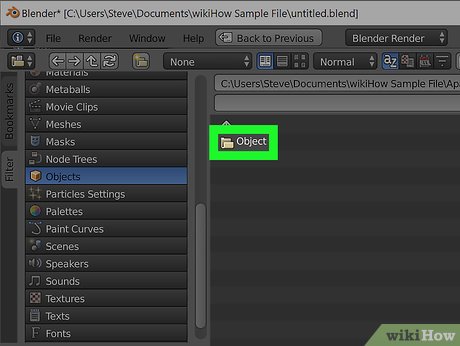 ClickObject. You'll see a list of categories of things that are inside this blend file. You can find all the objects in the Object folder here.
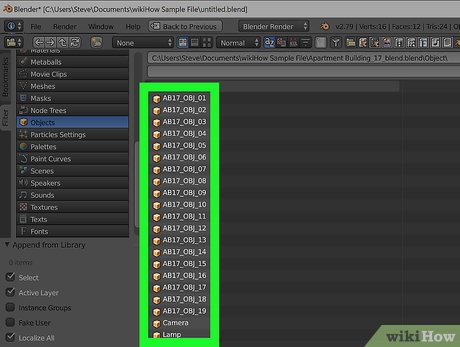 Select the object you want to import. Click on the object's name in the Append window to select it.
- Click theLoad Librarybutton. This button is in the upper-right corner of the Append window. It will import the selected object, and add it to your current project.
FAQ
What is File: How to Import Models into Blender on PC or Mac about?
It provides a structured overview of file, explains the main context, and highlights practical takeaways for readers.
Why does this topic matter?
Understanding the main concepts helps readers evaluate the issue, avoid common mistakes, and make better-informed decisions.
How should readers use this information?
Use the guidance as a practical starting point, confirm details that may have changed, and follow current product, safety, or security recommendations.
Related Articles
 Blender - Free and Powerful 3D Modeling Tool7 minutes read
 What's New in Blender 3.04 minutes read
 Common Mistakes When Using Blender and How to Fix It7 minutes read
![Is Osaka Blender Good: [Review] Is the Osaka Blender Good?](/data/thumbs_200x120/[review]-is-the-osaka-blender-good_thumbs_200x120_5MHR2bTZg.jpg) Is Osaka Blender Good: [Review] Is the Osaka Blender Good?8 minutes read
Is Osaka Blender Good: [Review] Is the Osaka Blender Good?8 minutes read A Few Notes That Help Extend the Life of the Blender8 minutes read
 How to Install Blender4 minutes read
Reader Comments 0
Sign in with email or Google to join the discussion.