Table of Contents
Format an external drive in File Explorer on Windows or Disk Utility on Mac. Choose exFAT for a drive you want to write to on both systems. Formatting removes access to existing files on the selected volume, so back them up elsewhere and confirm the drive's identity before you start.
Pick a file system for the devices you use
- NTFS: Use for a general-purpose Windows drive. macOS can usually read NTFS but does not write to it by default.
- APFS: Use for a drive intended for modern Macs. Check Mac OS Extended (Journaled) if you need compatibility with older macOS versions.
- exFAT: Use for a modern Windows and Mac shared drive, including large files. Check the manual before choosing a format for a camera, console, or TV. Some older devices require FAT32, which has a per-file limit of about 4 GB.
Format an existing external volume in Windows
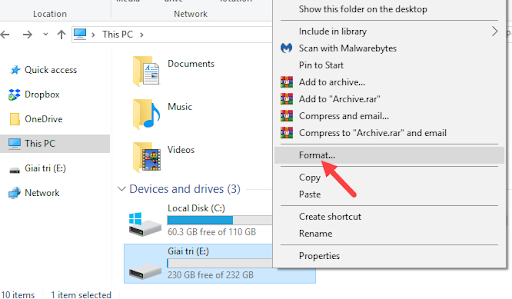
- Open File Explorer → This PC. Confirm the intended drive by label, capacity, and drive letter. Disconnect other removable drives if it is easy to confuse them.
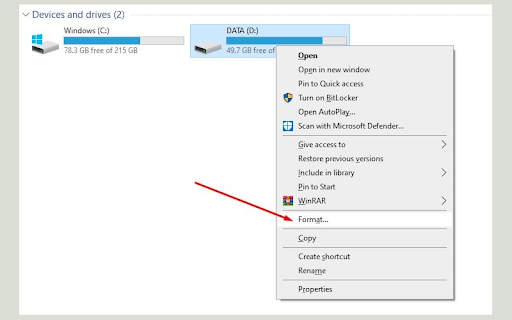
- Right-click the intended drive and choose Format. Select the file system, enter a recognizable label, and leave the allocation unit size at its default unless a device specifically requires something else.
- Recheck the target, start the format, and confirm. Afterward, copy a small test file to the drive and open it.

If the drive appears in Disk Management but has no drive letter, check the existing layout before choosing an action. The Windows storage guide explains physical disks, partitions, and volumes.
Erase an external drive in macOS Disk Utility
- Open Disk Utility and select View → Show All Devices.
- Select the external device by model and capacity to reformat the whole disk. Choose an existing volume only if that is the intended target. Click Erase.
- Choose a name and format. For a modern computer, use GUID Partition Map when formatting the whole device unless the destination specifies another scheme. Confirm and wait for the operation to finish.
See Apple's external storage instructions for the device and volume views.
When formatting is the wrong first step
For a nearly full system drive, start by recovering space safely. For a drive that disconnects or reports errors, protect your files first. If you are selling or donating a device, use the manufacturer's reset or media-sanitization guidance. A normal format alone does not guarantee that old data is unrecoverable.
Related Articles
 How to format the hard drive on Windows
 Top 10 free and easy-to-use hard drive dividers and formats
 How to format a hard drive into NTFS in Linux
 How to format and format a hard drive on a Windows computer
 How to Format a Hard Drive
 How to partition hard drive without losing data on Windows 10, 11 simply
Reader Comments 0
Sign in with email or Google to join the discussion.