Table of Contents
This article examines Google Released Android Oreo Go for Low-profile Smartphones. It presents the main facts, practical implications, and key points in a clearer, easier-to-follow format.
Understanding Google Released Android Oreo Go for Low-profile Smartphones
With more than 2 billion Android devices worldwide, this mobile OS has a big advantage. The Android Oreo Go version is intended to give users a better experience, regardless of hardware limitations when it is designed specifically for devices with 512MB to 1GB RAM.
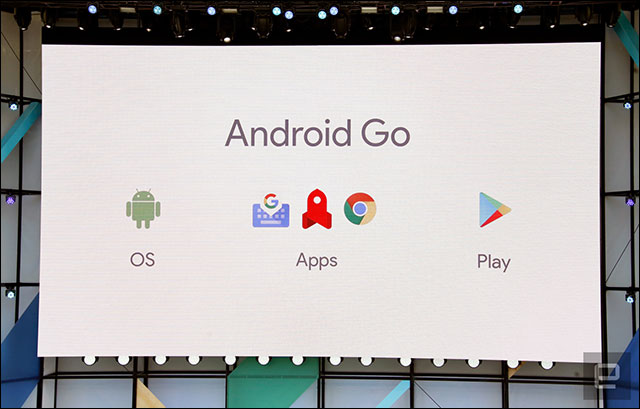
At the 2017 I/O event in May last year, Google announced Android Go - the optimal Android version for low-profile phones. Recently, they officially released Android Oreo Go Edition as part of the release of Android 8.1.
See also: Install Android Oreo now
Google made a statement about the new OS at an event in India - a potential market for their new Android operating system version. Android users are more in India than in the US, turning it into a big market, alongside other developing countries.
 Google targets the Indian market with this low-profile version of the device.
Accordingly, this OS will accelerate startup time to 30% and optimize storage space up to 2 times. These are thanks to three factors: The ROM for Oreo Go is only half the Nougat ROM, the application suite is half lighter than usual and the Play Store Go has a new section that introduces its own applications for Low-profile device, such as Lite versions. Of course, you can still download the normal version.
 Expected to have devices running Android Oreo Go early next year.
Applications preinstalled on Go include Google Go, Google Assistant Go (previously only available on 1.4GB RAM phones or above), YouTube Go, Google Maps Go, Gmail Go, Gboard, Google Play, Chrome and Files Go. Applications are said by Google to be 50% smaller and 15% faster than normal. Google Go is less than 5MB and Chrome automatically turns on Data Saver.
Applications on the Go will also 'update lighter', it is unclear how much less often. Android Go has features that save data, memory for both OS or Chrome, and file management tools, cleaning up memory like Files Go. This application can be installed separately and run on a machine other than the Go version.
In general, the changes are not too big compared to the official Android version, but anyway it is helpful for users using low-profile devices.
See also: Android 10 years old, 10 times surprised the world.
FAQ
What is the main point of Google Released Android Oreo Go for Low-profile Smartphones?
With more than 2 billion Android devices worldwide, this mobile OS has a big advantage. The Android Oreo Go version is intended to give users a better experience, regardless of hardware limitations when it is designed specifically for devices with 512MB to 1GB RAM.
Why is Google Released Android Oreo Go for Low-profile Smartphones important?
Google Released Android Oreo Go for Low-profile Smartphones matters because it can affect how readers understand, choose, use, or respond to the subject discussed in the article.
What should readers verify about Google Released Android Oreo Go for Low-profile Smartphones?
Check the date, product or software version, compatibility, and any current guidance before acting, especially when technology, security, health, or pricing is involved.
Related Articles
 Google Is About to Launch Android 9 Pie (Go Edition) for Low-end Smartphones3 minutes read
 Emulator Android 8.1 Oreo Running Windows Launcher Was Officially Released, Invited to Experience3 minutes read
 Google Officially Launched Android O 8.03 minutes read
 5 Certain Tricks Must Know If You Are Using Android 8 Oreo7 minutes read
 List of Xiaomi Smartphones to Android 8 Oreo and Android 9 Pie3 minutes read
 How to Customize Battery Saving Mode on Android Oreo6 minutes read
Reader Comments 0
Sign in with email or Google to join the discussion.