Table of Contents
Research shows that ChatGPT is inconsistent when answering the same question multiple times and struggles to determine correctness.
ChatGPT can provide very fluent and convincing answers, but a new study shows that the system still struggles to determine what is true.
Professor Mesut Cicek from Washington State University and his colleagues tested ChatGPT by incorporating hypotheses derived from scientific studies. The AI's task was to determine whether those hypotheses were supported by research evidence—in other words, whether they were true or false.
In total, the research team tested over 700 hypotheses, and each hypothesis was entered into the system up to 10 times to assess the consistency of the responses.
For more context before choosing a tool, compare Claude and ChatGPT and review these practical AI tools for students.
The accuracy is not yet truly reliable.
In the first experiment in 2024, ChatGPT answered approximately 76.5% of the questions correctly. When the study was repeated in 2025, this number increased slightly to 80%.
However, when the element of random guessing is removed, the results are far less promising. The actual performance of the AI is only about 60% higher than that of random guessing, which is considered quite low by academic standards.
In particular, the system faces significant difficulties in identifying false statements. The rate of correctly identifying inaccurate information is only about 16.4%.
Another notable issue is inconsistency. According to Professor Cicek, when the same question is asked multiple times, ChatGPT doesn't always provide the same answer. In about 73% of cases, the answer remains consistent, but the rest vary.
There are situations where the same question receives a series of alternating 'true – false – true – false' responses. In some cases, the number of 'true' and 'false' answers is even when repeated multiple times.
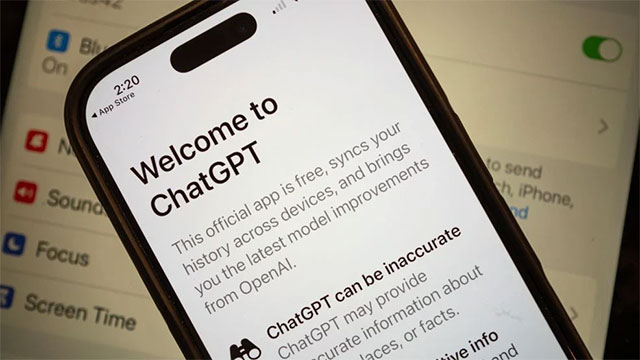
AI speaks well but doesn't truly 'understand' yet.
The research, published in the Rutgers Business Review, highlights a crucial point: the ability to generate smooth language does not necessarily mean that AI truly understands the issue.
According to Cicek, current AI systems lack the ability to think like humans. They primarily rely on memorizing and processing data, thereby generating answers that seem plausible but are not always accurate.
This suggests that generalized artificial intelligence (AGI) — with its true reasoning capabilities — may still be a long way from what many people expect.
The study involved many leading scientists. The team analyzed 719 hypotheses from scientific research papers in the business field published since 2021. Determining whether a hypothesis is proven is inherently complex, as it depends on many different factors.
In the experiment, the team used ChatGPT-3.5 in 2024 and ChatGPT-5 mini in 2025. The results showed no significant difference between the two versions.
The research reveals a key limitation of large-scale language models: while they can generate polished and persuasive answers, they struggle with deep reasoning. This leads to situations where AI can draw conclusions that sound plausible but are actually incorrect.
Why caution is needed when using AI.
Based on these findings, researchers recommend that users—especially managers and business leaders—verify information provided by AI, rather than blindly trusting it.
They also emphasized the importance of educating users to understand the strengths and limitations of AI.
Although the research focused on ChatGPT, similar tests with other AI systems yielded similar results. Previously, a 2024 survey also showed that consumers tend to be less interested in products when they are heavily promoted using AI.
Related Articles
 Does ChatGPT Have Plagiarism?7 minutes read
 How to Always Get Perfect Replies from ChatGPT with These 7 Prompts10 minutes read
 Question.AI: What You Need to Know11 minutes read
 When Asked 'Why Should We Choose You', This Guy's Unresponsive3 minutes read
 How Do We Know That AI or Supercomputers Can Solve Problems That Humans?7 minutes read
 NotebookLM vs ChatGPT: Which AI tool is better?18 minutes read
Reader Comments 0
Sign in with email or Google to join the discussion.