 Home
Home
 Wifi Tips
 Fix Computer
 Windows 10
 Windows 11
 Artificial Intelligence
 Space Science
 Strange story
Arithmetic pointer in C / C ++
As explained in the main chapter, the cursor in C / C ++ is an address, which is a numeric value. Therefore, you can perform arithmetic operations on a pointer as you would with numeric values. There are 4 arithmetic operators that can be used on pointers: ++, -, +, and -.
As explained in the main chapter, the cursor in C / C ++ is an address, which is a numeric value. Therefore, you can perform arithmetic operations on a pointer as you would with numeric values. There are 4 arithmetic operators that can be used on pointers: ++, -, +, and -.
To understand arithmetic pointers, we assume that contro is an integer pointer that points to 1000 addresses. Assuming an integer of 32 bits, we perform the arithmetic operation on this pointer:
contro ++
Now, after the above operation, the contro will point to position 1004 because each contro is incremented by one, it will point to the next integer which is the next 4 bytes of the current position. This will move the cursor to the next memory location without affecting the actual value at the memory location. If contro points to a character whose address is 1000, then the above operation will point to position 1001 because the next character will be at 1001.
Increase a Cursor in C / C ++
We prefer to use a pointer in the program instead of using an array because the variable pointer can increase, unlike the array name, cannot be increased, because it is a constant pointer. The following program increases the variable pointer to access each element of the array:
#include using namespace std ; const int MAX = 3 ; int main () { int mang [ MAX ] = { 10 , 100 , 200 }; int * contro ; // bay gio chung ta co mot mang dia chi trong con tro. contro = mang ; for ( int i = 0 ; i < MAX ; i ++) { cout << "Dia chi cua mang[" << i << "] = " ; cout << contro << endl ; cout << "Dia chi cua mang[" << i << "] = " ; cout << * contro << endl ; // tro toi vi tri tiep theo contro ++; } return 0 ; }
Running the above C / C ++ program will produce the following results:

Reducing a Cursor in C / C ++
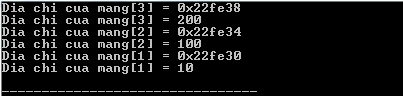
The following program to reduce a pointer, which will reduce its value by the number of bytes of the data type as follows:
#include using namespace std ; const int MAX = 3 ; int main () { int mang [ MAX ] = { 10 , 100 , 200 }; int * contro ; // bay gio chung ta co dia chi cua phan tu cuoi trong con tro. contro = & mang [ MAX - 1 ]; for ( int i = MAX ; i > 0 ; i --) { cout << "Dia chi cua mang[" << i << "] = " ; cout << contro << endl ; cout << "Dia chi cua mang[" << i << "] = " ; cout << * contro << endl ; // tro toi vi tri o truoc contro --; } return 0 ; }
Running the above C / C ++ program will produce the following results:
Compare Pointer in C / C ++
Pointers can be compared using relational operators, like ==, <, and>. If p1 and p2 point to variables that are related to each other, such as elements of the same array, then p1 and p2 can be compared meaningfully.
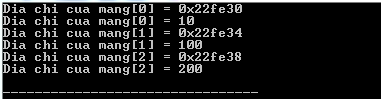
The following program modifies the previous example by increasing the variable pointer so that the address it points to is less than or equal to the address of the last element of the array, & var [MAX - 1]:
#include using namespace std ; const int MAX = 3 ; int main () { int mang [ MAX ] = { 10 , 100 , 200 }; int * contro ; // bay gio chung ta co dia chi cua phan tu dau tien trong con tro. contro = mang ; int i = 0 ; while ( contro <= & mang [ MAX - 1 ] ) { cout << "Dia chi cua mang[" << i << "] = " ; cout << contro << endl ; cout << "Dia chi cua mang[" << i << "] = " ; cout << * contro << endl ; // tro toi vi tri o truoc contro ++; i ++; } return 0 ; }
Running the above C / C ++ program will produce the following results:
According to Tutorialspoint
Previous article: Cursor NULL in C / C ++
Next article: Cursor NULL in C / C ++
 Jessica Tanner
- Cursor this in C ++
- The way to teach children fast mental arithmetic of Japanese people
- Cursor in C
- How to use Head Pointer on a Mac
- How to fix the mouse pointer disappearing on Windows 10
- Cursor NULL in C / C ++
- How to change the mouse pointer on Windows 11 with many styles and colors
- How to change the mouse pointer size and style in Windows 11
- Cursor and Array in C ++
- C ++ exercises have solutions (sample code) for variables, data types, and operators
- Operator overload and Load overlap in C ++
- Instructions for installing Dev-C ++
- Cursor this in C ++
- Dynamic memory in C ++
- Preprocessor in C ++
- How to install C-Free to program C/C++ on Windows
- Overload the one-seat operator in C ++
- Web programming in C ++


-
 How to change laser pointer color on PowerPoint - Mouse pointer effect
-
Instructions to change mouse cursor on Windows 11
-
How to turn off mouse acceleration on Windows 11
-
Why is the mouse cursor tilted and not straight?
-
How to Fix Lost Mouse Pointer on Laptop Screen?
-
How to change mouse pointer on Google Chrome - Personalize mouse pointer
 How to change laser pointer color on PowerPoint - Mouse pointer effect
 Instructions to change mouse cursor on Windows 11
 How to turn off mouse acceleration on Windows 11
 Why is the mouse cursor tilted and not straight?
 How to Fix Lost Mouse Pointer on Laptop Screen?
 How to change mouse pointer on Google Chrome - Personalize mouse pointer
 Program
 Unix and Linux
 SQL Server
 SQL
SQL Python
 Programming C
 PHP
PHP NodeJS
 MongoDB
 jQuery
 JavaScript
 HTTP
HTTP HTML
HTML Git
Git Database
 Data structure and algorithm
 CSS and CSS3
 C ++
C ++ C #
C # AngularJS
 System
 Mac OS X
 Hardware
 Game
Game Tech info
 Technology
 Science
 Life
Life Application
 Electric
 Mobile