Table of Contents
A house address sounds simple, but how should you read it if there are more alleys or punctuation marks? This guide explains you on how to read a house address with / and alleys and punctuation marks!
A house address Sounds simple, but how should you read it if there are more alleys or punctuation marks? This article will guide you On how to read a house address with / And alleys and punctuation marks!
What is the address?
Home address is a familiar concept to all of us, but not everyone knows its exact definition as well as how to read and write the address of a lane, group, village, hamlet, etc.
Address is information used to let others know where you live. A home address indicates the location of a specific building, apartment, condominium, or plot of land. A basic home address usually includes the house number, neighborhood, alley (if any), ward, district, and city.
The more specific your home address is, the easier it will be for your family, friends or business partners to find you. That's why it's important to write it down and pronounce it correctly.
Home address plays a very important role in daily life as well as in many other areas. Here are some of the main reasons:
- Locate: An address helps pinpoint the exact location of a home, store, business, or organization. This is how You can find the right place.
- Delivery of goods and letters: An accurate address helps postal and delivery services operate more efficiently. Avoid loss or confusion when sending letters, parcels or goods.
- Public services: Water, electricity, internet, cable TV, etc. all need an address for installation and service provision.
- Legal & administrative documents: Home address is important information on personal documents such as ID card/CCCD, household registration, driver's license, etc.
Also, home address is also necessary information when participating in community activities or registering for groups, or whenever you need help, you need a specific home address.
So how to read a home address in Vietnam. Here are detailed instructions.
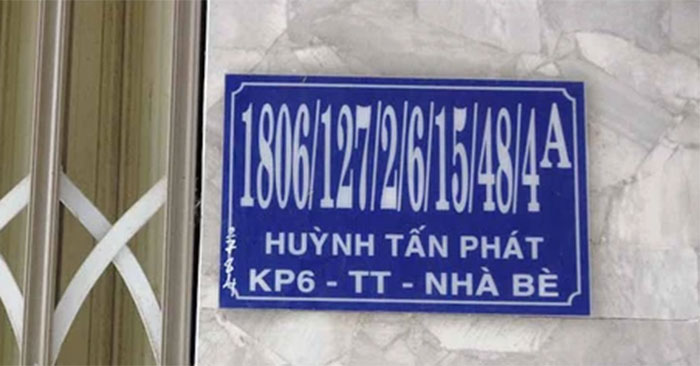
How to read home address
The address consists of two basic parts: the house number, street or village name, and the remaining part according to administrative boundaries.
The first part consists only of the house number and street or road name.
For example: number 58 Duy Tan street.
- If there is no house number or street, read by team or hamlet, village.
For example: Team 1, Doai village or Hamlet 1, Chua hamlet, Nhat Tao village.
- This way of reading leads to the phenomenon of many households and individuals having the same address, especially in rural areas. However, most people in the same team, hamlet, village, and neighborhood know each other, so just knowing the name of the head of household will help someone determine the home address.
Administrative boundaries
The administrative boundaries corresponding to the 3 administrative management levels are commune level: commune, ward, town; district level: district, county, town, city under province; provincial level: province, city under central government.
When reading domestic addresses, the country name is usually not included, except in cases where there is a foreign element.
According to the general principle when reading home addresses, introducing home addresses, and addresses of organizations, we read or write from detailed to general.
Read urban housing address
For urban areas, read in order: house number, alley number, lane number, street name, street name, ward name, commune name, town name, district name, city name under province, province city under central government.
For apartment buildings, read in order: room number, floor number, building name, apartment building name or urban area or residential area name, alley number, street name, street name, ward name, commune name, town name, district name, city name under province.
For rural areas, it will be villages, hamlets, communes, wards, towns, districts, towns, provincial cities, provinces, and centrally run cities.
Examples of some ways to read an address are as follows:
- House No. 09, To Vinh Dien Street, Khuong Trung Ward, Thanh Xuan District, Hanoi City.
- No. 19, Alley 24/3, Phao Dai Lang, Lang Thuong Ward, Dong Da District, Hanoi City,
- Room No. 308, 3rd floor, building A6, lane 10, Ngoc Hoi street, student housing area Phap Van - Tu Hiep, urban area Phap Van - Tu Hiep, Hoang Liet ward, Hoang Mai district, Hanoi city.
- Village 2, Lam Dong commune, Thuy Nguyen district, Hai Phong city.
How to find home address
To find an address, you have to read it backwards, that is, you have to find the street, then find the alley or side street. If the side street has an alley, find the alley number and then find the house number.
Principles of alley numbering, house numbers and standard writing method
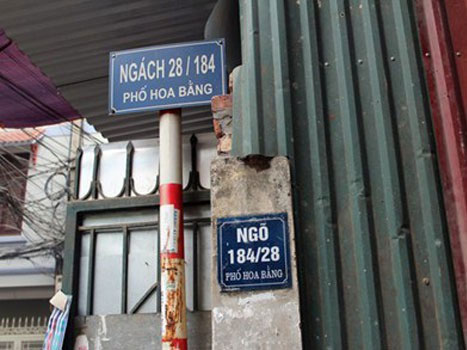
Numbering houses on the street or in the alley uses the numbers 1, 2, 3, 4… n in order from small to infinite. The row of houses on the left will have odd numbers, meaning the house number has the last natural number 1, 3, 5, 7, 9, while the right will have even numbers, meaning the natural numbers ending in 2, 4, 6, 8, 0.
Regarding the direction, the house numbering from small to large numbers until the end of the street, road or according to the administrative management boundary will be done from North to South, that is, along the vertical direction of the map, from East to West horizontally of the map. In the remaining cases, it will be from Northeast to Southwest, from Southeast to Northwest. In the case of an alley with only one end leading to the road or a dead end, the house number will be numbered from the end of the house adjacent to the main road until deep inside.
The direction from the first house in the alley adjacent to the street or road whose name the alley bears to the end of the alley on the other side. In the case of a dead-end alley or dead-end lane, the house number plate is also based on the house number on the street right in front of the alley or lane entrance.
As you can see reading a home address is straightforward, right?
Remember, your home address is important information, so don't post it on social media unless absolutely necessary. You should also avoid using location check-ins on social media, such as when you visit a cafe, bar, restaurant, or gym. Someone could use that information to determine your neighborhood and learn about your daily or weekly routine.
You should also adjust your social media settings to make your profile as private as possible. Ideally, strangers should not be able to see your friends and family, view your photos and posts, or randomly message you. In cases where it is necessary to be public, consider and confirm personal or financial information when you receive it online.
FAQ
What Is an Address? Principles, How to Read and Write House Numbers, Alleys?
In practical terms, a house address sounds simple, but how should you read it if there are more alleys or punctuation marks? This guide explains you on how to read a house address with / and alleys and punctuation marks.
Why does what is an address matter?
The article highlights that this guide explains you On how to read a house address with / and alleys and punctuation marks.
What is the main takeaway?
The main takeaway is that home address is a familiar concept to all of us, but not everyone knows its exact definition as well as how to read and write the address of a lane, group, village, hamlet, etc.
Related Articles
 Instructions to Write and Read the Code Is Correct7 minutes read
 How to Write Exponential Numbers in Word5 minutes read
 Year // Year, Fourth // Fourth, Fashion // One... How to Read in5 minutes read
 How to Write Exponential Numbers in Excel3 minutes read
 How to Increase the Read and Write Speed of HDD, SSD on the Computer5 minutes read
 How to Test the Read and Write Speed of a USB Drive5 minutes read
Reader Comments 0
Sign in with email or Google to join the discussion.