Table of Contents
Round robin gives each eligible item a turn in a fixed order. In CPU scheduling, runnable tasks take turns using the processor for a limited time. In load balancing, successive requests can go to successive servers.

How round-robin CPU scheduling works
The scheduler takes the first runnable task from a queue and lets it run for up to a time slice, also called a quantum. If the slice expires and the task still needs CPU time, it returns to the back of the runnable queue. A task that finishes leaves the queue. A task waiting for input or output becomes runnable again when the event it is waiting for completes.
Round robin rotates through the runnable queue.
Example: Three jobs with a two-millisecond time slice
Suppose A needs 5 ms, B needs 3 ms, and C needs 1 ms. All are ready at time zero, and the example ignores the time spent switching tasks.
| Time (ms) | Task | Result at end of turn |
|---|---|---|
| 0–2 | A | 3 ms left |
| 2–4 | B | 1 ms left |
| 4–5 | C | Finished |
| 5–7 | A | 1 ms left |
| 7–8 | B | Finished |
| 8–9 | A | Finished |
Short slices let other tasks have a turn sooner, but increase the number of context switches. Long slices reduce that overhead and can make a newly runnable task wait longer. Equal turns also don’t guarantee that jobs will finish equally quickly.
How round robin distributes web requests
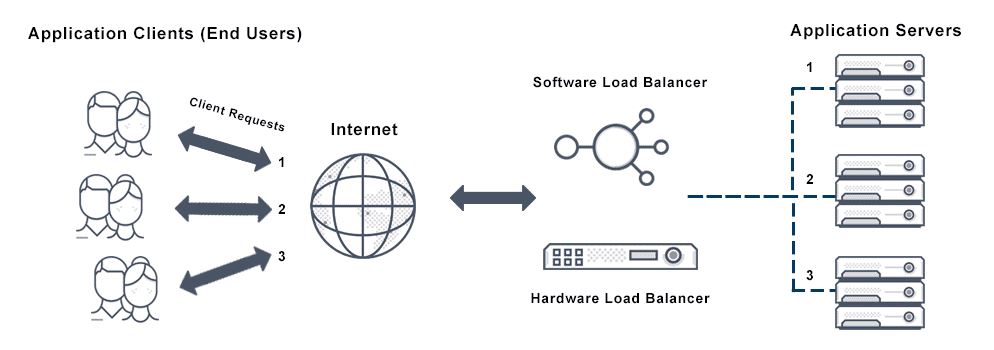
With three equivalent backends, a load balancer might send requests to A, B, C, then A again. This spreads request counts. If requests vary widely in cost, one backend can still end up doing more work than another. Weighted round robin gives some servers more turns. Least-connections routing uses the number of active connections to choose a backend. The Nginx load-balancing guide shows how those policies are used.
Related Articles
 Invite to see the beautiful Concept that comes with many unique features of iOS 12
 This is the iOS 14 operating system we all expect
 Invite to admire the Concept Windows 11 with many unique features and design interface Mac OS style
 Please admire the latest iOS 13 Concept with a unique design
 Lesson for managers from the mind of Baidu CEO
 IOS 13 concept invitations with new features that satisfy the dreams of iFan
Reader Comments 0
Sign in with email or Google to join the discussion.