Table of Contents
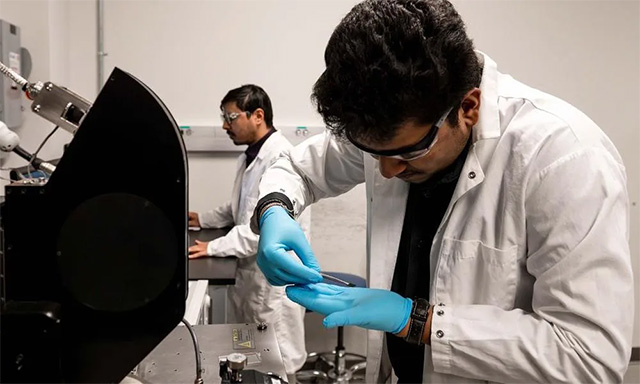
Researchers at Penn State have developed a microscopic temperature sensor that can be integrated directly onto a computer chip. The device is intended to measure rapid, localized temperature changes that larger or more distant sensors may miss.
Better temperature data could help a processor's control system respond more precisely to hot spots, balancing performance, power use, and hardware protection. The research is promising, but the sensor is not by itself a complete solution to chip overheating; it is a measurement tool that could support better thermal management.
A sensor with a tiny footprint
The reported sensor occupies an area of about one square micrometer. That small footprint could allow many sensors to be distributed across a chip instead of relying on a few monitoring points.
Heat is not distributed evenly across a processor. A demanding workload may create a hot spot in one region while another area remains cooler. A sensor outside the active region can detect the general temperature but may not capture a short-lived local spike.
Why the two-dimensional material matters
The device uses a two-dimensional material only a few atoms thick. According to the research description, its low thermal mass enables it to react to small temperature changes on a very short timescale.
The sensor can reportedly detect a change in about 100 nanoseconds. Fast measurements are important because modern processors adjust voltage, clock speed, and workload placement dynamically; a slow reading may arrive after the hot spot has already shifted.
The ultrathin structure may also require less energy than conventional silicon-based monitoring circuits. That matters when designers want to add many sensing points without using a significant part of the chip's power budget.
How on-chip thermal data could improve performance
Processors protect themselves from excessive heat by reducing clock speed or power, a behavior commonly called thermal throttling. Conservative controls may slow a large part of the chip even when the highest temperature is confined to a small region.
A dense map of fast temperature readings could support more targeted responses. A control system might redistribute work, reduce power only in the affected area, or adjust cooling before a hot spot reaches the throttling threshold.
Potential benefits include:
- more accurate detection of local hot spots;
- faster control of voltage and clock speed;
- less unnecessary throttling in cooler chip regions;
- better energy efficiency; and
- additional data for designing processor layouts and cooling systems.
Research still has to become manufacturable
Integrating a laboratory sensor into commercial processors requires more than a small prototype. Engineers must show that the device can be manufactured reliably, calibrated across many chips, connected to control circuitry, and operated for the life of the processor without disrupting nearby transistors.
As chip features become smaller and power density rises, precise thermal measurement will remain important. Penn State's sensor offers one possible way to observe heat where it is generated, giving future thermal-control systems better information on which to act.
Related Articles
 How to Fix Windows 11 Computer Overheating Problem10 minutes read
 6 Potential Hardware/software Issues That Cause Laptops to Overheat10 minutes read
 Causes and Effective, Simple Solutions for Laptop Overheating12 minutes read
 Causes of GPU Overheating and How to Fix It8 minutes read
 How Much CPU Temperature Is Overheating?10 minutes read
 How to Effectively Fix iPhone Overheating6 minutes read
Reader Comments 0
Sign in with email or Google to join the discussion.