Table of Contents
Scania used two autonomous trucks in a controlled demonstration near its headquarters in Södertälje, Sweden, to show how accurately the vehicles could approach a defined stopping point. The company developed the driving system with PlusAI.
The stunt is visually striking, but it should not be treated as proof that a driverless truck can handle every public-road condition. The stronger evidence comes from repeated operation, safety validation, and regulatory approval in the specific environments where the system will be used.
What happened in the demonstration?
Two trucks drove toward each other and stopped with a narrow gap between them. Mountain-bike athlete Matt Jones then rode through the space as part of a Red Bull collaboration. Scania described the maneuver as a display of the autonomous system's positioning and control accuracy.
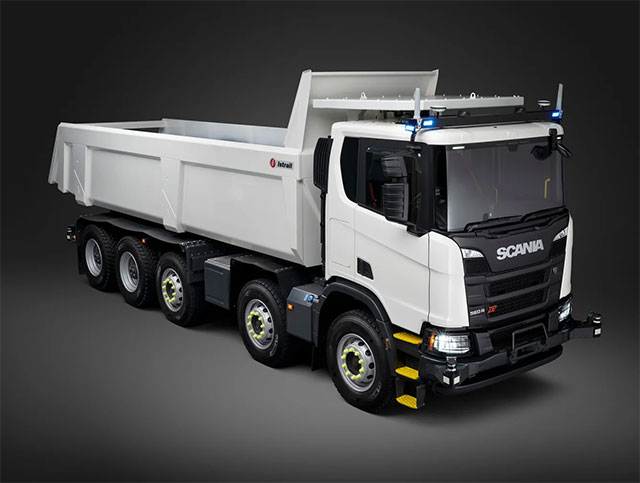
“Millimeter precision” describes the planned demonstration under controlled conditions. It does not by itself establish the system's accuracy in traffic, poor weather, construction zones, sensor obstruction, or emergency scenarios.
Why mines are an early use case
Scania is developing autonomous haulage for mines, where vehicles follow repeated routes inside a controlled operating area. Removing drivers from hazardous zones can improve exposure risk, while centralized fleet management can coordinate movement and charging or refueling.
Scania has discussed deploying autonomous mining trucks in Australia and later expanding to other markets. Timelines, payloads, and operating conditions depend on each customer site and local approval.
Continuous operation is a potential advantage, but a driverless vehicle is not maintenance-free. Mines still need remote supervision, inspections, traffic rules, fallback procedures, communications coverage, and trained personnel able to stop or recover a vehicle safely.
Public-road hub-to-hub testing
Scania and PlusAI have also tested autonomous trucks on Swedish public roads with a safety operator in the cab. The reported route between Södertälje and Jönköping is roughly 300 km and represents a hub-to-hub model: freight moves between fixed terminals on a known corridor.
The target is Level 4 automation within a defined operational design domain. Level 4 does not mean the truck can drive anywhere in all conditions. The system must specify the roads, speeds, weather, maps, and fallback behavior under which it can operate without expecting a human to take over immediately.
Potential logistics benefits—and what must be proven
- More predictable schedules: fixed routes can be coordinated centrally, although loading, maintenance, and terminal delays still matter.
- Driver allocation: automation could move some long-haul work away from drivers while creating remote-operations and service roles.
- Fuel and energy use: smoother driving may improve efficiency, but results depend on vehicle weight, traffic, route, speed, and powertrain.
- Safety: fewer people in hazardous zones may reduce exposure, but companies must validate perception, braking, cybersecurity, and fallback systems.
Autonomy alone does not guarantee lower emissions. Emissions depend mainly on energy source, vehicle efficiency, utilization, and any additional empty travel. Electrification can reduce operational emissions where charging electricity is sufficiently low-carbon, but that is a separate design choice.
How to judge future autonomous-truck claims
Look beyond a single demonstration. Useful evidence includes the number of operating hours and miles, intervention rates, the defined operating domain, incident reporting, independent safety assessment, and performance in adverse conditions. Also check whether a “deployment” is a supervised pilot, a closed-site commercial service, or genuinely driverless public-road operation.
Scania's work shows why controlled mines and fixed freight corridors are practical early targets. Commercial scale will depend on reliable performance, cost, regulation, infrastructure, and public-road safety—not precision in one choreographed maneuver alone.
Related Articles
 How to Become a Truck Driver: Step-by-Step Guide14 minutes read
 minutes read
 How to Drive a Moving Truck: Step-by-Step Guide13 minutes read
 How to Drive a Stick Shift Truck: Step-by-Step Guide10 minutes read
 Injured in a Truck Accident: Who Is Responsible for Paying7 minutes read
 How to Change a Truck Tire: Step-by-Step Guide12 minutes read
Reader Comments 0
Sign in with email or Google to join the discussion.