Table of Contents
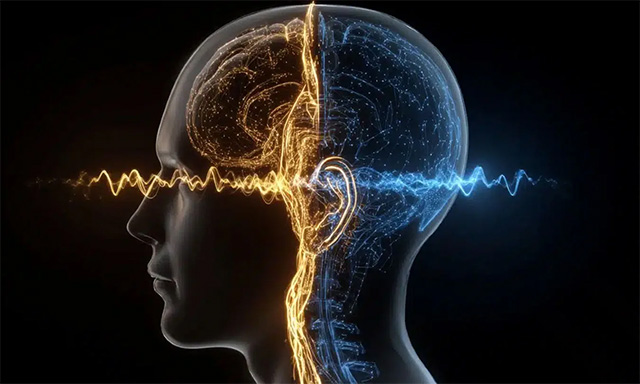
A small EEG study reported that listeners' brain activity differed when they heard human and synthetic speech, even when their button-press judgments were often wrong. The result is evidence of measurable neural processing differences under the experiment's conditions—not proof that the brain has a reliable hidden “AI voice detector.”
What the researchers tested
The study, attributed to researchers at Tianjin University and the Chinese University of Hong Kong and published in eNeuro, involved 30 participants. They listened to sentences spoken by humans and by two synthetic-voice systems, including a more natural-sounding system.
Participants classified each sample as human or synthetic while electroencephalography (EEG) recorded electrical activity at the scalp. They also completed a short training session intended to improve discrimination.
Behavioral performance remained limited: listeners continued to misclassify samples. The EEG analysis, however, found response differences between the speech categories after training. The authors reported effects at roughly 55, 210, and 455 milliseconds after sound onset.
What an EEG difference does—and does not—mean
EEG can show that two categories of sound produce statistically different patterns across participants or experimental conditions. That does not necessarily mean an individual listener consciously recognizes the category, or that the signal could identify every modern synthetic voice in everyday use.
The early timing is also not evidence that a correct conscious decision was completed within 55 milliseconds. Early responses can reflect basic acoustic processing, attention, or stimulus differences; later responses may relate to categorization and decision processes. Establishing the exact cause requires more than observing a difference at a particular time point.
The study's acoustic analysis reported differences in modulation within approximately 5.4 to 11.7Hz. That range may help explain why the recordings produced different neural responses, but it should not be treated as a universal fingerprint. Other speakers, languages, microphones, compression formats, background noise, and newer speech generators could produce different results.
Why the study should be interpreted cautiously
- Small sample: results from 30 participants need replication in larger and more varied groups.
- Limited voice systems: two synthetic-voice conditions cannot represent every text-to-speech or voice-cloning model.
- Controlled recordings: laboratory audio is different from a short, noisy phone call or a compressed social-media clip.
- Training-specific result: the reported neural changes followed a brief training task; the study does not show how long they persist.
- Group analysis versus individual detection: a measurable average EEG effect does not automatically become an accurate detector for one person or one recording.
For those reasons, the most defensible conclusion is that the auditory system may respond to subtle acoustic differences that listeners cannot reliably turn into explicit judgments. More research is needed to determine whether training can improve conscious detection across unfamiliar voices and real-world audio.
This is not a practical defense against voice scams
Even if the brain reacts differently to some synthetic speech, a person should not rely on intuition, tone, or supposed audio artifacts when money, credentials, or private information are at stake. A scammer can combine voice cloning with caller-ID spoofing, personal details from social media, urgency, and pressure to prevent verification.
The U.S. Federal Trade Commission advises people who receive a family-emergency call not to trust the voice alone. Contact the person using a phone number you already know, or verify through another relative or friend. The FTC's voice-cloning scam guidance also flags requests for wire transfers, cryptocurrency, and gift cards as warning signs.
How to verify a suspicious voice message
- Pause the conversation. Do not let urgency force an immediate payment or disclosure.
- Use a separate channel. Call the person or organization through a saved number or an official website, not a number supplied by the caller.
- Verify the event. Ask another trusted contact and check whether the claimed emergency, invoice, or account problem is real.
- Protect authentication factors. Never read out a one-time code, password, recovery phrase, or payment-card PIN.
- Save evidence safely. Keep the voicemail, phone number, transaction request, and timestamps, then report the attempt to the relevant service or authority.
A prearranged family verification phrase can add another check, but it should not replace calling back through a trusted number. Avoid questions whose answers are easy to find on social media.
What the finding may contribute
The experiment may help researchers identify which acoustic cues and stages of auditory processing are involved in synthetic-speech perception. That could inform better training studies or complement technical detection methods. It does not establish a consumer-ready EEG test, a universal deepfake signature, or a guarantee that people can learn to spot any cloned voice.
The practical message is therefore narrower than the original headline suggests: some synthetic speech produced distinguishable neural responses in a controlled, small study, while conscious classification remained unreliable. For real-world safety, independent verification is still more dependable than trying to hear whether a voice “sounds AI-generated.”
Related Articles
 How to Accurately Distinguish iPhone 6 or iPhone 6s?8 minutes read
 How to Identify Counterfeit Money, Real Money from the State Bank7 minutes read
 How to Create AI Voices on OmniVoice3 minutes read
 Male and Female Brains Are Already Different in the Womb8 minutes read
 Differentiate USB 2. 0 and USB 3. 09 minutes read
 Just Looking at the Position Can Distinguish 3 Common Types of Headaches4 minutes read
Reader Comments 0
Sign in with email or Google to join the discussion.