Table of Contents
MolmoBot is an open suite of robot-manipulation policies from the Allen Institute for AI (Ai2). Its central result is that policies trained on a sufficiently large and varied simulation dataset can transfer to physical robots without task-specific real-world training or fine-tuning.
The work is a research result, not proof that simulated data can replace real-world testing for every robot or task. It focuses on specific tabletop and mobile-manipulation evaluations using two hardware platforms.
Why train robots in simulation?
Collecting demonstrations on physical robots is slow, costly, and difficult to reproduce across laboratories. Real hardware can wear out or damage objects, and human operators must repeatedly perform and record actions. Simulation makes it possible to generate many trajectories in parallel and vary the scene systematically.
The persistent challenge is the “sim-to-real gap”: simulated physics, cameras, lighting, and objects do not perfectly match the physical world. MolmoBot tests whether scale and diversity in simulation can reduce that gap without mixing real demonstrations into the training set.
MolmoSpaces and the synthetic dataset
Ai2 built MolmoBot-Engine to procedurally generate training trajectories in MolmoSpaces. The released MolmoBot-Data dataset contains 1.8 million expert trajectories covering articulated-object manipulation and pick-and-place tasks.
The pipeline uses the MuJoCo physics engine and domain randomization. Object appearance, camera viewpoint, lighting, dynamics, and other scene properties vary across examples, making it harder for a policy to depend on one narrow simulated setup.
Three policy designs
The researchers trained three policy classes on the same synthetic data:
- MolmoBot: a Molmo2-based multi-frame vision-language policy with a flow-matching action head;
- MolmoBot-Pi0: a policy patterned after the π0 architecture to support controlled comparisons;
- MolmoBot-SPOC: a lighter policy intended for constrained hardware and further reinforcement-learning experiments.
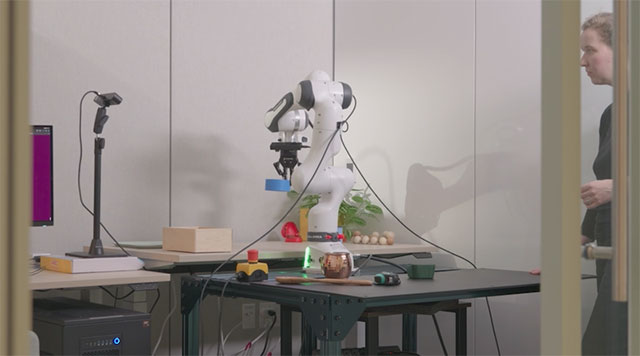
They evaluated the policies on a Franka FR3 arm for tabletop tasks and a Rainbow Robotics RB-Y1 mobile manipulator for door, drawer, cabinet, and mobile pick-and-place tasks.
What the reported results show
According to the technical report, the policies transferred to previously unseen physical objects and environments without real-world fine-tuning. On the paper's four tabletop pick-and-place settings, the main MolmoBot policy achieved a 79.2% success rate, compared with 39.2% for the evaluated π0.5 baseline.
Those figures describe the authors' evaluation protocol; they should not be interpreted as a universal ranking across all robots or tasks. Robot success rates can change substantially with hardware calibration, object choice, camera placement, safety constraints, and the number of test trials.
Why the open release matters
Ai2 released the model suite, training data, and generation pipeline for research use. This gives other teams a way to inspect the method, reproduce parts of the evaluation, and test whether greater simulated diversity transfers to new hardware.
The project's larger contribution is a shift in where robotics data work happens. Instead of recording every behavior manually, researchers can invest in procedural environments and then reserve physical testing for validation and safety. Real-world evaluation remains essential because a simulator cannot model every contact, failure mode, or operating condition.
Technical details, evaluation settings, and limitations are available in the MolmoBot research paper and the official project page.
Related Articles
 Series of Photos Demonstrating Life as a Simulated World3 minutes read
 Giant Robot War: America Wins Japan2 minutes read
 World's Fastest Robot Boxer, Response Delay Less Than 1/15 Blink Time3 minutes read
 Cyberdog 2 Robot Dog: Complete Guide3 minutes read
 The World's First Terrain-crossing Robot Can Move Like a Snake4 minutes read
 Robot Fish Helps Us Experience the Close-up of the Ocean World4 minutes read
Reader Comments 0
Sign in with email or Google to join the discussion.