Table of Contents
This guide explains how to use ISREF Function in Excel, including its syntax, required arguments, practical examples, and common errors.

Description: The function returns True if the value is a valid reference value. Application function to check if the value is a reference value or not.
Syntax: ISREF (value)
Inside:
- value: The value you want to check is a reference or not, is a required parameter.
Attention:
- The function returns True if the value is a reference and vice versa the function returns False.
For example:
Is determining the value in value a reference?

- In the cell to calculate enter the formula : = ISREF (C6)

- Press Enter -> return value is:

- Similarly copying the formula for the remaining values results:

- Here if value is blank -> the function returns True.
- Where is not a reference -> enter the formula: = ISREF ("Excel. net")
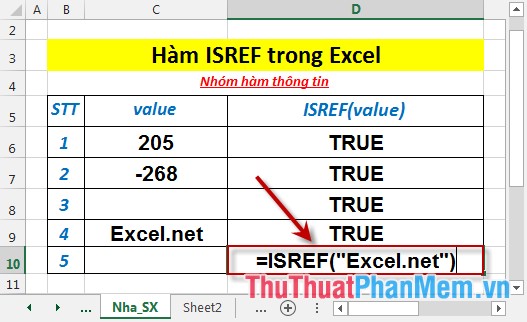
- Press Enter -> function returns False value :

Above are instructions and some specific examples when using the ISREF function in Excel.
Good luck!
FAQ
What does the ISREF function do in Excel?
The ISREF function performs the calculation described in this guide. Use the correct arguments and compatible data types for reliable results.
How do I enter the ISREF function correctly?
Start with an equals sign, enter ISREF, add the required arguments inside parentheses, and confirm that cell references and separators are correct.
Why does the ISREF function return an error?
Common causes include missing arguments, invalid data types, incorrect cell references, unsupported values, or regional separator settings.
Related Articles
 How to Use the ISFORMULA Function in Excel3 minutes read
 How to Use the IF Function in Excel1 minutes read
 How to Use the SHEETS Function in Excel3 minutes read
 How to Use the ISODD Function in Excel3 minutes read
 How to Use Address Function in Excel: Excel. MS Excel9 minutes read
 How to Use the IFS Function in Excel 20166 minutes read
Reader Comments 0
Sign in with email or Google to join the discussion.