Table of Contents
This updated guide examines Emoji: How to Type Emoticons and organizes the essential facts, background, and practical takeaways in clear American English.
Method 1of 7:
"Western" Emoticons
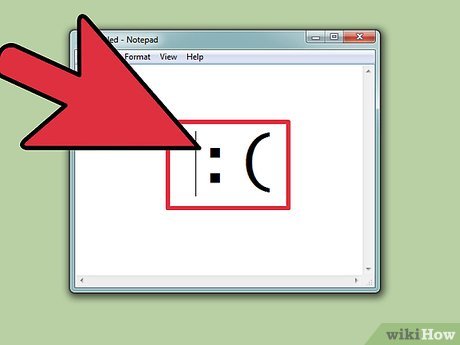 Understand how "Western" emoticons are typed. "Western" emoticons rose from early chat services such as IRC and AOL, primarily in North American and European countries. They are typically written horizontally from left to right; the top of the "head" is almost always on the left side.
- Western emoticons tend to focus more on the "whole face", and tend to have more literal translations that "Eastern" emoticons.
- Western emoticons typically just use Latin letters and are often distinguishable by single characters.
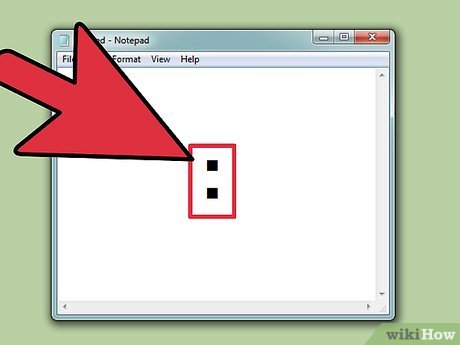 Use. : for the eyes (in most cases). Most Western emoticons rely on:to be the "eyes", though other characters can be substituted depending on the circumstances.
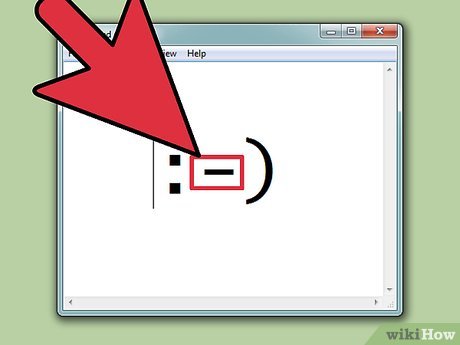 Include a nose if you want. Western emoticons are often expressible both with and without noses, which are shown with-. Whether or not you decide to include a nose is entirely up to your preference.
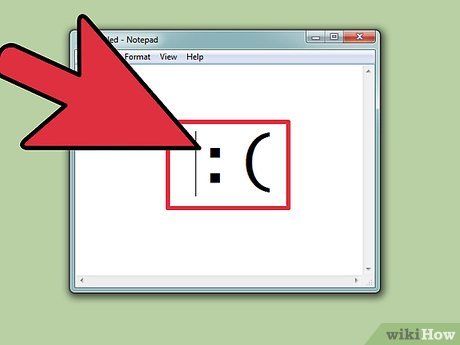 Build up from a base. The simplest emoticon is the Smiley:). From this base, there are hundreds of possible emoticons. You can add a hat (<]:)) or a beard (:)}), or anything else you can come up with. Below are some of the more common Western emoticons, though there are countless variations: Emotions and Actions Emotion/Action EmoticonHappySad
:(
Excited:D
Tongue Out:P
LaughingXD
Love<3
Surprised:O
Winking;)
Tongue-tied:&
Crying:*(:'(
Worried:S
Displeased:
Angry>:(
CoolB)
Indifferent:
Evil>:)
Dunce<:-
DisbeliefO_o
High Fiveo/o
Cheero/
Kiss:^*
Yawn|-O
- Feel free to add noses or make other adjustments to any of these emoticons. That's half the fun! Characters and Objects Character/Object EmoticonRobocop
([(
Robot[:]
Mickey Mouse°o°
Santa*<
Homer Simpson~(_8(I)
Marge Simpson@@@@@:^)
Bart Simpson∑:-)
Rose@>-->--
Fish<*)))-{
Pope+<:-)
Lenny( ͡° ͜ʖ ͡°)
Skateboardero[-<]:
Arrow<------K
Sword<========[===]
Uncle Sam=):-)
Wilma Flintstone&:-)
Dog:o3
Method 2of 7:
"Eastern" Emoticons
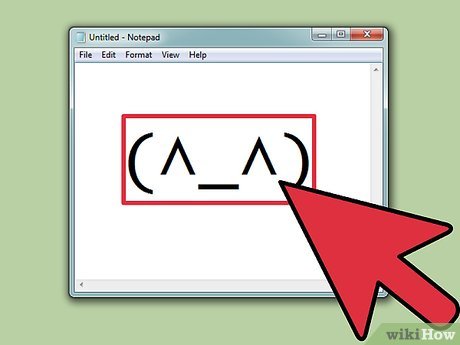 Understand how "Eastern" emoticons are typed. Eastern emoticons originate from southeast Asia. they are typically written "front-facing", as opposed to the horizontal orientation of Western emoticons. Much more emphasis is put on the eyes, which are used to convey the emotion.
- Many Eastern emoticons use non-Latin characters. This gives the writer a much larger range of designs that can be created, but some computers may not be able to properly display all of the characters.
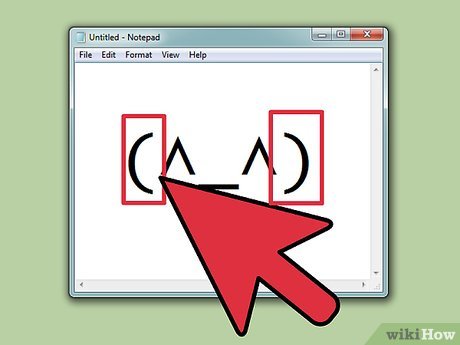 Decide to include the body. Many Eastern emoticons are surrounded by( )to denote the outline of the head or body. It's up to you whether or not you want to include it. Some emoticons work better with or without it.
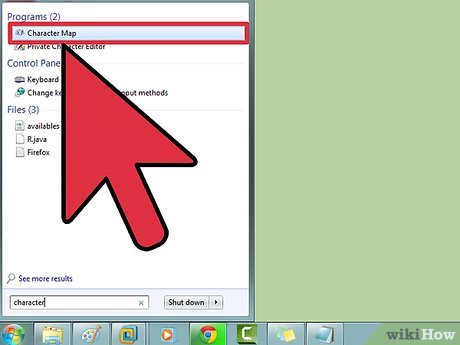 Use the Character Map to find symbols. Both Windows and OS X have a Character Map (Character Viewer in OS X) that allows you to browse through all of the fonts on your system to find specific characters. Use this to find characters to create your emoticons with, but remember that the other person won't be able to see it unless they have that same font installed.
- Windows - Press⊞Win+Rand typecharmapto open the Character Map. Use the menu at the top to switch between your fonts. Search for and download a font called "Code2000" for access to nearly any Eastern symbol. Click here for instructions on installing fonts.
- Mac - Click the Apple menu and select "System Preferences". Click "Keyboard", select the "Keyboard" tab, and then check the "Show Keyboard & Character Viewers in menu bar". Click the new icon that appears next to the clock, and select "Show Character Viewer". OS X comes with all of the fonts you need to make most Eastern emoticons.[1]XResearch source
^_^(^_^)*
Troubled/Angry(>_<)
Nervous(^_^;)
Sleepy/Annoyed(-_-)
Confused((+_+))
Smoking Octopus Fish>゜)))彡
Bow<(_ _)>
Wink(^_-)-☆
Cat(=^・・^=)
Excited(*^0^*)
Shrug Headphones((d[-_-]b))
Tired(=_=)
Table-flip Rage "Do it" Ultraman(o
Look of Disapproval- Eastern emoticons are often shown both with or without the surrounding( )to signify the face.
Method 3of 7:
Creating Shortcuts (iOS)
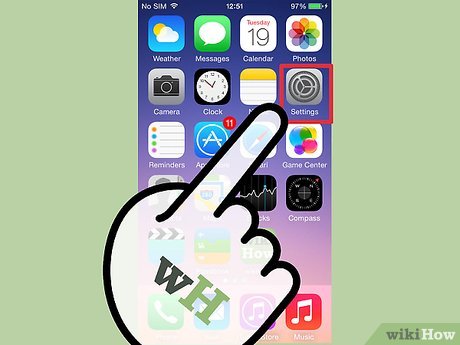 Open the Settings app on your iOS device. If you find yourself using a complex emoticon such as an Eastern emoticon often, you may find it easier to create a shortcut for it so you don't have to always track down one to copy and paste or hunt for characters.
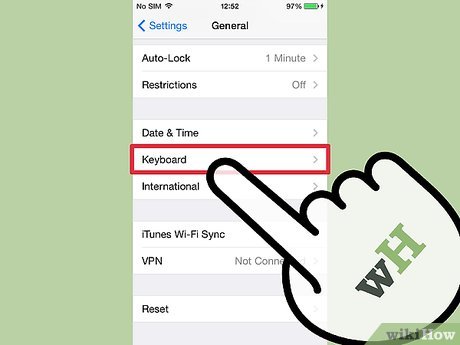 Tap "General" → "Keyboard" → "Shortcuts".
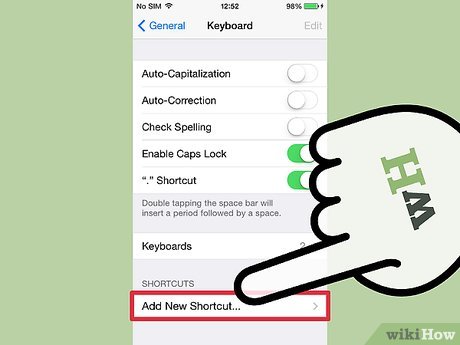 Tap the "+" to create a new shortcut.
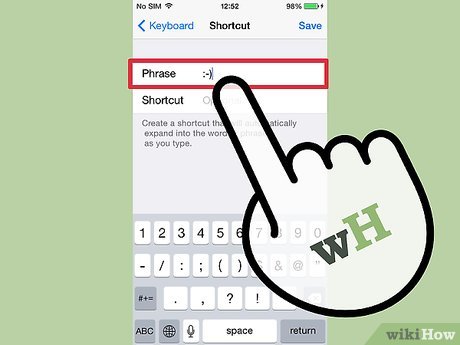 Paste or type your emoticon into the "Phrase" field.
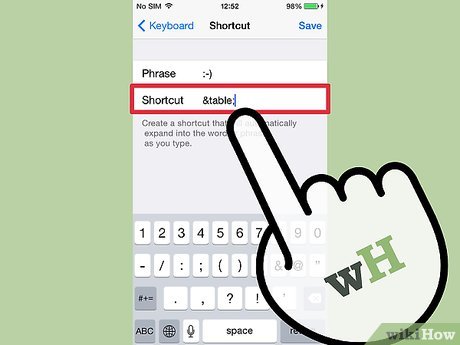 Type the shortcut that you want to use into the "Shortcut" field. It's crucial that you don't type a phrase that you use for other things, as the shortcut will get replaced any time it is used.
- A common trick is to use HTML-style tags as the phrase. For example, if you are creating a shortcut for(╯°□°)╯︵ ┻━┻, you could type&table;into the "Replace" field. The∧ensure that you won't replace a real word by accident.
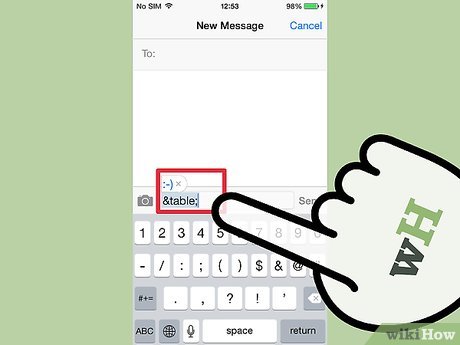 Type your shortcut and press. Space in any text field to insert your emoticon.
Method 4of 7:
Creating Shortcuts (Android)
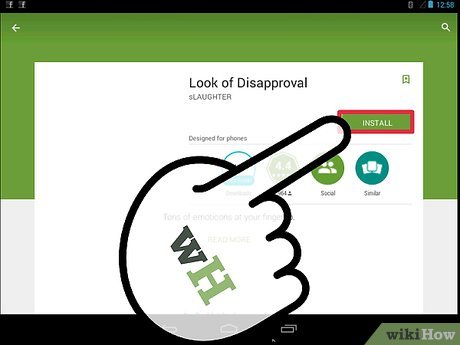 Download the "Look of Disapproval" app. This is a free app that allows you to quickly copy a variety of emoticons to your Android's clipboard so that you can paste them in a text field. You can also add custom emoticons for quick access.
- You can download "Look of Disapproval" from the Google Play Store.
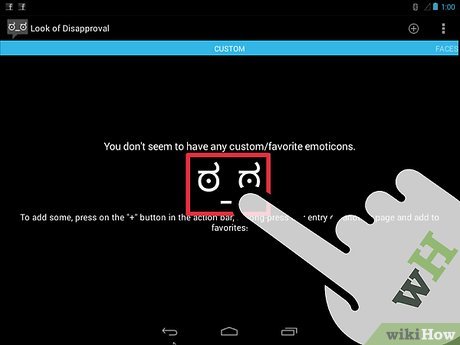 Browse through the preloaded faces. The app comes with a ton of faces that you can scroll through.
 Tap the "+" button to create a custom emoticon. If the emoticon you want isn't on the list, tap the "+" button and add it. It will appear on the "Custom" list.
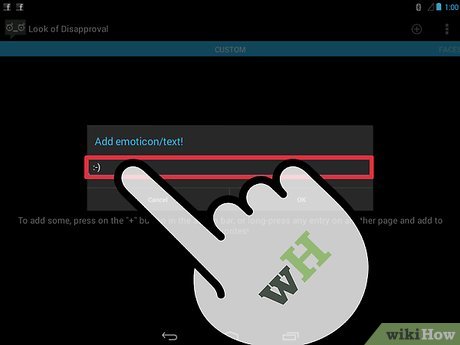 Tap an emoticon to copy it to your clipboard.
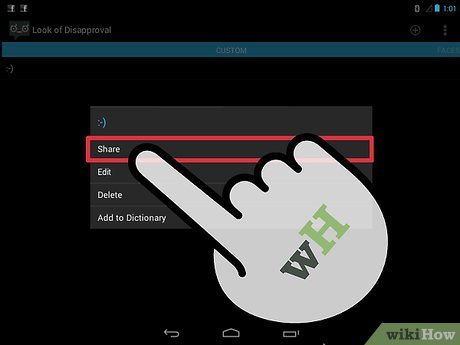 Press and hold in a text field and select "Paste" to paste your copied emoticon.
Method 5of 7:
Creating Shortcuts (Mac)
 Click the Apple Menu and select "System Preferences". If you find yourself using a complex emoticon such as an Eastern emoticon often, you may find it easier to create a shortcut for it so you don't have to always track down one to copy and paste or hunt for characters.[2]XResearch source
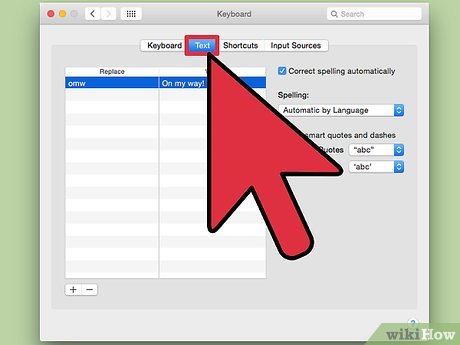 Select "Keyboard" and click the "Text" tab.
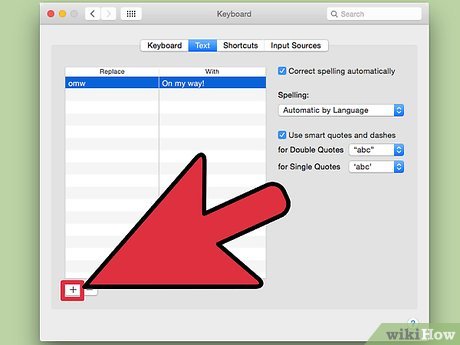 Click the "+" button to create a new shortcut.
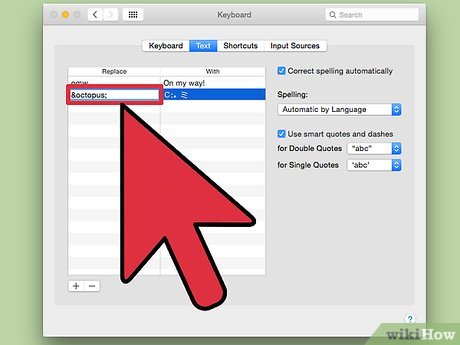 Type the phrase that you want to be automatically replaced with the emoticon. It's crucial that you don't type a phrase that you use for other things, as it will get replaced often.
- A common trick is to use HTML-style tags as the phrase. For example, if you are creating a shortcut forC:。ミ, you could type&octopus;into the "Replace" field. The∧ensure that you won't replace a real word by accident.
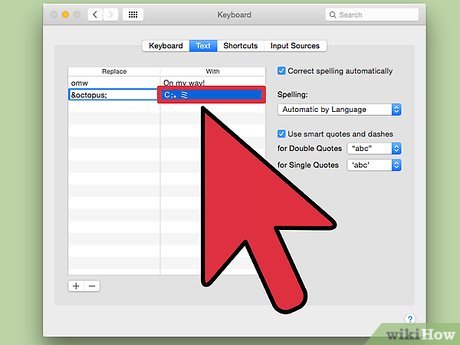 Paste the emoticon into the "With" field.
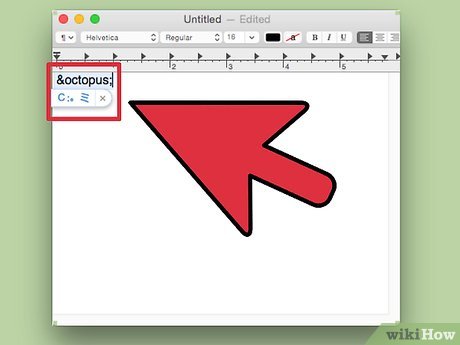 Type your shortcut and press. Space in any text field to insert your emoticon.
Method 6of 7:
Creating Shortcuts (Windows)
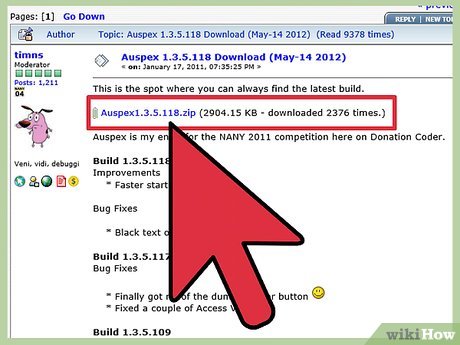 Download Auspex. This is a freeware tool designed to help speed up typing, and can be used to create keyboard phrase replacement shortcuts.
- You can download Auspex for free from here. You will need to extract the file by right-clicking on it and selecting "Extract Here".
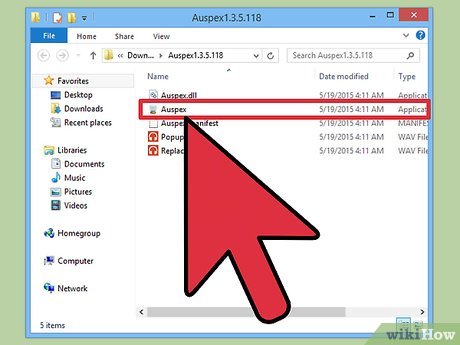 Run Auspex. It will immediately be minimized to your System Tray.
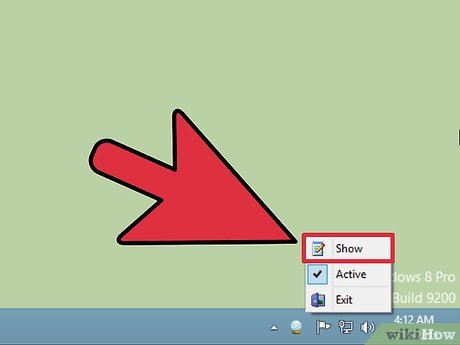 Right-click on the Auspex icon and select "Show". This will open the Auspex window.
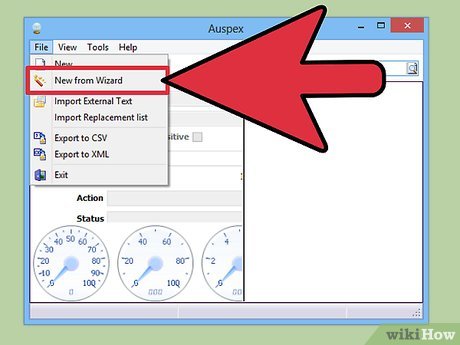 Click "File" → "New from Wizard". This will start the shortcut creation process.
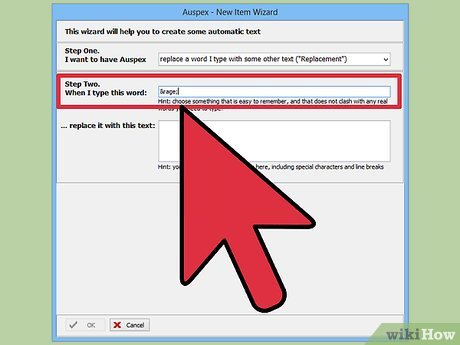 In the "Step Two" field, enter the phrase that you want to act as the shortcut. It's crucial that you don't type a phrase that you use for other things, as the shortcut will get replaced any time it is used.
- A common trick is to use HTML-style tags as the phrase. For example, if you are creating a shortcut for(ಠ益ಠ), you could type&rage;into the "Replace" field. The∧ensure that you won't replace a real word by accident.
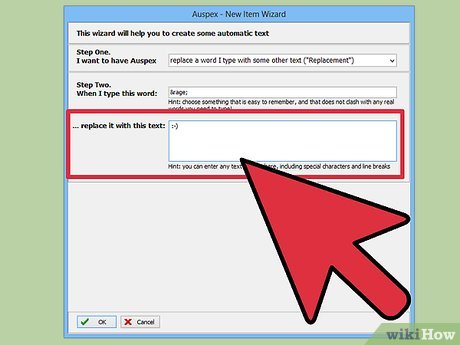 In the large field at the bottom of the window, type or paste the emoticon. Click the "OK" button when finished.
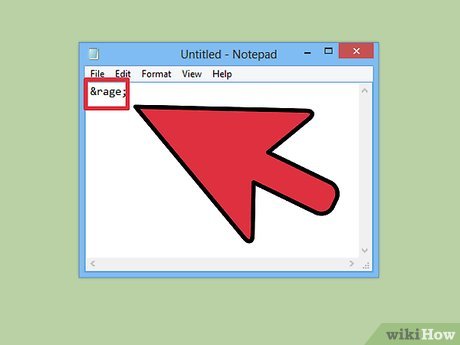 Type your shortcut and press. Space , Tab↹ , or ↵Enter to make the emoticon appear. These are the default trigger keys. You can change them using the "Triggered by" menu in Auspex when the shortcut is selected.
Method 7of 7:
Emoji
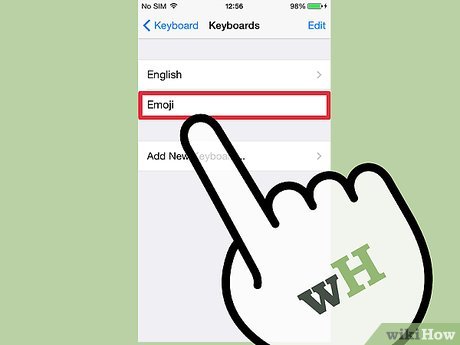 Understand what emoji are. Emoji are a set of picture characters that you can use in place of emoticons. They are most commonly used in chat programs and on mobile devices.
- Determine if your system or program supports emoji. Emoji is a non-standard set of characters, and is not supported by all systems. Both you and your recipient must have emoji support in order for them to be seen by both sides.
- iOS - All iOS devices running iOS 5 or later have emoji support built-in. The emoji keyboard may need to be enabled. Click here for instructions.
- Android - Not all Android devices support emoji, though certain apps such as Hangouts and WhatsApp do regardless of device. To add emoji support to your Android device for all apps, click here.
- OS X - OS X has built-in emoji support since OS X 10.7.[3]XResearch source
- Windows 7 and earlier - Emoji support is based on the internet browser, so make sure all of your browsers are updated to the latest version.
- Windows 8 - Windows 8 includes a built-in emoji keyboard. To enable the keyboard, open Desktop mode, right-click on the taskbar, and select "Toolbars" → "Touch Keyboard". You'll see the keyboard icon appear next to the System Tray.[4]XResearch source
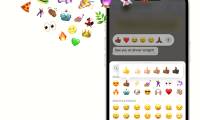
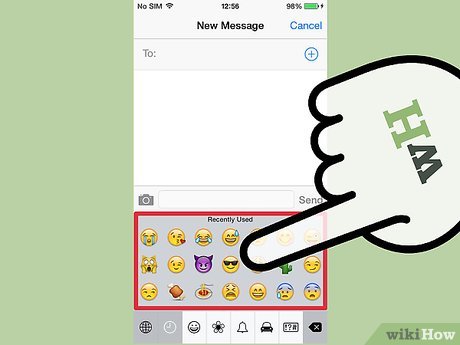 Add emoji symbols to your text. Emoji symbols are added by selecting the specific symbol you want instead of typing a set of characters. The process for selecting the symbol differs depending on the system you're using.
- iOS - After enabling the emoji keyboard, tap the Smiley-face button when the keyboard is up to open the Emoji keyboard. If you have more than one language installed, the button will be a Globe instead of a Smiley-face. Scroll through the options and tap the one you want to add.
- Android - The exact method for opening the emoji menu depends on the version of Android you are running and the keyboard you are using. Usually you can tap the Smiley-face button, though you may have to press and hold a button to make it appear instead. Scroll through the options and tap the one you want to add.
- OS X - In 10.9 and 10.10, you can press⌘Cmd+Ctrl+Spaceto open the emoji selection window. In 10.7 and 10.8, click the Edit menu in the program you are using and select "Special Characters". Click the Gear icon and select "Customize list". Check the emoji box to allow emoji characters to be selectable.
- Windows 7 and earlier - If your browser is up to date, you can copy and paste emoji from various emoji databases like Wikipedia. There is no way to type emoji characters.
- Windows 8 - Click the Keyboard button that you enabled in the previous step. Click the Smiley-face button at the bottom of the keyboard to open the emoji menu. Click the emoji that you want to add.
FAQ
What is Emoji: How to Type Emoticons about?
It provides a structured overview of emoji, explains the main context, and highlights practical takeaways for readers.
Why does this topic matter?
Understanding the main concepts helps readers evaluate the issue, avoid common mistakes, and make better-informed decisions.
How should readers use this information?
Use the guidance as a practical starting point, confirm details that may have changed, and follow current product, safety, or security recommendations.
Related Articles
 Instructions to Add Emoticons on Facebook: Facebook Emoticons2 minutes read
 How to Add Kaomoji Emoticons on Android3 minutes read
 Instructions for Turning on Emoji Keyboard on iPhone3 minutes read
 How to Drop Whatsapp Message Emoji3 minutes read
 How to Make Emoticons6 minutes read
 Microsoft Abandons 3D Emoji Plan on Windows 113 minutes read
Reader Comments 0
Sign in with email or Google to join the discussion.