Table of Contents
This updated guide examines Rotation: How to Fix a Rotated Screen and organizes the essential facts, background, and practical takeaways in clear American English.
Steps
Method 1of 2:
Windows
- Rotate your device or monitor if it is equipped with a rotation sensor. If your device is a tablet, 2-in-1 PC, or desktop with a rotatable screen, then you can rotate the monitor to fix the issue. If that does not work, then check that rotation lock is not enabled by opening the action center.
- If you do not see rotation lock in the action center, then try reconnecting the USB cable (not HDMI or VGA) cable for your monitor. This should fix the rotation sensor.
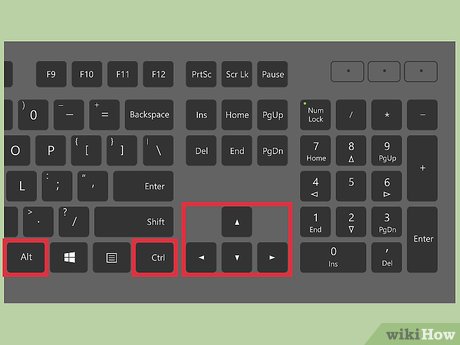 Press ctrl, alt, and a direction key. Some graphics cards assign the hotkeyCtrl+Alt+↓to flip the screen upside down. To reverse this, pressCtrl+Alt+↑. Use the same key combination with←or→to reverse a screen flipped right or left.
- Some graphics cards use⇧Shift+Alt+↑instead.[1]
- You may need to use the Alt key to the right of the spacebar, sometimes labeledAltGr.[2]
 Fix rotation manually. Computers running Windows 7 or later have an option to switch between portrait and landscape mode. Fix this as follows:[3]
- Right-click your Desktop.
- In the drop-down menu, selectDisplay Settings(Windows 10) orScreen Resolution(Windows 7 or 8). (Alternatively, go toStart→Control Panel→Display, then selectDisplay SettingsorScreen Resolution.)
- Click the Orientation drop-down menu and change it to Portrait or Landscape, depending on your monitor setup.
- Click Apply to rotate your screen back to normal.
 Access your graphics card options. If nothing else works, you may need to access your graphics card settings. Depending on which card you have, you may find this under Graphics Options, Graphics Properties, Nvidia Control Panel, Catalyst Control Center, or Intel Control Center. You can either locate this using the search bar, or (usually) right-click your Desktop and select it from the drop-down menu.
 Change the rotation setting. There is no standard menu arrangement in graphics card menus, so you may need to search a little. On some graphics cards, the "Rotation" or "Orientation" setting is in the Displays Manager menu.
- You may need to select "advanced options" to find this setting.
- If you're not sure why your screen rotated, you may have accidentally pressed a keyboard shortcut. Look for a Hotkeys menu item and disable it.
Method 2of 2:
Mac
 Hold down command and option. Press and hold⌘Commandand⌥Option. Continue holding these keys down for the rest of this process.
- If you are using a Windows keyboard with your Mac, hold downCtrl+Altinstead.
 Open System Preferences. Click the apple symbol in the top left corner of your screen. SelectSystem Preferencesfrom the drop-down menu.
- If System Preferences was already open, you may need to quit and relaunch it while pressing the keys.
 Go to the Display settings. ClickDisplay. Continue to press both keys.
- If you have multiple displays, select the problem monitor in the list of options before you continue.
 Change the rotation settings. Holding down these keys unlocks the rotation options in the Display settings. SelectStandardfrom the Rotation drop-down menu to return to the default display.[4]
- If no Rotation option appears, your hardware does not support Apple's built-in rotation settings. Check your Applications folder for third-party software that may have rotated your screen.
FAQ
What is Rotation: How to Fix a Rotated Screen about?
It provides a structured overview of rotation, explains the main context, and highlights practical takeaways for readers.
Why does this topic matter?
Understanding the main concepts helps readers evaluate the issue, avoid common mistakes, and make better-informed decisions.
How should readers use this information?
Use the guidance as a practical starting point, confirm details that may have changed, and follow current product, safety, or security recommendations.
Related Articles
 Simple Way to Fix a Horizontally Rotated Computer Screen: Complete Overview6 minutes read
 How to Fix a Computer Screen That Is Rotated Upside Down5 minutes read
![[Confusing] the Toolbar on the Computer Is Rotated Vertically - How to Fix It](/data6/thumbs_200x120/[confusing]-the-toolbar-on-the-computer-is-rotated-vertically-how-to-fix-it_thumbs_200x120_kKKldRmhL.jpg) [Confusing] the Toolbar on the Computer Is Rotated Vertically - How to Fix It7 minutes read
[Confusing] the Toolbar on the Computer Is Rotated Vertically - How to Fix It7 minutes read Solve the Error of Photos on Facebook Being Rotated Horizontally in 1 Minute8 minutes read
 How to Rotate Windows 10, 8, 7 Computer Screen Quickly3 minutes read
 Samsung Is Preparing to Launch the First Galaxy Camera Pop-up, Which Can Be Rotated 180 Degrees6 minutes read
Reader Comments 0
Sign in with email or Google to join the discussion.