Table of Contents
SEO Local: How Does Google Determine Local Rankings? is easier to understand when the core ideas are paired with practical examples. The sections below explain the topic clearly, highlight useful steps, and point out details that can prevent common errors.
When users search for keywords on Google, if the results table shows the names of businesses, along with the location location will be much more user attention. If the higher the rankings, the more prominent the website will be in Google's search list. That concept is called Local SEO. So what role does Google play in determining business rankings on the rankings?
Here, we will help you understand the factors that help Google determine the local ranking of your business, in addition to filling out your business information, area validation, opening hours and review management. of cutomer.
1. Relevance:
Relevance refers to the level of business matching with what users are searching for, such as location, business name,. So in the process of filling in the confirmation information, you need to fully prepare the information and accuracy about the business.

2. Distance:
Business proximity to searchers. Remember that relevance is more important. If a business is farther away from the searcher but has more relevance than the business nearby, Google will give them higher rankings.
Moreover, if users do not confirm their location, Google will calculate the distance based on what they know about the user's location.
3. Highlights:
You will have to ask how your business is famous?
There are more famous places in the offline world and search results only try to reflect this on the local. As an example,, famous and well-known places like hotels and famous brands' stores will have a prominent ranking on local search results.
The highlight is also based on the information that Google has about that business via websites such as links, articles and contacts pages. The number of reviews and points on Google are the ranking signals of the local. More reviews and better ratings will improve your business rankings.
Business rankings on search are typically a signal, so SEO tips can still be applied to Local SEO.
Your usual organic ranking will also be one of the ranking factors on the local. The on-page SEO tips or off-page SEO techniques are useful for Local.
4. Review of customers:
As I said, any business that reviews as well as good customer ratings will also help on the search results table. Customer reviews will account for 8.4% of the total ranking factors .
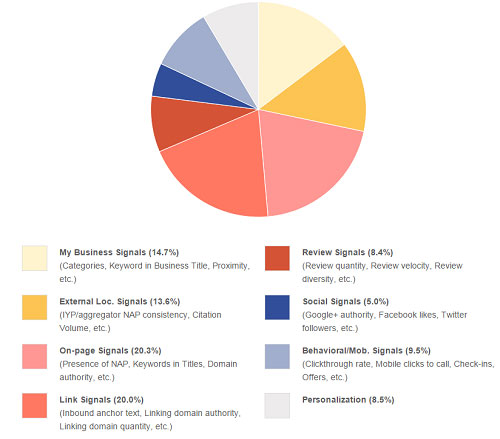
As such, we have provided you with content that Google can rely on to evaluate business rankings in search results.
Refer to the following articles:
- SEO website process on Top Google
- The terms need to know in SEO
- Check SEO onpage with SEOQUAKE tool
Hope this article is useful to you!
FAQ
What should you know about 1. Relevance?
Relevance refers to the level of business matching with what users are searching for, such as location, business name,. So in the process of filling in the confirmation information, you need to fully prepare the information and accuracy about the business.
What should you know about 2. Distance?
Business proximity to searchers. Remember that relevance is more important. If a business is farther away from the searcher but has more relevance than the business nearby, Google will give them higher rankings.
What should you know about 3. Highlights?
You will have to ask how your business is famous?
Related Articles
 6 Ways to Improve Your Google Rankings7 minutes read
 How to Determine the Device IP Address on the Local Network7 minutes read
 How to Appear on the Front Page of Google7 minutes read
 How to Configure Your PC to a Local Area Network8 minutes read
 9 Tips to Increase YouTube Video Rankings on Google12 minutes read
 Keep SEO Rankings in 5 Effective Ways8 minutes read
Reader Comments 0
Sign in with email or Google to join the discussion.