Table of Contents
Graph Data Structure (Graph) is easier to understand when the core ideas are paired with practical examples. The sections below explain the topic clearly, highlight useful steps, and point out details that can prevent common errors.
What is the graph data structure?
A graph (graph) is a form of visual representation of a set of objects in which pairs of objects are connected by links. Interconnected objects are represented by points called vertices, and links that connect vertices are called edges.
In general, a graph is a set of sets (V, E), where V is a set of vertices and E is a set of edges that connect point pairs. You follow the following graph:
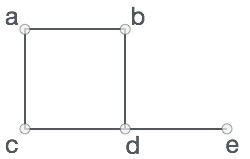
In the above graph:
V = {a, b, c, d, e}
E = {ab, ac, bd, cd, de}
Graph data structure (Graph)
Mathematical shapes can be represented in data structures. We can represent a shape using an array of vertices and a two-dimensional array of edges. Before continuing, we explore some of the following important concepts:
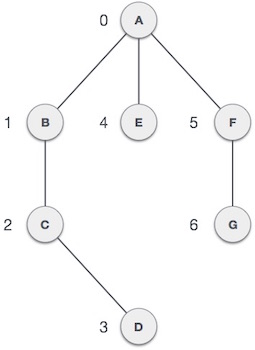
Vertex (Vertex) : Each node of the shape is represented as a vertex. In the example below, circles represent vertices. Therefore, points from A to G are vertices. We can represent these vertices using an array, where vertex A can be identified by index 0, point B is index 1. as shown below.
Edge (Edge) : The edge represents a line connecting the two vertices. In the figure below, the lines A and B, B and C,. are the edges. We can use a two-dimensional array to represent these edges. In the example below, AB can be represented as 1 in row 0; BC is 1 in row 1, column 2,.
Juxtaposition : The two vertices are contiguous if they are connected through an edge. In the figure below, B is adjacent to A; C is close to B,.
Road : Line represents a series of edges between two vertices. In the figure below, ABCD represents a line from A to D.
Basic operations on graph data structure
Following là cơ sở dữ liệu chính chính của một Graph, mà theo sau.
Add vertices : Add a vertex in the graph.
Add edges : Add an edge between two vertices of a graph.
Peak display: Displays a vertex of a graph.
This chapter is only an introduction to the Graphical Data Structure, to refer to this data structure, you can refer to some documents on Tutorialspoint or from any other source.
According to Tutorialspoint
Previous lesson: Quick Sort (Quick Sort)
Next lesson: Deep search algorithm
FAQ
What is the graph data structure?
A graph (graph) is a form of visual representation of a set of objects in which pairs of objects are connected by links. Interconnected objects are represented by points called vertices, and links that connect vertices are called edges.
What should you know about graph data structure (Graph)?
Mathematical shapes can be represented in data structures. We can represent a shape using an array of vertices and a two-dimensional array of edges. Before continuing, we explore some of the following important concepts:
What should you know about basic operations on graph data structure?
Following là cơ sở dữ liệu chính chính của một Graph, mà theo sau.
Related Articles
 Wide Search Algorithm: Search Algorithm by Width4 minutes read
 How to Implement a Graph Data Structure in Golang9 minutes read
 Deep Search Algorithm: Tips and Examples5 minutes read
 What Is Data Structure?5 minutes read
 Chart: How to Add a Second Y Axis to a Graph in Microsoft Excel4 minutes read
 Stack Data Structure (Stack): A Practical Guide12 minutes read
Reader Comments 0
Sign in with email or Google to join the discussion.