Table of Contents
Deep learning is a branch of machine learning that uses neural networks with multiple layers to learn patterns from data. It powers many systems for image recognition, speech processing, language, recommendation, and scientific analysis.
Its rapid progress since the 2010s did not come from one discovery. Larger datasets, faster graphics processors and specialized accelerators, improved training methods, and better software made it practical to train much larger networks.
Biological neurons and artificial units
The human nervous system contains tens of billions of neurons connected through a much larger network of synapses. Biological neurons receive signals, integrate them, and communicate with other cells.
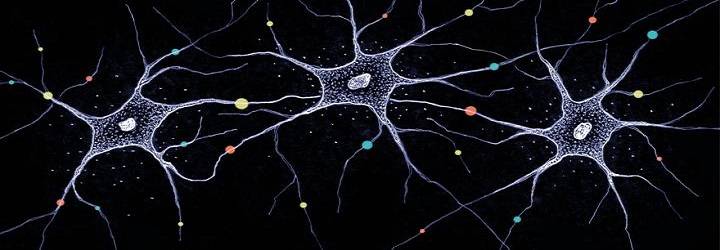
An artificial neural-network unit is only a loose mathematical analogy. It receives numbers, applies weights, adds a bias, and passes the result through an activation function. It does not reproduce the full behavior of a biological neuron or imply that the model thinks like a brain.
How a neural network processes data
A network is arranged in layers:
- Input layer: receives features such as pixel values or token representations.
- Hidden layers: transform those values into increasingly useful internal representations.
- Output layer: produces a prediction, class score, generated token, or another requested result.
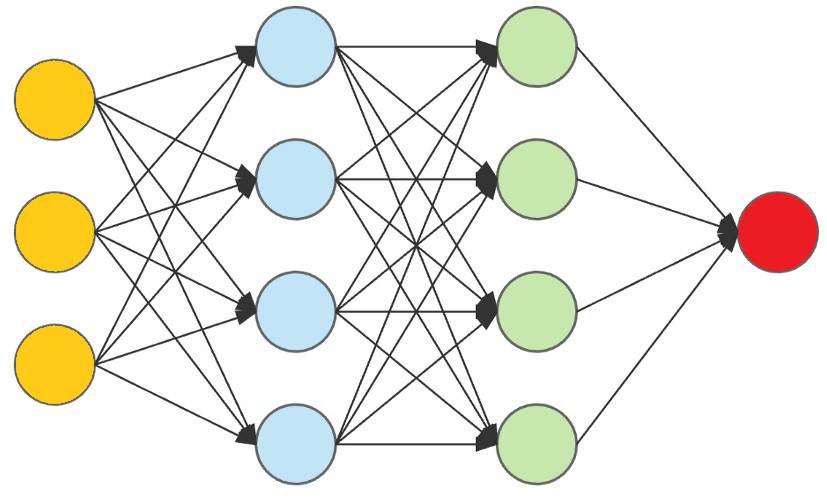
A “deep” network has multiple learned layers. Not every artificial neural network is simply a multilayer perceptron; convolutional networks, recurrent networks, transformers, and graph neural networks use different structures.
Training: predictions, errors, and updated weights
During supervised training, the model receives examples paired with desired outputs. It makes a prediction, a loss function measures the error, and backpropagation calculates how the weights contributed to that error. An optimizer then adjusts the weights.
This process repeats over many batches of data. Performance must be checked on validation or test examples that were not used to fit the weights; otherwise the model may memorize the training set without generalizing.
A classic definition associated with computer scientist Tom M. Mitchell describes learning in terms of a task, experience, and a performance measure: performance on the task improves with experience. These elements should be explicit in a machine-learning project.
Machine learning, deep learning, and AI
- Artificial intelligence is the broad field of building systems that perform tasks associated with intelligent behavior.
- Machine learning is a part of AI in which a system learns patterns from data or experience.
- Deep learning is a part of machine learning centered on multilayer neural networks.
Traditional software follows rules written by developers. A trained model learns parameters from examples, but developers still choose the data, architecture, objective, training process, and evaluation.
The Giraffe chess project
In 2015, Imperial College London student Matthew Lai described Giraffe, a chess engine that used a neural network to evaluate positions. The network learned from data rather than relying entirely on a hand-written evaluation function.
The often-repeated claim that Giraffe was “built in 72 hours” is misleading. A reported training stage took about 72 hours, while the overall research and software development required far more work. The project was reported to reach approximately international-master strength, not the level of a top grandmaster.
Giraffe was notable because it demonstrated learned position evaluation before later systems made self-play and neural-network chess widely known.
What deep learning can and cannot do
Deep learning can find complex statistical patterns and often performs well when training data and computing resources are sufficient. It is used in medical-image research, face detection, speech recognition, translation, and many other applications.
These systems can also fail when data is biased, incomplete, or different from the conditions seen during training. A high test score does not guarantee safe performance in a hospital, vehicle, or other high-stakes setting. Deployment requires domain validation, monitoring, security, and human accountability.
Related Articles
 What Is Machine Learning? Complete Guide9 minutes read
 The Difference Between AI, Machine Learning and Deep Learning10 minutes read
 AI Engineer Facebook Talks About Deep Learning7 minutes read
 Deep Learning - New Cybersecurity Tool?9 minutes read
 Google Researchers for Gaming AI to Improve Enhanced Learning Ability6 minutes read
 What Is Deep Learning? Features, Uses, and Key Details5 minutes read
Reader Comments 0
Sign in with email or Google to join the discussion.