Table of Contents
This guide provides a clear, practical overview of configure SSH server and SSH client on Windows server 2019, with useful context, important details, and straightforward takeaways for everyday readers.
Configure SSH Server on Windows Server 2019
Step 1. Run Powershell as admin and configure SSH server as follows:
PowerShell Copyright (C) Microsoft Corporation. All rights reserved. # get available name of OpenSSH PS C:UsersAdministrator> Get-WindowsCapability -Online | ? Name -like 'OpenSSH*' Name : OpenSSH.Client~~~~0.0.1.0 State : Installed Name : OpenSSH.Server~~~~0.0.1.0 State : NotPresent # Install OpenSSH Server PS C:UsersAdministrator> Add-WindowsCapability -Online -Name OpenSSH.Server~~~~0.0.1.0 Path : Online : True RestartNeeded : False # start sshd service PS C:UsersAdministrator> Start-Service -Name "sshd" # set [Automatic] for Startup PS C:UsersAdministrator> Set-Service -Name "sshd" -StartupType Automatic # verify PS C:UsersAdministrator> Get-Service -Name "sshd" | Select-Object * Name : sshd RequiredServices : {} CanPauseAndContinue : False CanShutdown : False CanStop : True DisplayName : OpenSSH SSH Server DependentServices : {} MachineName : . ServiceName : sshd ServicesDependedOn : {} ServiceHandle : SafeServiceHandle Status : Running ServiceType : Win32OwnProcess StartType : Automatic Site : Container : # if Windows Firewall is running, allow 22/TCP PS C:UsersAdministrator> New-NetFirewallRule -Name "SSH" ` -DisplayName "SSH" ` -Description "Allow SSH" ` -Profile Any ` -Direction Inbound ` -Action Allow ` -Protocol TCP ` -Program Any ` -LocalAddress Any ` -RemoteAddress Any ` -LocalPort 22 ` -RemotePort Any Name : SSH DisplayName : SSH Description : Allow SSH DisplayGroup : Group : Enabled : True Profile : Any Platform : {} Direction : Inbound Action : Allow EdgeTraversalPolicy : Block LooseSourceMapping : False LocalOnlyMapping : False Owner : PrimaryStatus : OK Status : The rule was parsed successfully from the store. (65536) EnforcementStatus : NotApplicable PolicyStoreSource : PersistentStore PolicyStoreSourceType : LocalStep 2. Open Start> Settings .

Step 3. Click on Apps .

Step 4. Click Manage optional features .

Step 5. Click Add a feature .

Step 6. Select OpenSSH Server and click the Install button .

Step 7. After the installation is completed, the OpenSSH Server will be added to the services. Launch it and change Startup to Automatic .

Step 8. If Windows Firewall is running, please enable SSH service port (22 / TCP).

Configure SSH Client on Windows Server 2019
Step 1. On Windows Server 2019, OpenSSH Client is installed by default. But if it is not already installed, install it from Start> Settings> Apps>> Manage optional features> Add a feature> OpenSSH Client .

Step 2. You can use the command client ssh as follows on PowerShell or Command Prompt:
PS > ssh (username)@(Hostname hoặc địa chỉ IP của SSH server)
Step 3. You can also log into the Linux Host where the SSH server is running.
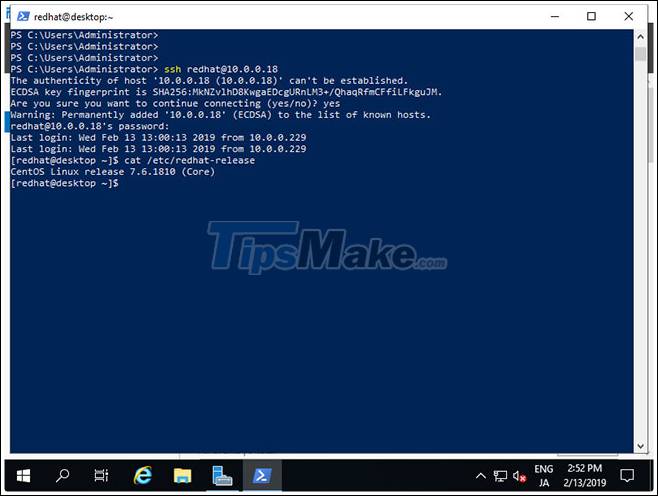
Step 4. You can also use scp command and sftp command to transfer SSH file.


Key Takeaways
Use the information above as a practical reference for configure SSH server and SSH client on Windows server 2019. Review each step carefully, confirm any requirements, and choose the option that best fits your situation.
FAQ
What does this guide explain about Configure SSH Server and SSH Client on Windows Server 2019?
It explains the main concepts, practical considerations, and useful steps related to configure SSH server and SSH client on Windows server 2019 without requiring advanced knowledge.
Who can benefit from learning about Configure SSH Server and SSH Client on Windows Server 2019?
This information is useful for readers who want a clear overview, practical guidance, and reliable steps related to configure SSH server and SSH client on Windows server 2019.
What should I check before applying this information?
Review the requirements, confirm that your device, software, or situation matches the instructions, and back up important data before making major changes.
Related Articles
 How to Install Isa Server Enterprise 2000 -- Part Iii18 minutes read
 How to Configure NTP Server and NTP Client in Windows Server6 minutes read
 KMS Activation Deployment for Windows 10, Windows 8.1, Windows23 minutes read
 Deploy KMS Activation on Windows Server 20089 minutes read
 Creating Ssl Server 2008 Server with Isa 2006 Firewalls (Part 1)21 minutes read
 How to Install, Configure, and Test Windows Server 2012 R2 Single8 minutes read
Reader Comments 0
Sign in with email or Google to join the discussion.