Table of Contents
The central solenoid coil in the core of the ITER fusion reactor possesses a super-strong magnetic field, powerful enough to lift an aircraft carrier out of the water, earning it the nickname "the world's strongest magnet".
The central solenoid (CS) coil is assembled from six modules and is considered the heart of the ITER fusion reactor. The CS consists of coils of electrically conductive wire wound in a cylindrical shape, which will generate an extremely powerful current from the plasma.
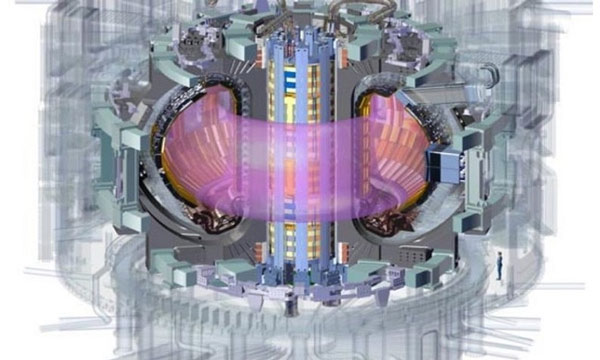
The central solenoid coil of ITER is approximately 13-18 meters tall, the support base has a diameter of 4.3 meters, and weighs up to 1,000 tons. The internal coils operate independently to generate enormous electromagnetic forces in different directions. To launch the space shuttle, the support base must withstand twice the thrust force.
The ITER fusion reactor is under construction in southern France. The first CS module will be delivered there in the fall of 2020. This, the world's strongest magnetic coil, was manufactured by the American defense and energy corporation General Atomics and was completed in 2021.
Please watch the video provided by Sci Tech Daily showing the construction process of the ITER reactor by the engineers.
CS plays a crucial role in the magnetic system of the ITER reactor. The ITER fusion reactor generates energy by combining two light hydrogen nuclei, deuterium and tritium, to form a heavier helium nucleus. ITER will produce 500 MW of electricity, 10 times the energy required to operate.
Fusion reactions only occur at temperatures of around 120 million degrees Celsius, many times higher than the temperature at the core of the Sun (approximately 15 million degrees Celsius). ITER uses a toroidal magnetic chamber called a tokamak to generate this superheated temperature.
To create ITER's toroidal Central Solenoid, 100,000 km of niobium-tin (Nb3Sn) superconducting fiber, weighing over 400 tons, was needed. This fiber was manufactured by ITER project suppliers—China, Europe, Japan, South Korea, Russia, and the United States. Production began in 2009 and concluded in 2014, at a rate of approximately 150 tons per year. The total length of the Nb3Sn fiber produced for ITER would wrap around the Earth at the equator twice.
When completed, ITER's 100,000km of superconducting wire, made from a niobium-tin alloy at -269 degrees Celsius, will generate a magnetic field of 5 Tesla, 100,000 times stronger than Earth's magnetic field (approximately 25 to 65 micro Tesla).
The enormous numbers about ITER
150 MILLION °C
In ITER, the temperature would reach 150 million°C, 10 times the temperature at the core of our Sun (15 million°C), and 2500 times the temperature at the Sun's surface (6,000°C).
23,000 tons
The ITER machine will weigh 23,000 tons, three times the weight of the Eiffel Tower. This complex machine will have approximately one million components.
310 tons
Each of the 18 toroidal (D-shaped) field coils of the ITER tokamak is 17 meters high, 9 meters wide, and weighs 310 tons, nearly the weight of a fully loaded Boeing 747-300 aircraft.
104 KM
A special 104km stretch of road, known as the ITER Route, had to be modified to transport the heaviest components of the ITER machine.
The heaviest component of ITER will weigh nearly 900 tons, including the transport vehicle; the tallest component will be approximately four stories high; some will be 33 meters long, and some will be 9 meters wide.
- Engineers create the world's first 'uncuttable' material.
Related Articles
 Close-up of the World's Largest Crane, Capable of Lifting 5,000 Tons of2 minutes read
 Special Cable, Only a Few Countries in the World Can Produce It Explained5 minutes read
 Looking Back at 27 Years of Development of the Boeing 777 -5 minutes read
 How to Repaint an Entire Aircraft2 minutes read
 Stratolaunch, the World's Largest Twin Aircraft Has Just Completed a Speed Test on the Runway4 minutes read
 The Largest Aircraft in the World Looks Like a Butt Taking Off3 minutes read
Reader Comments 0
Sign in with email or Google to join the discussion.