Table of Contents
Overview
This guide covers amazing facts about snow in clear, practical terms. It covers the key concepts, recommended steps, common limitations, and useful checks so you can make a better-informed decision.
The belief that no two snowflakes are exactly alike is just a myth. You will be surprised by the interesting facts about snow below.
Snowflakes come in many different shapes.
Snow can also precipitate as graupel or hail. Not to be confused with hail, graupel (or snow pellets) are opaque ice particles that form in the atmosphere when ice crystals fall through frozen cloud droplets—that is, cloud particles that are colder than the freezing point of water but still in liquid form. The cloud droplets clump together to form a soft, lumpy mass. Hail, in contrast, consists of raindrops freezing into small, clear balls of ice as they fall from the sky.
Syracuse, New York, Tried to Make Snow Illegal
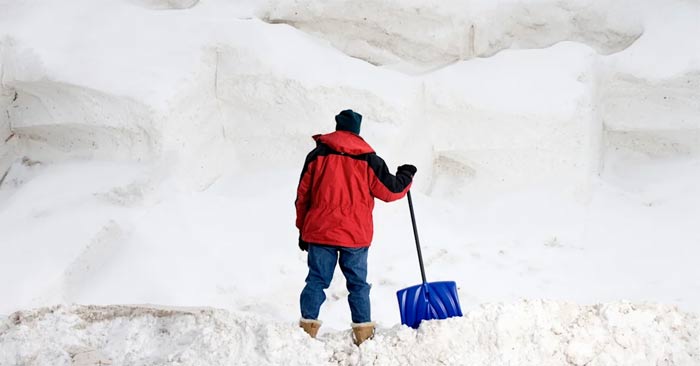
America's snowiest major city has an impressive arsenal of plows, but in 1992, the city tried a new trick to control the whiteout. The City Council passed an ordinance that made any snowfall before Christmas Eve illegal. As it turned out, Mother Nature was the lawbreaker—it snowed just two days later.
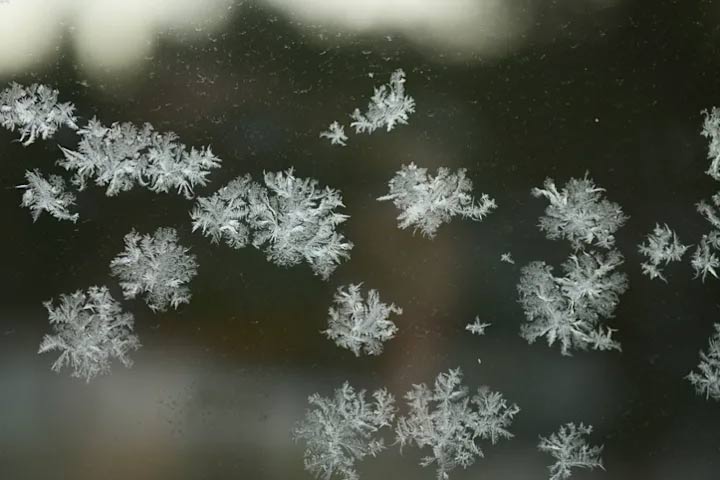
There is a myth that no two snowflakes are exactly alike.
In 1988, a scientist found two identical snow crystals. They came from a storm in Wisconsin.
The largest snowflake ever seen may have been 38cm in diameter.
According to some sources, the largest snowflakes ever observed fell during a blizzard in January 1887 at Montana's Fort Keogh. While eyewitnesses said the snowflakes were "larger than a milk pan." However, this claim has yet to be proven.
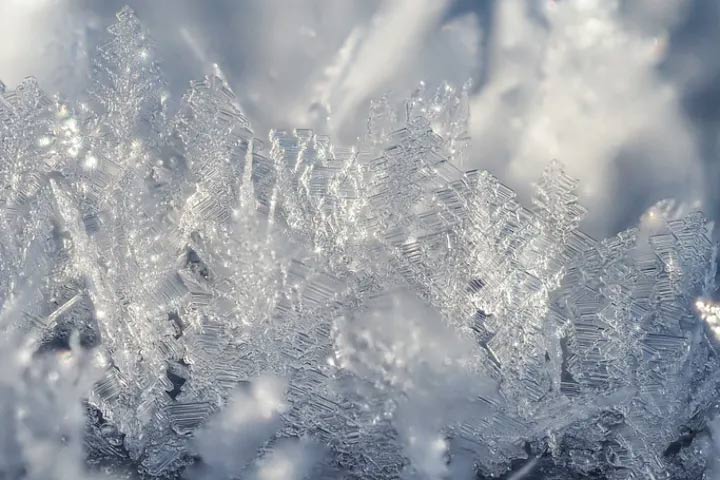
Snow is transparent, not white
Snow, like the ice particles that make it up, is actually colorless. Snow is transparent, meaning that light does not pass through it easily (like clear glass), but instead reflects it. The light reflected off the surface of the snowflake is what gives it its white appearance.
But why white? The reason we see objects as colored is because some wavelengths of light are absorbed while others are reflected (remember, light is a spectrum of colors). Objects appear to be whatever color the light reflects. For example, the sky appears blue because blue wavelengths are reflected while other colors are absorbed. Because snow is made up of so many small surfaces, the light that hits it is scattered in many directions and will actually bounce from one surface to another as it is reflected. This means that no wavelength is absorbed or reflected with any consistency, so the white light is reflected back as white.
Key Takeaways
Use the guidance above as a practical reference for amazing facts about snow. Check compatibility, follow the steps carefully, and verify important details with official documentation when software, security, accounts, health, or purchases are involved.
FAQ
What is the main point of this article?
This article explains amazing facts about snow, including the central facts, context, practical implications, and details needed to understand the topic.
Why does this topic matter?
It may affect performance, cost, safety, convenience, purchasing decisions, or how people understand a broader development.
Could the information change over time?
Yes. Product details, software features, prices, policies, codes, and news developments can change, so verify time-sensitive information with official sources.
Related Articles
 Top 19 Incredible Facts Not Everyone Knows: Interesting Facts11 minutes read
 15 Interesting Facts About DRAGON Phenomenon You May Not Know3 minutes read
 Interesting Facts About Dinosaurs You May Not Know3 minutes read
 Instagram and Amazing Facts Not Everyone Knows2 minutes read
 Add Falling Snow to Photos Using Photoshop: Step-by-Step Guide11 minutes read
 9 Astonishing Facts About Dolphins: Complete Guide7 minutes read
Reader Comments 0
Sign in with email or Google to join the discussion.