Table of Contents
A 2026 study in npj Complexity found that simulated AI agents could make cooperation more favorable in a public-goods game when they mirrored the behavior of other players. The researchers used an evolutionary computer model. They did not test actual human participants or self-driving cars, so the result is a theoretical mechanism rather than evidence of safer traffic.
How the public-goods game works
In the model, a player can contribute to a shared pool or keep their contribution. The pool is multiplied and divided among everyone, including non-contributors. This creates an incentive to benefit from others' contributions while withholding your own. The model follows how the tendency to cooperate changes over repeated simulated generations.
The video below illustrates the broader idea of shared-resource dilemmas; the study itself used a simplified game:
The three agent rules the researchers compared
- Always cooperate: The AI agents contributed regardless of other players' behavior. In the model, simply adding unconditional cooperators did not create the desired change in the human-player strategy.
- Let players control the agents: Players could make their agents contribute while withholding their own contributions. That did not solve the incentive problem.
- Mirror player behavior: Agents cooperated in response to cooperation and withheld contributions in response to defection. Under the model's conditions, this lowered the threshold at which cooperation could emerge.
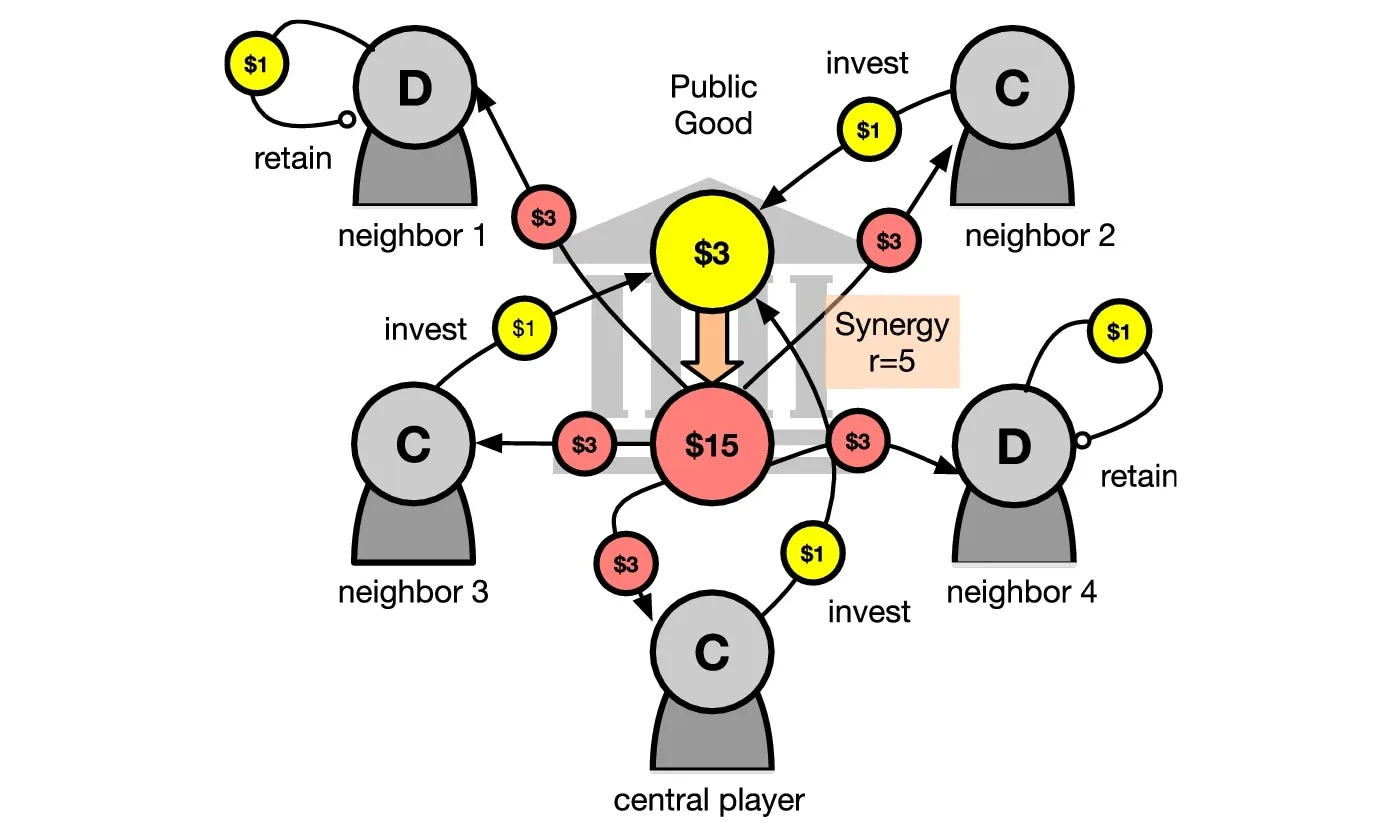
The result depends on the model's rules, including how payoffs are shared and how accurately an agent can mimic a player's actions. “AI makes people less selfish” is too broad: the simulated incentive changed which strategy paid off. The authors explicitly identify perfect behavioral mirroring as an idealization that future work must relax.
What does this imply for autonomous vehicles?
One possible analogy is a vehicle system that responds predictably to cooperative behavior, such as coordinated merging or shared road access. This is an application to investigate, not a tested feature of robotaxis. Real traffic involves safety constraints, incomplete observations, mixed human and automated drivers, road rules, and unequal consequences of mistakes. A road system could not simply punish a driver by copying unsafe behavior.
Further research would need realistic traffic simulations and safety evaluation before making claims about journey times or collisions. For background on the technology in vehicle perception, see TipsMake's deep learning overview and LiDAR explainer. Those sensing technologies address different parts of the driving problem from the cooperation model studied here.
Related Articles
 Playing the Game Call of Duty Can Help You Improve Your8 minutes read
 Teenage Programmer Brings Real-life Self-driving Car Technology to the6 minutes read
 Nissan Revealed the Technology to Predict the Human Brain to Drive Safer3 minutes read
 Qualcomm Partners with BMW to Launch Snapdragon Ride Pilot Autonomous Driving4 minutes read
 Summary of the Latest Driving Empire Code and How to Enter3 minutes read
 How to Drive: Step-by-Step Guide22 minutes read
Reader Comments 0
Sign in with email or Google to join the discussion.